Showing posts with label Tablets. Show all posts

Tuesday, January 24, 2012

Beneath the Excitement of iBooks 2

Last week, Apple pulled the wraps off its latest offerings, iBooks 2 and iBooks author in a publicised event in New York City. Whilst the announcement has proved exciting and potentially world changing, digging a little deeper, there's probably just as much to be concerned about as there is to be contented about.

I'm just going to start by stating the shallowest of my sentiments - this announcement is darn exciting and will no doubt change the state of education and of course, reading as a whole. But, , whether it will change education and reading for the better or for worse is something we can't be entirely sure of.

Ebooks are certainly the next big thing in reading, but I doubt they'll ever fully replace paper, not in our lifetime. We will always want books, I will always want the option of an actual book, libraries will never just be online catalogues. It's not about nostalgia at all, well maybe a little, but certainly not all of it. The reason why books have lasted so many centuries as a technological medium for knowledge distribution is because they simply provide so many practical benefits which are irreplaceable through technological innovation.

Dieter Bohn of The Verge recently published a lengthy feature titled 'Sorry iBooks,paper books still win on specs', which outlines all the books practical benefits which can't be ported digitally due to the very limitations of technology itself. Here's a few crucial ones: books don't crash, books don't run out of power, books have a consistent user interface, books are compatible with every nook and cranny of our daily lives.

Sure eBooks exhibit traits that are impossible for paper to ever adopt, but that's how it is, books and ebooks are just compromises of an impossible optimum which is why we still need both.

To play the nostalgia card by saying that there is a nothing quite like curling up with a good book, turning paper pages and the smell of an old book isn't really worthy of awarding a point to the good old traditional book. For the most part, these claims are distorted by a desire to cling onto the past.

People are always afraid of adopting unproven things and letting go of the past, especially when it's something like the binded book which has served us so well for countless years. In the hypothetical situation that the world regressed from iPads to paper books, we'd look nostalgically back at the swift beauty of swiping to turn a page and puke at the thought of touching paper.

But then again, I feel that eBooks do have the capacity to devalue intellect. Despite being a grace to the spread of knowledge, the fact that it is now so easy to publish books with iBooks author and distribute them freely, it is no longer really special to have a book published under your name. Additionally, it potentially makes it harder to find genuinely good books, and easier to stumble across one that someone may have simply published for a school project.

In many ways, it's comparable to what email has done to letters, making it easier to receive and dispatch letters, yet also a lot easier for spammers to get to you. And perhaps also what blogging has done to traditional paper journalism.

On the education side of things, I can't be one hundred percent certain that interactive iBook textbooks is truly what education has been looking for. iBook textbooks are indisputably a preferable alternative to the fat textbooks of today - interesting, useful, engaging, it's all there for the iBook textbook. What's concerning is having the iPad in class at all.

There's a reason why cellphones are generally not permitted for use in class despite their potential utility as a learning tool. It's because electronics are distracting; pair that with the fact that learning subjects that a student dislikes is boring and you have a fairly tasty recipe for procrastination, in class texting, and Facebook-ing. Interactive books will never make a student interested in a subject that inherently bores them in the same way that playing Halo won't make me a fan of guns.

Apple's interactive textbook is a double edged sword, empowering engaged students to learn in new and better ways, but for the kids who aren't really engaged in the first place, it's just a brand new way to get away from class. By trying to emulate the quick access and fast paced immediacy of current technology in the new interactive textbooks, we're also emulating the negatives – the constant contingency to lose focus.

If we want to fix education, we can't simply implement books that move and talk, we need to change the curriculum so that students don't have to do science or math if they simply don't give a sh*t.

Interactive textbooks aren't a step forward for education, but more like a step to the side. IBooks and eBooks are a step to the side for reading too, another alternative that is appropriate for certain use cases but can't replace paper books which are appropriate for other use cases. I can't really sum this up any better than Dieter Bohn did in his article on The Verge, but if we ever want digital to become the dominant medium for books, we need to make sure we can try recreate at least some of the better things about paper into electronics.  

Tuesday, January 3, 2012

TECHGEEK.com.au - Windows Phone 7 is far from dead

Check out my article on TECHGEEK.com.au in response to 'Is Windows Phone's Consumer Focus Killing It?' published on Wired Epicenter.


"Wired Epicenter recently published an article on Windows Phone titled 'Is Windows Phone's Consumer Focus Killing It?' It's certainly reasonable to propose that the consumer focus is a reason for Windows Phone's less than spectacular adoption, but to say that Microsoft's will to satisfy the end consumers to the highest degree possible will be a prominent cause in the platform's possible demise is pushing it much too far.

That's obviously not to plainly suggest that Microsoft taking a very Apple-like approach with smartphones isn't holding them back even slightly. It's a large reason for Windows Phone's general lack of awareness amongst phone shoppers, and the obvious lack of sparkle in Microsoft's Windows Phone lineup. Unlike Google with its Android operating system, Microsoft places strict hardware guidelines on manufacturers developing Windows Phones. OEMs are not permitted to have a screen resolution that is beyond or below 800 X 480 and processor requirements remain particularly strict and unmoving..."

Saturday, December 17, 2011

Open sourcing webOS changes nothing


A couple of months after the company announced the death of webOS, HP's new CEO Meg Whitman has thrown the OS a lifeline in the form of the open source community. The greatest takeaway from this announcement is the fact that webOS is not dead. It's now vastly in the hands of passionate developers to build upon and improve efficiently whilst being freely distributed for anyone to use.

From the outset, we couldn't have possibly gotten it better, open source developers as a collective can make changes and improvements much more quickly and efficiently than the vast bureaucratic corporate structure of HP ever could. And speaking from a consumer's own vantage, we have another free operating system to contribute to the highly valued element of choice. As well as being a free operating system, webOS exhibits polish, the kind of quality you'd generally expect to pay for.

Looking past the thin veil of optimism, none of this changes the fact that HP webOS failed tremendously, such to the point that it was actually dead for a period of time. It doesn't change the fact that there is yet to be any worthy complementing hardware for webOS and in no way does it contribute to the operating system's relatively minute app developer community. It offers no succour for the fact that iOS, Android and even Windows Phone already have significant market share to leverage whilst webOS has virtually none to boot. Most importantly, it doesn't change the fact that HP is still yet to find any significant value proposition in webOS to gain hardware partners.

It's quite clear that keeping webOS as a proprietary OS in the hands of HP was no longer a viable option. The fledgling operating system was already skating on thin ice even before HP's immense Touchpad failure, and the heat of the competition from Apple and Google was slowly melting away at HP's chances of even minor success. The Touchpad, as the inaugural HP/webOS tablet had to be pretty darn good, but it wasn't.

I've always believed that it takes multiple subsequent impressions to eliminate the sentiments from a single first impression, and HP's first efforts at a truly mobile operating system in webOS left consumers and pundits with a sour sour taste. It would take the bare minimum of two years to manufacture sufficient subsequent efforts to try and clean the taste, and even then, imminent slow sales could hamper the webOS image even further and render the $1.2 billion acquisition essentially worthless. It would be too risky. Leo Apotheker wasn't completely out of his mind to cancel HP's webOS project altogether.

So, as much as persevering with webOS would have been a desirable trajectory, the plan was ultimately destined for failure. HP had various other options including licensing and selling the operating system off. Both these options I believe would have been higher on HP's priority list given their capabilities of monetization. But licensing was always an unreachable dream given the free availability of an operating system in Android with a lot more to offer, and there simply isn't a discernible target market large enough for those hardware manufacturers wanting webOS purely for diversity. To add insult to injury, clearly nobody was interested in buying webOS from HP.

By the looks of it, open sourcing was just a last resort for an HP that had completely run out of ideas. They couldn't make it work for themselves, they couldn't license it, they couldn't sell it so they've decided simply give it away.

HP is a profit-seeking corporation, they certainly wouldn't want to open source and wouldn't have made the decision had they not be in a position that forced it. The soul reason that Google voluntarily open-sources Android is because they have an ecosystem to tie users into so they can profit from users consequentially by putting their services into as many hands as possible.

All HP has is a lonesome operating system, tied into an ecosystem with little value, and no web services aside from a fairly deserted sandpit of an app store attached to it. Open sourcing doesn't cater to HP's personal vantage aside from the distant goal that perhaps they could capitalise on webOS in any way in the future if it ever gains any traction - but that's a far-fetched dream with various apples and green robots obstructing the path to the gold medallion.

Despite the aura of optimism and excitement shrowding the open sourcing of webOS, webOS is still in a poor position to compete. I hate to be the pessimist, in fact, I'm usually the optimist - I believed for a long time that if Sony played it right they could compete against Apple's iPod, I still believe that RIM can get right back into the smartphone game and I believed that HP had a shot at tablet market share if the Touchpad hadn't been a year out of date.

webOS has polish, it has a clean interface, it works darn well but that's not enough for a world so invested in apps, content and cross device integration. HP's open source plan will maintain webOS as a niche platform for a community of passionate webOS die-hards, but it will never find the mainstream traction HP were hoping for simply because it doesn't have the ecosystem lever that companies like Google, Apple, Amazon and Microsoft possess.

Saturday, October 29, 2011

Rant: Blackberry Buzzkill

RIM earlier this week made the maligned announcement that the much anticipated Playbook OS 2.0 wouldn't be out until February 2012. RIM made clear that they wanted very much to have the product in our hands today, but unfortunately had to make the difficult decision to wait until they were confident they had a decent, complete and market-ready product. Well, that sure does speak a lot about the initial launch of the Blackberry Playbook, doesn't it?

The leaders at Blackberry have shrouded themselves in a cloud mushroom of lies and broken promises, and are desperately trying to make amends of their tattered public image by hiding behind a veil of PR small talk. Whatever it is they're doing, it's really not working because more than ever, consumers have lost faith in what was once the beloved makers of the Blackberry. A few months ago, the well-informed technology society was given the clearest indication that RIM was a breaking company. Aside from the declining market share and dwindling influence that was so plainly obvious on the outside, the open letter written by a disheartened RIM employee to RIM's senior management team gave us a snapshot of the turmoil residing inside RIM's inner sanctum. It became clear that it was not only a company that was losing a battle to the competition, but a company that was a losing a battle to itself, a company run by people who forgot their goal and were too busy playing catch up to recognise what they were really here for.

RIM's response to this letter funnily enough encapsulated entirely what was so wrong with this company - they were, and still are, completely out of touch. The letter response dodged every single valid question and objection posed to the RIM senior management team, cluelessness was haplessly disguised in phoney statements of optimism and opportunity pursuits, written by a person who much like the group he represented had absolutely no idea what he was doing.

Which brings me to now, and why I'm writing this rant today.

Back when the Playbook launched, the RIM leaders promised a native email client, a native contact client and a native calendar app 'soon'. We later found out that the root cause for the delays of these instrumental applications was deep within the foundations of RIM's system itself. We accepted this, so we gave RIM time. After Blackberry World 2011 RIM representatives told the press that we would be getting native email sometime this 'summer' without a specific date. We waited. We never got it. We were then told Playbook OS 2.0 would be made available in mid October after Blackberry Devcon America. But it wasn't. And now it's been pushed back 4 months to February 2012 which will make it little less than a year for an update that really should have been available from day 1.

Buying the Playbook always meant taking the good with the bad, and with the Playbook it meant filling a few gaping holes with a few tolerable compromises. Being an early adopter means buying products not for what they are, but for the potential that you see in them. When I bought the Blackberry Playbook, I didn't turn my back on it and make snide remarks on the absence of essentials, but I saw it for the multitasking prowess that QNX possessed and the ways it could integrate with RIM's acclaimed services and their overall vision.

Early adopters drive the market, and they drive competition. Without them, there wouldn't be a tablet market at all, but merely an iPad market; because what sober person, save for the Apple haters, would pick up a Honeycomb tablet as the product it is today against the iPad 2 as it is today. I'm trying to remain as objective as I possibly can here, so here's a few points you can't possibly argue against - Honeycomb has a serious app deficiency against the iPad and Honeycomb is unarguably a less stable operating system. And a few subjective points that I hold against Honeycomb are the inconsistency of aesthetics within the UI and the utter uselessness of multiple home-screens on a large display.

But I digress. The crucial point here is that early adopters are driven by promise of what will be delivered in the future. As an early adopter of the Blackberry Playbook I was fed by the promise of native email, native calendar, native contacts 'soon', 3 essentials that would make the Playbook a more complete utility - something that the product wasn't when it launched. It's taken more than half a year and deducing from RIM's sly previous efforts at PR, these three native apps are nowhere close to fruition.

Congratulations on killing the buzz, and absolutely butchering the first year of your entrance into the tablet world RIM. Stellar job. You failed to excite the average consumer market, you failed to entice the enterprise, and worse, you made the early adopters second guess their risky investment in buying your incomplete product. I don't regret purchasing a Playbook, not at all. In fact, despite its glaring omissions I'm still proud to say it's the greatest tablet on the market. But, had I known RIM were going to take their sweet time in blessing us with native email, contacts and calendar then I sure as hell would have taken my time in buying one too.

Saturday, October 22, 2011

When things start to get a little out of hand

'Super size me,' is what the smartphone told the world. And so we did.

The inexorable rise of the mega-phone, or the super-phone or the jumbo-phone pretty much sums up the trajectory of the majority of smartphone vendors - Power = bigger and bigger = better. I talk a lot about the superficial and non-pragmatic spec wars that so many Android vendors are focused on, attempting to make their phone that 1% faster for succeeding generations instead of making the basic phone experience better. It now seems that this focus for more powerful, more 'mega' and more 'super' is now translating to the phone's physical size - in a way saying 'I made this phone faster, but since specs are nothing more than a whole lot of coded tech jargon to most, I'm just going to make the screen bigger so you can easily see what I've done.' And yes, we can see what you've done, because now your phone is that much harder to grasp in the hand.

Whatever happened to small and chic? 6 or so years ago when there was no iPhone or big touch screen phones and the only successful smartphone was a Blackberry, small was in. Small was hip, and miniaturisation was definitive of high-tech. People were amazed that you could fit so much awesome into something so small. The whole line of Siemens phones comes to mind, a market failure no doubt but still undeniably cool. As a kid I didn't know a friend who wouldn't have pounced on a Siemens handset had they the cash - which is unfortunately something that elementary school kids inherently lack. Successful examples of handset miniaturisation are the Sony Ericsson W880i - a supermodel handset and the Motorola RAZR both emphasising their merits for both thin and small.

Fast forward several years and at the rate we're going we'll have six inch phones in a couple of years, and I hate to be the one to break it but the human race won't have hands big enough to account for such gargantuan gadgets in 2 years time - evolution is not that fast. Evolution isn't running a 1.2ghz dual-core, in fact it's probably running the same piece of junk hiding shamefully inside my graphics calculator.

I claim no hatred against these 'larger' phones nor do I consider myself a Luddite desperately clinging onto the simplistic past, but perhaps I do long for a society and a technology industry that embraced more the notion of holding a cute little pebble to my ear as opposed to a pancake to the side of my face. Times change implacably though and the altering physical form factor and size of smartphones is the most obvious simulacrum of the new way in which we communicate with our phones.

The iPhone augured a significant shift in phones, the paradigm shift in phones from passive to active. Phones used to be the passive device, a device that alerted us when someone wanted to contact us but was otherwise expect to remain discreet - seen but not heard. Hence, why make a phone big when we're meant to pretend it's not even there, why make it big when the only time we're meant to have it with us is when someone wants to contact us or when we want to contact someone else. Phones were passive and discreet, so they got smaller and smaller. Enter smartphone - a phone that we're always meant to have with us, and one that we're always using. Phone call or not, we're always on them because we can do so much more from them - we can browse the web efficiently, we can play worthwhile games and we can keep updated on the latest. With these smartphones, we're not waiting for them to surprise us with a phone call, we're not waiting to see what it's going to throw at us because we're hoping that it handles the tasks that we want to throw at it. Smartphone has to be a superlative in power and size to handle our growing demands, so it's getting bigger and bigger.

But something's got to give and these immense display sizes are actually subtle inconveniences in real world use. This preternatural display growth has got to find its limit, before it becomes borderline tablet.

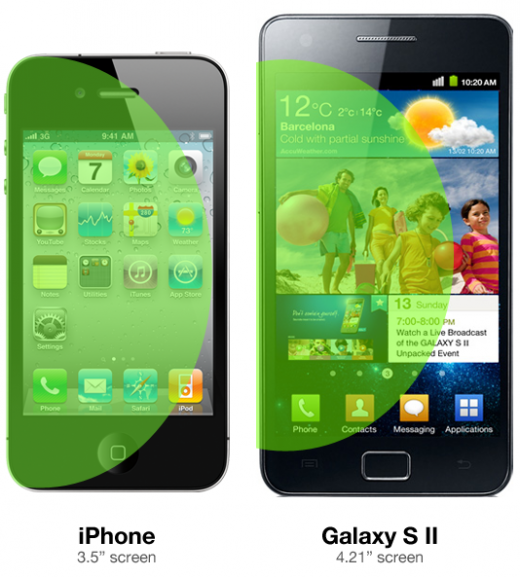
fourinches 520x577 Why the iPhones screen is 3.5 and will most likely never be bigger than 4To illustrate the point of the 'subtle inconvenience' I'll call upon an interesting article written by Matthew Panzarino on 'The Next Web'. He stated that designer Dustin Curtis had done a test in which he found that the disparate display sizes of both the iPhone 4 (3.5 inches) and the Galaxy S II (4.27 inches) made a genuine difference in terms of their usability and could perhaps pose a niggling issue for the Galaxy S II through time. He found that the display size of an iPhone 4 allowed every icon on its home screen to be reached with the thumb whilst holding the phone with one hand, whereas the limited thumb span proved too small to reach to the further edges of the display when using the Galaxy S II. To the left is a diagram that designer Dustin made to complement his contention.

Sure, you have to make a few sacrifices if you want the big and the better. That's how life and nature works right...a little give there and a little take there. But I don't think that's how it works for phones - because a smartphone is meant to materialise a vision for easy, portable computing. And traditionally a phones have blessed us with the advantage and accessibility of quick one-handed operation; the fact that phones have increased in brain size and processing power shouldn't compromise this one distinctive trait. Smartphones need to retain their one-handed usability and size because it's the only characteristic that preclude the smartphone and tablet from convergence. It's the only reason why they're still different things. Heck, if I could grab a tablet and hold it in one hand and use it with that one hand with ease I wouldn't need my phone, because my phone would just be a smaller and more eye-straining version of something I already have.

So I'm here looking at the new Galaxy Nexus and its 4.65 inch display, and I'm thinking to myself 'how big are your hands?' You might think I'm overreacting and these seemingly minor nitpicks are all in for the sake of a more spacious experience. But more than you think it's the insignificant things that leave an otherwise perfect product completely smitten - thumb hyper-extension and unnecessary two hand use are just a couple of those things. I use a 3.8 inch HTC Trophy daily and for me and my average sized hands that's just about the limit. Again, this is all completely subjective and for some of you this large screen size may suit your needs, and your hand-span, but strictly from my own personal vantage and I'm sure that of many others anything above 4 inch is a heck of a size, and anything larger than the Galaxy S II is really really pushing it.

Super size? Are you really lovin' it?

Wednesday, September 21, 2011

As Windows 8 propels Post-PC


Not too long ago, Microsoft pulled the wraps off the developer preview of its next generation operating system. I say 'next generation' intentionally as opposed 'next' because Windows 8 truly does signify a revolution for not only Microsoft, but personal computing as a whole. With Microsoft's pre-beta release of Windows 8, I can say without hesitation that computing is without doubt driving head-on into the age of direct manipulation computing, or 'Post-PC' if you like.

Anybody who counts Microsoft out as being an influential figure for the next decade of computing would have to be incredibly short-sighted. Eric Schmidt pointed out earlier this year that he considered his gang of the four most influential consumer technology companies to be Google (naturally), Apple, Amazon and Facebook. Microsoft did not make it into his little clique. This itself would seem almost a mathematical impossibility when you account for Microsoft's market share in the PC arena and also a direct affront to the 'chain of command' given the many ways that Microsoft indirectly and directly affects the lives of people and companies around it. Sure, Microsoft doesn't have the strong-hold it had on multiple markets 5-10 years back, but heck, Microsoft has commanding, monopoly-enabling market share in PCs – and market share means power.

We've all seen Microsoft's success as an underdog, and their success has always coalesced with the idea of 'slow and steady wins the race'. And perhaps slow and steady manifests Microsoft itself as a corporation, an influential giant completely devoid of the agility of its start-up days. The world was sceptical about the Xbox when it launched, it took time to gain traction but Microsoft eventually broke through with the product and it is now the best-selling console in the United States. Windows Phone still sits at the bottom of the smartphone pack with a single digit market share to boast, but Microsoft are in no position to give up on Windows Phone (I'm glaring at you, HP). With Nokia paving multiple new pathways and opening new doors for the platform, there isn't much to justify the opinions of anyone who believes Windows Phone is going down. I can see why analysts are bullish on their prospects for the platform.

At that, there's no reason why we as the consumers shouldn't be bullish on Microsoft and its Windows 8 project either. By all intents and purposes if Microsoft decides to dump the Windows monicker in the same way that they dumped 'Windows Mobile' for 'Windows Phone' it would not be completely out of line. After all, the new OS does not look, or more importantly, feel like Windows at all. It's touch-friendly, it's intuitive, it's animated...it's fun. Microsoft made a big case for touch technology at its BUILD 2011 event, slanting heavily towards an ideology that touch is the future of computer interaction, and I agree wholeheartedly.

As we all are fully aware, Microsoft's approach to slates and tablets has always appeared as half-hearted, not bothering to put in the full effort to have an OS optimised for iPad-like devices with the belief that a powerful operating system could justify the poor ease of use. Consumer reception has likewise been half-hearted. Microsoft obviously overlooked the fact that the power factor of the full Windows experience is only sufficiently augmented with the presence of a keyboard and mouse. So when it comes to slates, looking at Windows 8, despite its often frustrating switches between interfaces it's relieving to see that Microsoft has managed to acknowledge the writing on the wall and subsequently put their heart in the right place.

I guess we can thank the iPad for its applications as an impetus for a stagnating PC market. I believe that people and innovators are the creators of their own fate - yeah I know it's corny and it's cliche, but it's true. The technology market, or automotive market or any market that thrives on innovation isn't and should not be bounded by the perceived limitations of eras or times. I get the feeling that people believe that things have to remain a certain way until a specific time comes that rings a bell for a revolution or an overthrow of the current. Perhaps a good example to illustrate this very point would be flexible display technology - we'd all love to see flexible displays right now and the prospects are exciting but there's always going to be the consensus that the concept is simply too far ahead of its time. I'm glad that Microsoft has shown the gut to propel the industry with a revolution in Windows 8, instead of yet another evolution of Windows 7 which would only vitiate the industry's implacable transition into touch and 'post-PC'.

Windows 8 is not a perfect operating system, it's far from perfect and will most likely take a generation or two to eradicate legacy requirements which are by far its biggest gripe. I'm not predicting that Windows 8 will sell like hot cakes, will be insanely successful or by all means, not be a Vista. The developer preview of Windows 8 though is purely representational of Microsoft's trajectory, and the most I can say is that Microsoft have pointed their unwieldy ship in the right direction. They have proven themselves in the past that they are more than capable of winning a game slow and steady and have proven their ability to successfully leverage their assets and integrate tightly their cobweb of products and services. As far as I can see, these are a few crucial underpinnings for imminent success.  

Saturday, July 30, 2011

Second nature technologies for first class experiences.

By many, and notoriously for senior citizens, gadgets and tech has always been an area where years of experience and accumulated knowledge can sum up to practically zilch. What seems so obvious and almost natural for us late 80s to 90s generation sends senior heads whirling. How do I zoom in on this 'page'? What's this little scroll ball on the 'mouse'? And how do I get anything done? Basically, it's just a demoralising blankness once confronted by the display of a device. However to what will be the relief of many, technology is adapting in a way that is arguably more monumental than any other previous transformation, yet one we're hardly noticing.

What is it that makes a well designed tablet with a refined operating system an absolute joy to use? Of course it's portable and just, you know...fun, for want of a better word. But when we think about it, the pleasure of a tablet goes so much further than the initial novelty of a large touch screen. It's one of those things that affects us in the deepest but most subtle of manners. Put simply, tablets appeal to an instinctual need to connect and communicate directly with a device. When we touch or swipe, the effect of the action is instant and it feels natural. A PC plays second fiddle when compared to a touchy feely tab because it requires the mouse or keyboard as a middleman between us and our content. Example? When we zoom in on a PC we go Ctrl +, but when we zoom on a tablet, we physically touch our content and pinch our fingers and stretch, just like we would with items in the real world.

So essentially, the pleasure of a tablet lies in the simple fact that it's a product with a dangerously shallow learning curve. Why? How? It's all a simulation of the natural world we live in which we've all adapted to - swiping to scroll is a simulation of, well, the physics of nature and pinch to zoom does the same. Technologies like this don't require extensive manuals because heck, the skills required to use the product have been with us since the day we were born, they are the roots of our instincts. By allowing direct interaction, tablets bring us closer to our technology and content and thus breaking down the limiting technological wall. No wonder granny can use your iPad.

This 'instinct' factor is having applications all over the spectrum of technology, from computer OS's to social media. I was one of the first million to download Mac OS Lion on its day of launch, and by experiencing the simplicity of multi-touch gestures at first all I could muster was 'this is awesome!' Simon Sinek pointed out in his presentation regarding his Golden Circle model that our emotions and feelings are controlled by a completely different section of our brain than the one that controls rationality and language. That was the feeling I got when using Lion - it felt great, but aside from the joy of the swift motions of the multi-touch gestures I couldn't quite lay a finger on why, and all I could muster was 'this is awesome'. By appealing to natural humanly desires instead of the superficial elements of features and spec, Apple created a deeply pleasing experience, with what seemed like very little effort. 

In social media, Google+ has succeeded in creating a social networking service that emulates your real social life. The circles concept builds upon how our social life operates in our minds - we unwittingly create categories in which we organise certain friends and their importance to us. But only we're allowed to know. Google+ allows us to place these thoughts and inadvertent categorisations in a tangible form, thus realistically porting not only our friends, but the inner sanctum of our social lives onto the net. And in front page news on The Huffington Post, Randi Zuckerberg (marketing director, Facebook) stated 'anonymity on the internet has to go away'. Despite the context of her statement being in limiting cyber-bullying, anonymity online lends nothing to the growing trend of the 'instinct' factor. Nobody walks around behind closed doors, it's impossible to go out in public as an unidentifiable block of pixels, so why should it be on the internet? Google+ doesn't allow anonymity, not even fake profiles. 

I think we are at a certain cutting point in history, where we can demarcate the disparate separation between antiquated and somewhat complicated technologies and the current 'direct interaction' type of technology. We, currently, are the ones who have witnessed this change where traditionally buying a program or device means going through a lengthy set up process before 'excitedly' jumping onto the manual, up to now, where the status quo is quickly becoming installing a program through an efficient and hassle-free download process and learning the program or device through quick experimentation and prodding. Ironically, as it happens, the rate at which technology has progressed and become increasingly more complex on the inside has made technology easier on the outside. In five years time perhaps we will look at the tower desktop PC, or even a sleek all in one and award it the ignominy of the piece of gadgetry that a newbie can't just pick up and use. 

Doesn't it simply feel right when we can use technologies that are physically realistic, that respond the way we expect, behave the way expect and also act the way we act? I sure think so, and it's where the world is heading, definitely for the better. By creating technologies that are simply second nature, that understand, how we, as humans are programmed to behave not only makes technology more accessible to a wider range of differing user demographics but also creates a 'magical' first class user experience. 

Wednesday, July 13, 2011

webOS vs Blackberry - The Pony opinion


The tablet war has largely been seen thus far as a battle between two giants, iOS and Android. Respectively the number 1 and 2 tablet OS's currently. However a new battle is brooding, between the two newcomers HP and RIM who have come out and introduced the world to two very exciting tablet operating systems. It's an intriguing battle of the underdogs, and who are you rooting for? With this article, I'll be giving you a in-depth view of my insights on who I believe will emerge the most successful of the two, and whether any of these have a chance at toppling the big two: Apple and Google.

The early days of these two operating systems have been mired by a number of issues which they share, incomplete software at launch and a measly app selection. HP's Touchpad has copped a bit of a beating for inferior hardware. Nevertheless, we all have to start somewhere and from where I stand, both of these platforms have enormous potential for both consumers and enterprise. Everybody loves an underdog and both these operating systems are symbolic of what people admire so much with underdogs. They're creative, new and aren't afraid of stepping out of the traditional framework set out by the big two. RIM borrowed a lot from webOS for the design of their QNX basked Blackberry Tablet OS and I'm certainly not complaining, the UI on both these operating systems is stellar and a huge step up for tablets. The multi-tasking 'cards' if you like are handy, it's the kind of thing that you don't even know you want until you use it and have it. iOS's multi-tasking is primitive in comparison, and Android's doesn't feel as intuitive and dynamic.

Both webOS and BB Tablet OS both adopt a very gesture driven interface and from my experience with the Playbook it's a joy to use. I haven't used the HP Touchpad yet so it's hard for me to comment. However, on the Playbook the gesture interface isn't implemented in such a way that it feels like its there purely for differentiation but it actually brings very intuitive navigation of the tablet which is a pleasure to use. Swipe down from the top to reveal settings or options in an application, swipe from the top up to reveal the home screen, swipe from either side of the display to switch easily between running applications. It just works. With that, I say RIM and HP have a genuine shot at stealing significant market share.

Now, RIM have one big advantage that can't be underrated, and that is a well-established user base. There's no hiding a rapidly, and we mean, rapidly declining market share but at third place, RIM still have a considerable market share they can leverage to kick-start their voyage into the tablet world. HP doesn't have this, webOS has a drastically small market share and HP are hoping to kick-start their mobile endeavours with a tablet, which is an odd reverse of the conventional. Without a large existing user base behind their smartphone effort HP doesn't have the advantage of locking in existing consumers. Additionally competitors who do have a large user base for their smartphones, which is true for RIM, can attempt to woo consumers into buying their tablets by providing synergy between the devices.

When HP CEO Mark Hurd stated 'we didn't buy Palm to be in the smartphone business' I naturally found the very notion absurd. However, what he meant was HP's intentions with webOS go far beyond the smartphone business. HP have something that RIM could only ever dream of having, and that is an extensive lineup of hardware. RIM are focused on handsets and tablets, but HP builds phones, tablets, PC's, printers and all sorts of hardware. When we think of the ecosystem, we think of interconnected applications and services on our phones, tablets and PCs but we too often leave out more detached hardware like printers, set-top boxes and Blu-ray players. With a much more extensive hardware offering, HP have the ability to expand webOS to all of these devices, and create a uniform interface that connects all of these devices together, and thus connects us in even more places in our lives.

HP's biggest problem though is to get started. Without any credible smartphone market share to use as a trampoline, a measly app selection for the Touchpad and below par hardware for the Touchpad, well it's going to have to wait for Touchpad 2. Perhaps the Pre 3 will give HP a start, which to be frank looks awesome. However it's hard to imagine anyone aside from an existing webOS diehard purchasing it. A lot of people buy what their friends have, and webOS's market share is only about 2% in the US currently. Additionally, a relatively weak app store offers little succour for an already dire situation. For HP, it's a race against time. HP risk taking too long to gain enough market share before the competition catch up on HP's vision of 'a web-connected environment where now you can get a common look and feel and a common set of services laid against that (HP) environment' (quote from HP CEO, Mark Hurd). 

The Verdict
So who is it? Who do I think is going to be the winner between these two 'start-ups'? HP is extremely vulnerable right now, you get the feeling that there's no second chances, if they screw up big time, then, yeah, they screw up big time. Having said that, webOS like I said at the beginning is innovative and joyful but it needs time. RIM still has a strong market share, and the QNX-based Blackberry Tablet OS is an absolute winner. And with the promise of QNX arriving to Blackberry smartphones in the near future, I just can't place my bets on webOS. So Blackberry it is. 

Thursday, April 28, 2011

Competing in a fat tablet market, and why Android is the culprit.


We can't all help but notice the continuing overflow of tablets coming into the market. Tablet after tablet, here and there, most of no differentiation to one another. The announcement of Sony's tablet comes as no surprise as inevitably Sony would want to join the big party, albeit a little late. The product didn't surprise me either: Honeycomb, Qriocity, 'Playstation Certified' were all expected, the dual screen clamshell was surprising, especially Sony's odd design. Instead of the traditional linear chassis, instead they have opted for a distinctively curved design, which looks astoundingly similar to those glasses cases that have the ability of closing from both directions. I hope you know what I'm talking about as I am at a loss in better ways to explain it.

Nonetheless, Sony's entrance into the tablet space is well, just another tablet. Just another Android tablet.

I wanted to discuss the overflow of products in this segment with this article, it has been discussed many times before but it simply gets all the more prominent every passing day. Almost everyday, when I hang out on tech blogs, there's bound to be a new post with a table, displaying a new tablet's specifications, display size, processor, Honeycomb no doubt. And possibly a release date. Ok, cool. Forgotten. Another new tablet: Wow, Tegra 2, 1ghz dual-core! Cool story bro. Another one? The point is that all these devices are flooding in, and most of them don't manage to take hold and are just dropping in like dead fish into the sea of sameness. Instead of being, a glorious and vibrant emerging market, the tablet segment is becoming a breeding zone for 'me too' devices. We're not seeing a great collection of products that scream innovation and freshness, but rather a pile of cheap devices made simply with the mentality of 'I can do that too'.
I can sum it up pretty well in this rather clever analogy, the tablet market isn't expanding in a good way, too many devices of no value or differentiation don't add value to magnitude, rather the tablet market is becoming much like an obese person, filled with fat and excess, with little muscle.

If I was to pick someone to blame for this shocking outcome, you'll be surprised at who I'm pointing my finger at: Android.

This is certainly not a bad thing, and given some of my previous articles you might be deceived into thinking that I'm not a fan of Android. In actual fact, speaking as a consumer, we can never really get enough options or choices and Android has provided us virtually limitless choices. Speaking from a vendor's point of view however, Android's benefits have been countered almost equally by a set of growing disadvantages. There's no doubting that the sole benefit that Android has provided to its OEM's is a very good operating system with a vast app store, to compete sufficiently with the iOS app store. Additionally, OEM's will not have to spend time and funds to build their own operating system which would inherently be inferior due to the initial lack of third party applications. Sounds great at first glance, but what is most disadvantageous, is that all potential OEM's have access to this operating system, thus creating an enormous environment of virtually identical devices made by different manufacturers.

This creates the quite grand problem of finding a way to make your product exclusive amongst almost indistinguishable competitors. It's impossible to stand out in terms of app selection. It's possible to stand out in terms of user experience, but Android can only be skinned so much until it becomes loaded and impractical. Simply, in terms of the devices software, there is no way to give it enough exclusivity to warrant a no-brainer purchase over other Android competitors nor is there enough exclusivity to warrant a significant price gap over competitors as well. Thus, competing purely with software, the only hole-proof way to win in the Android space is via competitive pricing. And because bare-bones products with rock bottom prices is not feasible to many licensees, it is evident that many vendors have decided that in order to attract consumers, they must win in the hardware space. It's very obvious: high end processors, better graphic capabilities, more RAM, and faster 3G or 4G internet access. Instead of placing an emphasis on a great user experience, it appears that the focus is now on the fact that it's fast, it's light and possibly more physical connectivity to peripherals. Maybe even an attachable keyboard.
These are all good things but at the end of the day the consumer makes a decision based on four fundamental factors: how enjoyable something is to use, how easy it is to use, how customisable the device is and how attractive the product design is. Of these four major factors, only one corresponds directly to the quality of the hardware.

It's common knowledge that in a digital and connected age, the software takes precedence over the hardware. TV's are no longer purchased primarily on the quality of the picture, phones are no longer focused on call quality, nor are tablets made or broken by the specifications of the components inside. The software is what consumers experience and feel and 'connect' with, if the software isn't up to scratch, there's no way hardware can save that. This is why the Xoom was so astoundingly underwhelming at launch, and more importantly its sales volume was vastly disappointing. The Xoom was just another Honeycomb tablet, albeit the first one, and it didn't quite strike a home run with its hardware either. Despite its Tegra 2 and powerful innards, the display quality disappointed.

It's difficult, and more or less a Catch 22 situation for Android OEM's. Either win in the hardware arena or create a cheap no-frills Android tablet. None of these options is optimal in winning back market share from Apple. Through my eyes, I see two ways out of this quagmire: either introduce an exclusive service, or go out on a limb and just create an innovative and entirely new product. Possibly even start up a sub-market within the tablet segment. Neither of these are as simple as it sounds. However if there's one company off the top of my head that has the framework to achieve both of these, it's Sony.

The Playstation brand is much like a stepping stone for everywhere that Sony decides to go, and I understand and I encourage that since it would be wasteful to not utilise such a strong brand. Unfortunately though they've decided to ruin the potential exclusivity of 'Playstation Certified' by allowing it to be used by all Android vendors. However, Qriocity is still an exclusive Sony only service presently and represents the first way out of the Android dilemma: introducing an exclusive service. Like I said it's not as simple as just implementing the service into Sony devices. Qriocity is not yet a strong enough brand in its own right, and iTunes still has the immense trust and loyalty of its consumers. Also speaking of trust and reliability, Qriocity's reputation has already been damaged by the hacker predicament from the last week involving credit card access and service shut downs. Qriocity is still in relative infancy and requires time to grow, and just as importantly more funds need to be directed into marketing.

Additionally, in regards to 'creating an innovative and entirely new product' Sony has the building blocks for this too, and it was just announced this week. I'm referring to the S2 tablet, the dual-screen sun glasses case looking contraption. In my next article I will be talking more deeply about the advantages and disadvantages of the dual-screen concept. What I can say now is that dual screen has great potential if executed correctly. I don't think I've seen any manufacturer quite nail the two screen idea yet, apart from Nintendo. And even though the Nintendo DS has been a winner in the sales department, there's certainly room for improvement.

All the same, you've probably inferred it's becoming increasingly difficult for manufacturers to compete in an ever expanding tablet market. Each time a new generic Android device pops up, no matter how poor it is, everyone takes a hit. The Android arena has more or less been split into two major segments: low end no frill tablets for the simple minded and high end power tablets for the tech savvy. Here, the high end manufacturers are putting all their eggs into the hardware basket in an attempt to fend off competing Android tablets but are mindlessly missing the bigger picture. iPad. In essence, despite their obviously smaller ecosystems, platforms like webOS, and Blackberry tablet OS are in a better position, merely because they don't have to compete against generic rivals in a price battle. They can consequently put their focus into slaying the monster (iPad), not their 'allies'. Being exclusive has these advantages.

My analysis concludes that the availability of Android is become as much of a problem as it as an advantage. Given the immense scale of the Android ecosystem, manufacturers of Android tablets therefore have to deal with two battles: the battle against competing Android vendors and the more important battle against the iPad. If the race continues this way, individual Android OEM's will never be winners unless of course they can create a winning formula in either two methods I described earlier: introduce exclusive services or create entirely new products.

Sunday, February 27, 2011

About time someone built a real competitor to Apple’s iPad.

There's no denying Apple is the king of the tablets with an enormous and phenomenal 93% market share. With a year or so head-start, Apple is finally starting to get some competition in the Motorola XOOM and Samsung Galaxy Tab. But, with the iPad 2 about to be released in a week to much fanfare, I simply cannot see the iPad going down anytime soon.

The iPad’s success has been attributed to two important factors, exclusivity and the fact that Apple’s competitors are simply playing catch-up.

If there's one thing that Apple has been really great at this past decade, it's been making their products exclusive. People would buy a Mac, not because it's necessarily better than the competition, but because you get the Mac experience, people buy an iPod because they get the iPod experience and they can tell people they have an iPod.

The problem with both of the iPad’s current main competitors (Samsung and Motorola) is that despite their superior hardware offerings, they’re both just another two Android tablets floating in what we call, ‘the sea of sameness’.
Galaxy Tab and Xoom chilling in the sea of sameness.
Phil Molyneux, president of Sony Electronics spoke briefly in a press meeting about avoiding the ‘sea of sameness’. He spoke of entering an electronics store and being confronted by a wall of LCD TV’s of different brand and sizes and wondering how to decide which to purchase, this is what he referred to as the ‘sea of sameness’.

I’m going to take this a step further - walk into any electronics store and you’ll see a line of computers and then a Mac section, you’ll see a line of MP3 players, and then an iPod section, and soon enough I reckon we will be seeing a line of Android tablets, and then an iPad section. This is exactly what I’m talking about when I refer to exclusivity, Apple products aren’t necessarily better, but they are different in a good way.

Both the Galaxy Tab and Xoom are both superior devices on a pure spec front, but how many consumers really care about the amount of RAM inside or the processor used. In the end, the Galaxy Tab and Xoom are just another two Android tablets essentially worth forgetting. Apple products on the other hand target the average consumer market, not the consumer who will go ‘Oh dam a Tegra 2! I’m sold’ or ‘’Goddammit, why do you have to use Android 2.1 and not 3.0 Honeycomb’. Apple targets the consumer that will walk into the store and look at a product and say, ‘Whoa, that’s cool’, and say it after trying the product, not after looking at the spec sheet. It’s the exclusive Apple experience that sells a product.

I’ve always been a firm believer of one of my own sayings,
‘don’t sell what a consumer is buying, sell what a consumer wants’. 
Right now, iPads, clearly are what consumers are buying, it’s time that someone built a tablet that is a real competitor to the iPad, not just an imitation. Unless one is willing to take a risk and take a path entirely perpendicular to Apple’s,  there’s absolutely no reason why your average consumer would purchase anything over an iPad.

Tuesday, January 4, 2011

Perhaps Android not the way to go?

A lot of people have been eagerly anticipating more Android devices from Sony, particularly a tablet and the eagerly awaited rumoured Playstation Phone. With torrents of Android tablets and devices flooding the market though, I'm left wondering whether Android is still the way to go for Sony.

I'm a long time Sony fan and have always respected Sony as an innovator, never letting themselves fall into the spiral of imitation and generic products, it is the innovating spirit that birthed the Trinitron television and brought Sony out of post-war Japan into the international market.

If Sony enters the now crowded tablet market with an Android powered device, there would be almost nothing to differentiate it with its competition especially with more Android tablets expected to come in droves at CES 2011. Of course a Sony Android tablet would carry brand name prowess and superior design and build quality, but in the digital age, like I mentioned in my previous post, it is the software that matters, and all in all, the software would be fundamentally the same with only a custom skin of some description to differentiate.

If I were Sony right now, I would focus more on the OS used on the Playstation Portable or PS3, though I'm sure that they've already developed an Android tablet.

Utilising an optimised version of the Playstation OS (I don’t know the specific name of the operating system used on Playstation systems so that’s what I’m going to call it from now on) on an upcoming PSPhone, Tablet and other portable devices would serve several useful purposes.
ipad-design copy
What the XMB Interface will look like on a tablet display

Most importantly it would be exclusive, just like Apple devices and means that only Sony products will utilise the OS. This would of course maintain Sony's gradually disintegrating reputation of innovation and uniqueness and increase Sony's brand value. Also given that Sony is the builder of the Playstation OS, it would be easier for them to update and provide services relevant to consumers demands, rather than relying on Google updating their Android Platform in ways that might not match up to what Sony is wanting.

Also, very importantly it would help create a unified experience (XMB Interface) across all of Sony’s products, which like Apple, will keep consumers coming back for more and also establish a certain experience synonymous with the Sony name.

The Playstation platform is extremely popular, with millions of users worldwide, so gaining a loyal consumer base shouldn’t be a problem, particularly if the device is able to connect to Playstation Network and other Playstation devices.

A crucial thing that needs to be done though, is possibly to make the device compatible with Playstation Portable titles, if that isn’t possible then open up the Playstation Platform more widely to developers which I had suggested long ago in one of my earlier posts: http://thesonypony.blogspot.com/2010/11/thinking-what-im-thinking-apps-on.html. Given the popularity of the Playstation, third party developers will be coming in droves and in no time we will see a wealth of Apps and mini-games available on the platform.

Of course it will be quite costly, in optimising a button based OS into an intuitive touch screen interface and obviously opening up an app store and hopefully integrating PSP title compatibility (download only obviously). However this is a solution for the long term and I see incredible potential in it, rather than taking the easy short term solution of adopting Android and just being another ‘me too’ device. If Sony can do this, and nail it, then not only are they taking the right step into unifying and networking all their devices but they’ve found themselves a legitimate and capable iOS and Android competitor. And most importantly, it will be Sony exclusive.