CES 2012 has come and gone and if there was one thing that really stood out, it was perhaps surprisingly the smart TV and what it means as companies work harder to integrate their sparse hardware offerings. Samsung impressed, but Sony, of all the exhibitors at CES demonstrated the cuts to make this ecosystem thing really happen.
Samsung on the most superficial level was the ecosystem warrior at CES 2012, making a noise about its television sales numbers, which are objectively impressive and their focused strategy consisting of the three verticals - content, service and connectivity. With the reach of Samsung's TV user base, the reach of its enormous smartphone user base and the reach the company obtains by providing not only consumer electronics but home appliances, Samsung, in every possible way appears set to take the ecosystem war against Apple by storm.
By not conforming to the Google TV bandwagon, Samsung are playing their chances on the TV revolution alone. With a thriving developer community, popular smart TV platform and a successful consumer electronics business to leverage, why wouldn't they? Well because Samsung along with most of the industry are wrong about the Smart TV, and only Sony seems to get it.
Let's back up a little. Televisions are simply not like smartphones, and therefore applying the same principles that have made the smartphone a raging success simply won't work. Smartphones and the app approach have been a ground breaking success simply because smart, simple, streamlined apps are what's necessary to achieve anything when on the go. Minimise the number of button presses as possible, make things as simple, quick and engaging as possible and you have a big winner.
Do any of these values apply to television? Sure.
Sure it would preferable to have smart, simple and streamlined television apps, but looking at the broader picture, is apps really what's going to drive the TV revolution forward? To put it bluntly, no. Unlike mobile where things need to be snappy and fast, television is lazy and passive. Television is about content consumption, not content creation or content engagement. Although apps will be a hit gimmick sell, television will always be about consuming content - an area that Samsung simply isn't addressing with nearly enough punch and where Sony is flying high and mighty.
Sony Entertainment Network, a major talking point at Sony's press event may very well be Sony's big break. With significant leverage from the company's Playstation products, and the foundations of Android and Google TV rooted into its latest products, the company has the groundwork to make the content ecosystem its own.
The addition of cross-platform support in Sony Entertainment Network will not only allow the company to deliver highly compelling tablets, smartphones and connected products, but with SEN's unique placement as a single unified source for entertainment, Sony has the potential to turn its entertainment network into a cash cow.
Despite Samsung's breadth and sales, why Samsung isn't poised to take advantage of the TV revolution as well as Sony is, is simply because Samsung is placing too much of their efforts in their own hands. By developing every single facet of its own Smart TV and trying to be the be all, end all approach, the company can't use those same resources towards what really matters - deliver a truly compelling content delivery system.
Sony on the other hand, are taking advantage of Google's already established Google TV platform to gain them instantaneously what Samsung are working so hard to maintain whilst placing their own efforts into delivering an unsurpassed content platform with the deep cross device integration that the Japanese company promises.
Speaking from my own personal vantage, the ecosystem has always been something desirable, yet something I can never really obtain given the fickle nature of my technology desires. I own a Vaio PC, yet also own a Mac. I own a Windows Phone, yet use a Blackberry Playbook for my tablet needs. Hence, I've never had the coveted opportunity to be truly invested in any ecosystem.
iTunes never stuck with me because despite owning a Mac and a PC, my distinct lack of Apple mobile products eliminated much of iTunes' value proposition (besides, I'm more a fan of streaming). I trialled Zune Pass for 14 days when I purchased my Windows Phone, I loved the service but the fact that I couldn't use it on my Blackberry Playbook, TV or Walkman didn't prove it to be a worthy investment. The ability to help people like me is Sony's remarkably big opportunity.
No company has thus far delivered a single unified media distribution platform. If Sony plays their cards right, SEN could end up being just that. With support for all Android phones, upcoming support for iPhone and presumably iPad and of course, built in support with all Playstation products, Sony have formed the underpinnings for this master plan.
Deliver the service onto every platform imaginable (Windows Phone, Blackberry, Blackberry QNX, webOS etc...) and Sony have themselves an impossible to say no to, content 'sub-ecosystem' empire. Pair that with the advantages of owning a content studio (Sony Pictures) and it's hard not to envision a phenomenally compelling service.
While Samsung pays lip service to the success of its Smart TV offerings and integrated ecosystem trajectory, the inability to envision the larger picture may eventually have Samsung scrambling into the open arms of Google TV and have companies like Sony reign supreme in the TV revolution simply with their ability to deliver what it's really all about - content.

Showing posts with label Samsung. Show all posts
Showing posts with label Samsung. Show all posts
Sunday, January 15, 2012

Saturday, October 22, 2011
When things start to get a little out of hand

The inexorable rise of the mega-phone, or the super-phone or the jumbo-phone pretty much sums up the trajectory of the majority of smartphone vendors - Power = bigger and bigger = better. I talk a lot about the superficial and non-pragmatic spec wars that so many Android vendors are focused on, attempting to make their phone that 1% faster for succeeding generations instead of making the basic phone experience better. It now seems that this focus for more powerful, more 'mega' and more 'super' is now translating to the phone's physical size - in a way saying 'I made this phone faster, but since specs are nothing more than a whole lot of coded tech jargon to most, I'm just going to make the screen bigger so you can easily see what I've done.' And yes, we can see what you've done, because now your phone is that much harder to grasp in the hand.
Whatever happened to small and chic? 6 or so years ago when there was no iPhone or big touch screen phones and the only successful smartphone was a Blackberry, small was in. Small was hip, and miniaturisation was definitive of high-tech. People were amazed that you could fit so much awesome into something so small. The whole line of Siemens phones comes to mind, a market failure no doubt but still undeniably cool. As a kid I didn't know a friend who wouldn't have pounced on a Siemens handset had they the cash - which is unfortunately something that elementary school kids inherently lack. Successful examples of handset miniaturisation are the Sony Ericsson W880i - a supermodel handset and the Motorola RAZR both emphasising their merits for both thin and small.
Fast forward several years and at the rate we're going we'll have six inch phones in a couple of years, and I hate to be the one to break it but the human race won't have hands big enough to account for such gargantuan gadgets in 2 years time - evolution is not that fast. Evolution isn't running a 1.2ghz dual-core, in fact it's probably running the same piece of junk hiding shamefully inside my graphics calculator.
I claim no hatred against these 'larger' phones nor do I consider myself a Luddite desperately clinging onto the simplistic past, but perhaps I do long for a society and a technology industry that embraced more the notion of holding a cute little pebble to my ear as opposed to a pancake to the side of my face. Times change implacably though and the altering physical form factor and size of smartphones is the most obvious simulacrum of the new way in which we communicate with our phones.
The iPhone augured a significant shift in phones, the paradigm shift in phones from passive to active. Phones used to be the passive device, a device that alerted us when someone wanted to contact us but was otherwise expect to remain discreet - seen but not heard. Hence, why make a phone big when we're meant to pretend it's not even there, why make it big when the only time we're meant to have it with us is when someone wants to contact us or when we want to contact someone else. Phones were passive and discreet, so they got smaller and smaller. Enter smartphone - a phone that we're always meant to have with us, and one that we're always using. Phone call or not, we're always on them because we can do so much more from them - we can browse the web efficiently, we can play worthwhile games and we can keep updated on the latest. With these smartphones, we're not waiting for them to surprise us with a phone call, we're not waiting to see what it's going to throw at us because we're hoping that it handles the tasks that we want to throw at it. Smartphone has to be a superlative in power and size to handle our growing demands, so it's getting bigger and bigger.
But something's got to give and these immense display sizes are actually subtle inconveniences in real world use. This preternatural display growth has got to find its limit, before it becomes borderline tablet.
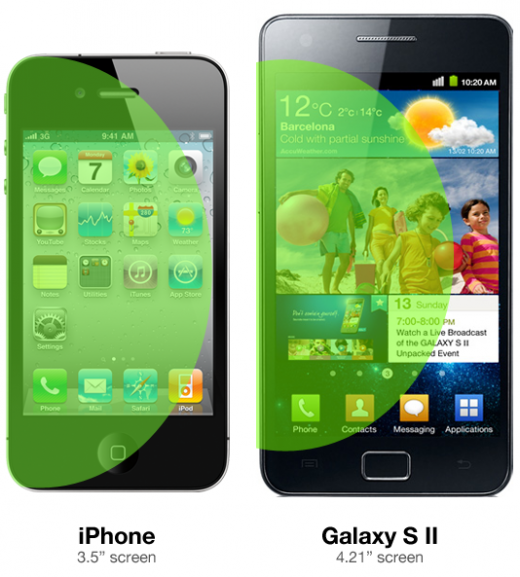 To illustrate the point of the 'subtle inconvenience' I'll call upon an interesting article written by Matthew Panzarino on 'The Next Web'. He stated that designer Dustin Curtis had done a test in which he found that the disparate display sizes of both the iPhone 4 (3.5 inches) and the Galaxy S II (4.27 inches) made a genuine difference in terms of their usability and could perhaps pose a niggling issue for the Galaxy S II through time. He found that the display size of an iPhone 4 allowed every icon on its home screen to be reached with the thumb whilst holding the phone with one hand, whereas the limited thumb span proved too small to reach to the further edges of the display when using the Galaxy S II. To the left is a diagram that designer Dustin made to complement his contention.
Sure, you have to make a few sacrifices if you want the big and the better. That's how life and nature works right...a little give there and a little take there. But I don't think that's how it works for phones - because a smartphone is meant to materialise a vision for easy, portable computing. And traditionally a phones have blessed us with the advantage and accessibility of quick one-handed operation; the fact that phones have increased in brain size and processing power shouldn't compromise this one distinctive trait. Smartphones need to retain their one-handed usability and size because it's the only characteristic that preclude the smartphone and tablet from convergence. It's the only reason why they're still different things. Heck, if I could grab a tablet and hold it in one hand and use it with that one hand with ease I wouldn't need my phone, because my phone would just be a smaller and more eye-straining version of something I already have.
So I'm here looking at the new Galaxy Nexus and its 4.65 inch display, and I'm thinking to myself 'how big are your hands?' You might think I'm overreacting and these seemingly minor nitpicks are all in for the sake of a more spacious experience. But more than you think it's the insignificant things that leave an otherwise perfect product completely smitten - thumb hyper-extension and unnecessary two hand use are just a couple of those things. I use a 3.8 inch HTC Trophy daily and for me and my average sized hands that's just about the limit. Again, this is all completely subjective and for some of you this large screen size may suit your needs, and your hand-span, but strictly from my own personal vantage and I'm sure that of many others anything above 4 inch is a heck of a size, and anything larger than the Galaxy S II is really really pushing it.
Super size? Are you really lovin' it?
Monday, September 5, 2011
Categorising Samsung's Galaxy Note

This year, I believe that the world of consumer technology has created and embraced what I see as the three musketeers of our computing lifestyles - PC, tablet and smartphone. All these devices augment the experiences of each other, and thus far none are capable of fully replacing one another. I couldn't possibly replace my phone with a tablet, and my tablet is simply not powerful enough nor practical enough to replace this laptop I'm typing on at this very moment. I think that one of the main things that holds back any of these devices from convergence or replacement of each other, is something that by its very nature simply cannot be fixed - its size. If people could comfortably fit an iPad, or even a Blackberry Playbook into their pockets and hold it to their ears during a phone call, people would very well do away with phones.
Unless you're the highly materialistic type like I who simply loves to bathe in collections of electronic devices, the lesser the number of devices that you have to deal with and manage is better. Hence the popularity of smartphones because they take on the purpose of a multitude of devices. All of this makes the unveiling of Samsung's potentially category pioneering Galaxy Note at IFA in Berlin all the more interesting. Cutting back from the trivial matters of detailed specifications, the Galaxy Note is a 5.3 inch 'device' with an incredible high resolution Super AMOLED display. As you can probably see from the image above of DJ Lee holding the Galaxy Note, the device is larger than Samsung's already large Galaxy S II smartphone but without looking entirely out of proportion. It's hard to believe that what is in his hands is a 5.3 inch display, which is certainly workable for a pocketable mobile workspace.
So, can this Galaxy Note succeed in converging tablet and smartphone for those who want to be burdened by less? It's certainly a compromise. Personally, the pockets of my jeans will only just hold a device of this size with a convincing shove. And then, it's not the greatest feeling (or look) walking around feeling a huge rectangle in my pocket pressing against my leg. On the other end of the spectrum, its size can also be considered to be too small. Even the Blackberry Playbook was criticised by many as being an inch or two below adequacy for a great web experience. Sure, the Note is great for the people who are willing to make the compromise to streamline their own device portfolio, but for the users looking for the best end to end experience, it's not going to happen here.
 We can't look at the Galaxy Note and attempt to categorise the product simply based on its size. It comes with a stylus, which has been shunned by Apple but in actuality has some really useful practicalities. We've already seen such a stylus implementation in HTC's 7-inch Flyer tablet. The stylus was used to draw at a level of accuracy that fingers alone do not permit and also to highlight, circle and make notes on the screen at any time. The concept was great because it emulated the way we like to manipulate content in the traditional way of pen and paper and how we often highlight and underline things. The stylus of the Galaxy Note takes this idea and integrates the stylus deeper into the product as such allowing us to use the stylus to navigate the device as well instead of just drawing. From use cases demonstrated in the official promotional video we can really get a sense of the wide-ranging possibilities of the underrated technology of touch-pen input.
Perhaps, Samsung isn't looking at the convergence of the devices, but rather creating something...semi-new. It could be called a tabphone? Meh. Or perhaps a smartlet - that's cute. The point I'm trying to make is that I personally don't see this as a really really big smartphone for really really big people.
As the name suggests, the Galaxy Note is perfect for such use cases like note-taking which is something that is actually abominably hard on touch keyboards. It's funny how we often don't notice these little things that we want until someone shoves it into our faces. That's what Samsung have done here; taking notes on any touch screen keyboard of any size isn't a situation we dream of being in, let alone having to take such notes in speed. The stylus merges the benefits of both traditional handwriting and the digital capabilities of mobile devices - given the Galaxy Note is able to handle accuracy and speed simultaneously, we could have a really capable 'jotting down' PDA-like contraption with unprecedented versatility. The problem with pen and paper is that once you finish writing things down, that's really all you can do with it. For it to be digitised, the convoluted process of scanning must be endured, and even then the simple image file that it becomes is limited in its capabilities. The Galaxy Note can change this simply through its digital nature.
I know you're thinking that a stylus isn't a huge innovation, in fact it's really not an innovation at all as styli are considered by many as previous generation technology for when we didn't have effective capacitive touch displays with big meaty buttons for our big meaty fingers. But the stylus isn't dead and it was never dead, it's just that everyone is simply so engrossed in the smartphone spec war to embrace true innovation and forward thinking.
The Galaxy Note is certainly not for everyone, but for those who are blessed with large hands and don't often wear skinny jeans will probably love the practicalities that this 'little' contraption provides. Living with a tablet for a month (Blackberry Playbook), I can't imagine my life without one, it is honestly the most liberating feeling being able to take almost the whole quota of my digital lifestyle with me everywhere without being weighed down. With Galaxy Note, if one embraces what this device offers I'm sure it will eventually morph into an essential in much the same way.
So is the Samsung Galaxy Note the start of a new trend? The return of the PDA? To be frank, it's niche factor is too large for it to be embraced by other manufacturers. I still stand by my digital trio of smartphone, tablet and PC. The Galaxy Note probably won't be purchased on its merits as a note-taking device or a PDA if you like, but for anyone that has pockets capable of housing 5.3 inches of Super AMOLED goodness and is looking for a smartphone - meet 'smartlet'.
Monday, July 11, 2011
Breaking down LG's smartphone troubles

There are hundreds of Android phones on the market right now, and no reasonable person would question why. After all, who wouldn't take a smartphone platform connected with services by the most important internet company in the world, surrounded by an immense ecosystem of apps if it was handed to them for free? LG's one of these 'people' who have chosen to adopt Android to launch themselves into the smartphone world. However the adoption of Android has seen LG fall victim to what I like to call: Androiditis. The issue of Androiditis is a simple one, you have a really good platform on your phone, with great services, plenty of apps, but everyone else is just as good as you. It's like being prime minister in a room full of presidents. All of LG's competitors who have joined the Android party have access to the same apps and to the same services. Essentially, if you have exactly the same software as your competitors then you're not really competing in that respect anymore are you?
Which brings LG down to its biggest issue, LG's inability to produce decent hardware. I'm yet to see an LG smartphone that has legitimately impressed me. When I walk into a phone shop and have a play around with an LG, nothing strikes me as being awesome or worth noting. Their phones have been receiving lackluster reviews not because they're bad phones per se, but because they're simply not better than their competitors and have nothing of value to distinguish themselves in an Android crowd chock-a-block with 'me toos' and 'pick me's'. There's also something to say about LG's apparently low standards in regards to hardware design. There was a billboard at a bus stop in Melbourne I saw that showed an attractive model holding an LG Optimus 2X in typical ad-like fashion with a tag line boasting the device's svelte hardware design. But, in contrast we see the Samsung Galaxy S II with its absolutely astonishingly, timeless and in my opinion, better hardware design which isn't even being advertised as a fashionable phone as such.
Design is a topic that's subjective, many people will say that LG's current smartphones are relatively pleasing to the eye. I'm not going to counter that, but I think it's right to say that LG has certainly lost some of its design flares from back in the days of the Chocolate and the Prada. To say the least, LG phones had a design that was not only attractive, but unique. Heck, the Chocolate BL40 (main image) still remains in my opinion the most attractive cellphone ever made. Full stop. It was beautiful, and unique. And I think that word is the key representation of where LG has lost touch.
LG needs something unique to separate themselves from the shadow of generic Android manufacturers. Samsung and HTC are undoubtedly the two most successful Android manufacturers because that's exactly what they have, something unique. It feels weird to be saying this since due to my own personal idiosyncrasies I hate Samsung, but Samsung have amongst the best smartphone hardware around. It's not just the design of their devices, but the succulent quality of their displays, particularly the Super AMOLED ones. HTC likewise have set themselves apart with their distinctive Sense UI, which is a hybrid of beauty and brains. Many manufacturers skin their Android handsets with the hope of giving them a distinctive look and feel, but none are more effective than Sense UI. When you use Sense, you just know that you're holding an HTC. Sometimes it's just that simple...you just know.
Despite having a design that it quite uniform across LG's smartphones, it's not unmistakeably LG in the same way that slim, blocky, rectangular designs are unmistakeably Samsung, and the distinctly shaped silver navigation buttons below Sony Ericsson phones just scream Sony Ericsson.
LG simply needs to find out where they belong, and create products that cater for their vision. Right now, bland hardware design and non-unique software aren't giving LG any legs to run away from the congested Android crowd. For a well-established brand like LG they need to do better than simply being another option for consumers. How about being the option? Everything aside, LG isn't in big trouble, no matter how far their sales fall they're still essentially on the same playing field as their Android competitors, they're sharing an ecosystem that others are assisting to maintain. They don't have an ecosystem to defend. That's the advantage of Android, LG need to capitalise by creating beautiful and unique hardware that I know they're capable of. It's time to make Life Good again.
Which brings LG down to its biggest issue, LG's inability to produce decent hardware. I'm yet to see an LG smartphone that has legitimately impressed me. When I walk into a phone shop and have a play around with an LG, nothing strikes me as being awesome or worth noting. Their phones have been receiving lackluster reviews not because they're bad phones per se, but because they're simply not better than their competitors and have nothing of value to distinguish themselves in an Android crowd chock-a-block with 'me toos' and 'pick me's'. There's also something to say about LG's apparently low standards in regards to hardware design. There was a billboard at a bus stop in Melbourne I saw that showed an attractive model holding an LG Optimus 2X in typical ad-like fashion with a tag line boasting the device's svelte hardware design. But, in contrast we see the Samsung Galaxy S II with its absolutely astonishingly, timeless and in my opinion, better hardware design which isn't even being advertised as a fashionable phone as such.
Design is a topic that's subjective, many people will say that LG's current smartphones are relatively pleasing to the eye. I'm not going to counter that, but I think it's right to say that LG has certainly lost some of its design flares from back in the days of the Chocolate and the Prada. To say the least, LG phones had a design that was not only attractive, but unique. Heck, the Chocolate BL40 (main image) still remains in my opinion the most attractive cellphone ever made. Full stop. It was beautiful, and unique. And I think that word is the key representation of where LG has lost touch.
LG needs something unique to separate themselves from the shadow of generic Android manufacturers. Samsung and HTC are undoubtedly the two most successful Android manufacturers because that's exactly what they have, something unique. It feels weird to be saying this since due to my own personal idiosyncrasies I hate Samsung, but Samsung have amongst the best smartphone hardware around. It's not just the design of their devices, but the succulent quality of their displays, particularly the Super AMOLED ones. HTC likewise have set themselves apart with their distinctive Sense UI, which is a hybrid of beauty and brains. Many manufacturers skin their Android handsets with the hope of giving them a distinctive look and feel, but none are more effective than Sense UI. When you use Sense, you just know that you're holding an HTC. Sometimes it's just that simple...you just know.
 |
| The Sony Ericsson Xperia buttons. Courtesy Jon Choo |
LG simply needs to find out where they belong, and create products that cater for their vision. Right now, bland hardware design and non-unique software aren't giving LG any legs to run away from the congested Android crowd. For a well-established brand like LG they need to do better than simply being another option for consumers. How about being the option? Everything aside, LG isn't in big trouble, no matter how far their sales fall they're still essentially on the same playing field as their Android competitors, they're sharing an ecosystem that others are assisting to maintain. They don't have an ecosystem to defend. That's the advantage of Android, LG need to capitalise by creating beautiful and unique hardware that I know they're capable of. It's time to make Life Good again.
Saturday, May 14, 2011
Capturing the 'indecipherable' ladies market
 |
| Beyond stereotypical image of two women frolicking in their natural habitat |
Given this brief analysis of female interests, dedicated ladies electronics have generally been extremely stereotypical. Most if not all dedicated ladies phones are jam packed with shopping applications, certain texting features, QWERTY keypads, crocodile skin aesthetics and often laden with that ghastly colour of hot pink. Perhaps throw in a free handbag in there too. None of these approaches have ever successfully completed the puzzle of consumer technology for females. I don't want to be stereotypical and say that all women are make-up obsessed, window shopping addicts, as thank god I have met many girls who are not like this. However, the general consensus is that there are many females that fit this description and a lot of consumer electronics vendors are trying to target just this. I'm going to explain why targeting females in such unimaginative ways will never work, and why targeting females at all is just an inefficient waste of time.
You might have noticed that the word indecipherable in the article title, is placed between apostrophes. This is because people assume that the ladies market is so confusing and unbreakable. We wonder if women want pink phones, or petite handbag sized netbooks. However in the end there is nothing to decipher at all. It's not as difficult as it is made out to be, there's no need to go into the deep complexities of female psychology. But rather, we just need to know one simple fact: women are just looking for a great experience.
The fact that most women aren't as knowledgeable or interested in the tech field has forced manufacturers to blindly assume that women are to be targeted separately via alternative means. Instead of having normal products for normal people, there's suddenly a need to have modified phones for women. It's like they're not normal humans! However, piecing apart the overall market and providing tailored products for individual segments not only dilutes the value and unity of products in the lineup, but is essentially more costly. Piecing apart and spreading the target market also means spreading promotional expenditure and support expenditure. It's an inefficient way to do business. I'm not necessarily a supporter of small one product line-ups, since one product is often not enough to be able to encapsulate the entirety of the target market. However the ratio of products to consumers should always remain as small as possible. Apple has done well in this respect, though they represent an extreme in this philosophy. The iPhone is one product for all, it suits females, it suits males, it suits students and it suits business professionals.
I know there are many people and manufacturers that would aggressively counter this philosophy, Samsung is probably the most prominent of such offenders. In my opinion Samsung's smartphone line-up is excessive. Excessive to the power of 4. Daily, there is a new review of a Samsung handset: Infuse 4G, Galaxy S II, Droid Charge and plenty more. To be brutally honest, only one or two of these have a legitimate reason for existence. The Galaxy S II is a great phone, and most of the others are just cheap copies of the same device. Evidently, Samsung is trying to break the smartphone market through pure scale. Not much effort has gone into branding or exclusivity, however the 'shove in your face' factor forms the core of Samsung's smartphone effort. They want that obnoxious Samsung logo to be so ubiquitous that when picking a smartphone, the odds are that you'll end up with a Samsung. I can't say that this plan isn't effective, because I would be lying and the ubiquity of Samsung's smartphone effort is from what I've heard proving to be effective. And Samsung's strong hardware calibre has definitely earned the respect of technology enthusiasts. However speaking as a consumer and analyser of such technologies, this strategy offers little in terms of gaining brand value and consumer respect. Only time will tell Samsung's prospects.
Back on topic (consumer electronics for females), another factor that must be considered is a product's general ease of use and tech appeal. And by tech appeal, I'm referring to a lesser focus on tech appeal. A recent article that I wrote talked much about most vendors focus on hardware superiority in the tablet space, instead of aiming to excel in user experience. If technology nerds are the target market, this strategy is gold, however for everyone else and particularly ladies this strategy is far from effective. In this regard, I could say I'm much like a female, I couldn't care less about that 'ghz' and 'dual-core' junk. If it works well and smoothly then it works for me. This is why expert studies have shown that females have a strong preference for iOS over the geeky Android. iOS's omnipresence and 'I don't need a manual' interface has ensured that a lot of consumers are aware of iOS's great user experience. Android's geeky name, general geek appeal, and tailored user experience across difference devices has added confusion and complexity into Android purchases. For example, just because the Galaxy S II is a brilliant phone, I can't be guaranteed that Xperia Arc which runs on Android too will likewise be a great phone. On the flip side, I can be certain that the white iPhone 4 will be just as good as the black iPhone 4, and iPad 2 will definitely be an improvement over iPad 1.
All up, I have shown two effective to captivate the minds of females. Being stereotyped as pink-loving window shoppers is not one of them. In actual fact, I believe that females dislike being patronised in such a way, the need to have devices specially tailored for them is somewhat degrading and evokes the feeling of deficiency. The most efficient way to capture females is to pull them into the company's overall target market, not aim for them individually by taking them out of the target market. Once again, females are just like males, looking for a great user experience, however, minus the hardware complexities.
What do you think about selling consumer electronics to women? Is it easier or harder than it looks?
Subscribe to:
Posts (Atom)