Showing posts with label Consumer Technology. Show all posts

Monday, January 30, 2012

Running On Fumes

Despite reporting an operating loss of over 1 billion dollars, Nokia managed to pull off a feat to mollify the investors - 1 million Lumia Windows Phone device sales. That’s actually quite a respectable result considering the device has yet to make a showing in markets such as North America and Australia.
But aside from that, Nokia’s future doesn’t appear to be looking any brighter than it was a year ago, in fact maybe it’s even a little bleaker. What Nokia use to have in the market was exclusivity and scale. The tandem of those two factors ultimately led to Nokia’s commanding success. 
Nokia has neither of these two factors today, aside from the exclusivity of being a 100% committed Windows Phone partner, but really that’s only working for Microsoft. The N9 running Meego Harmattan was certainly an exclusive, but with the promised commitment to run full steam with Windows Phone, Meego Harmattan’s potential may never be realised, or at most, a peripheral pursuit. 
Of course, it’s not like Meego Harmattan had a big chance anyway.
And scale, is something Nokia simply can’t obtain given the R&D required to build any good smartphone, especially if you’re Nokia and really trying to deliver with a bang. Nokia’s now signature polycarbonate shell in the N9 and Lumia 800, 900 models is a feat of engineering that simply couldn’t have been achieved if the company had floored it and delivered a tsunami of Windows Phones in generic form factors and hardware variations. 
The only segment where any economy of scale is possible, is in feature phones, once Nokia’s money-reeling gem but now declining precipitously in developed markets. Of course, there’s still money to be made there, and with most cellphone vendors relaying their focus to encompass smartphones 100%, Nokia is really in a position to take full control of the feature phone market. But there’s a reason why the world and the industry is stepping with both feet into the smartphone pool, it’s because not doing so would be committing to a world that will cease to exist in a very short time.
For Nokia, it’s even more crucial than this. As a company undergoing a brand image overhaul, investing excessively into feature phones would do nothing but hamper Nokia’s planned course to become viewed as a forward thinking company. Consumers can’t think of Nokia and see number keypads anymore.
Aside from the fact that Nokia no longer has significant leverage in the development chain to pump their business anymore, there’s also the issue of getting consumers to sign a contract to their phones which run on a platform that hasn’t gained the amount of traction that the company probably thought it would. Aside from getting the nod from reviewers, consumers are yet to see the great value proposition in Windows Phone.
Sure, 1 million sales exhibits promise, but it’s early days. The company has most likely skimmed the piece of market that gravitated towards Nokia in the first place, but from now on, it’s war and Nokia needs to pose some real fight - not only to lure consumers away from the eminent iOS and Android, but also to funnel them away from the other Windows Phone vendors in HTC, LG and Samsung among others.
The latter, an easy task that the company should win, but the former being a spectacularly tall order.
It stands to beg the question of why Nokia didn’t pursue the Android paved path in the first place. I can imagine it being an appealing option, Nokia’s acclaimed hardware quality and design paired with an OS that has solidified its position in the marketplace. It’s always nice to be on a winning team. But Nokia took a risk with Windows Phone, as a consumer I applaud the path they’ve taken, and from Nokia’s vantage, I would’ve done the exact same thing. 
Success in Windows Phone will yield a significantly greater reward that would be irksome to supplant, whereas success with Android would simply be providing another option, as opposed to a different option. 
It’s an uphill climb from here, and by sucking dry their loyal customer base in the first million sales, Nokia is essentially running on fumes. But since when is business not an uphill battle?  Build beautiful things, make sure people know about it and you can’t really go wrong. 

Sunday, January 29, 2012

Apple and Foxconn's Working Conditions

This is not an issue for Apple, it’s Foxconn’s problem and no consumer electronics company that sources their production to Foxconn can do a thing about it. 
It’s not Apple’s job to make sure that worker conditions in production facilities is acceptable, the fact that the company audits these factories at all is already generous. And, if from the goodness of their own heart (heh, doubt it) Apple really does give the slightest care about worker conditions in China, they’re not in a position to dictate terms. Apple can beg and beseech, but poke the bear and you’re treading on super thin ice.
Apple relies solely on Foxconn to make their nut. The majority of Apple’s supply and manufacturing, as with many other consumer electronics companies, is sourced to Foxconn. No other company in the world exists that can manufacture to quite the scale, speed and efficiency that Foxconn does. 
Foxconn relies on almost the entire industry to make their nut, so really, Apple, though of course a cash cow of a customer, doesn’t mean nearly as much to Foxconn as Foxconn does to Apple. The Chinese monster knows this, and permits themselves to cut corners and cross moral lines knowing that Apple really isn’t going to do anything about it, aside from throw a few unsubstantial ‘demands’ for better working conditions. It’s all PR.
As long as the company doesn’t significantly attract government attention or that of rights activists, Foxconn really does have the freedom to hire as many under-age workers as they want, have as many 12 hour workers as they want, and ignore as many safety regulations as they want. Chi-ching. Money, money, more money.
Even then Foxconn has the Chinese government in a strangle hold too, why would the Chinese government dare hamper the growth of such a lucrative corporate gem? They’re probably sitting there in their spin around chairs going, ‘Dayum our economy good’. And who’s to blame them, their economyis good.
To point fingers at Apple, or Sony or Dell or Microsoft as acting immorally and permitting torturous slave like conditions in Foxconn is akin to blaming your professor for poor grades, not their problem.
They’ve done their job, Apple has done their job in R&D, their job is to dream the ideas and create beautiful products for an end user. Foxconn’s job is to make it, and all the unfair blood, pain and suffering that goes into the birth of an Apple product is weighted on the manufacturing side of things.
Don’t blame Apple, blame Foxconn, it’s their job and they’re the ones doing it wrong. They’re the ones acting immorally on so many different fronts, not only by providing abysmal worker conditions but by abusing their monopoly position to permit themselves to do it even more.
Foxconn has a history of issues, a mainstay in which was the fourteen suicides in late 2010. The company resolved the problem by installing suicide prevention netting, like that was totally attacking the source of the problem. Not only does it show that Foxconn doesn’t get the staggering effect of their actions, but that they simply don’t care. 
But that’s business, and that’s capitalism. When someone makes some killer cash, somebody has to be on the other end of the trigger. When we look for something that is both awesome and affordable, and seek the best of everything, somebody has to end up with nothing.
The world is full of compromises, all we’re doing is shifting them, playing with the economics of life. I’ll just drop by my carrier store and get an iPhone that doesn’t quite burn the bank, while you, get no iPhone and pay for my cash savings through your weary eyes, swollen leg and back pains. 
The worst thing is, we’re all just like each other, I’m just like everyone else. While I do care about the workers, when its buying time I’ll do everything to nail that Mac at the best price possible.  
It doesn’t have to be this way though, Foxconn just needs to show a little heart. But shit, who am I kidding, it’s all money and vested interest.


Also on A Pony For President

Tuesday, January 24, 2012

Beneath the Excitement of iBooks 2

Last week, Apple pulled the wraps off its latest offerings, iBooks 2 and iBooks author in a publicised event in New York City. Whilst the announcement has proved exciting and potentially world changing, digging a little deeper, there's probably just as much to be concerned about as there is to be contented about.

I'm just going to start by stating the shallowest of my sentiments - this announcement is darn exciting and will no doubt change the state of education and of course, reading as a whole. But, , whether it will change education and reading for the better or for worse is something we can't be entirely sure of.

Ebooks are certainly the next big thing in reading, but I doubt they'll ever fully replace paper, not in our lifetime. We will always want books, I will always want the option of an actual book, libraries will never just be online catalogues. It's not about nostalgia at all, well maybe a little, but certainly not all of it. The reason why books have lasted so many centuries as a technological medium for knowledge distribution is because they simply provide so many practical benefits which are irreplaceable through technological innovation.

Dieter Bohn of The Verge recently published a lengthy feature titled 'Sorry iBooks,paper books still win on specs', which outlines all the books practical benefits which can't be ported digitally due to the very limitations of technology itself. Here's a few crucial ones: books don't crash, books don't run out of power, books have a consistent user interface, books are compatible with every nook and cranny of our daily lives.

Sure eBooks exhibit traits that are impossible for paper to ever adopt, but that's how it is, books and ebooks are just compromises of an impossible optimum which is why we still need both.

To play the nostalgia card by saying that there is a nothing quite like curling up with a good book, turning paper pages and the smell of an old book isn't really worthy of awarding a point to the good old traditional book. For the most part, these claims are distorted by a desire to cling onto the past.

People are always afraid of adopting unproven things and letting go of the past, especially when it's something like the binded book which has served us so well for countless years. In the hypothetical situation that the world regressed from iPads to paper books, we'd look nostalgically back at the swift beauty of swiping to turn a page and puke at the thought of touching paper.

But then again, I feel that eBooks do have the capacity to devalue intellect. Despite being a grace to the spread of knowledge, the fact that it is now so easy to publish books with iBooks author and distribute them freely, it is no longer really special to have a book published under your name. Additionally, it potentially makes it harder to find genuinely good books, and easier to stumble across one that someone may have simply published for a school project.

In many ways, it's comparable to what email has done to letters, making it easier to receive and dispatch letters, yet also a lot easier for spammers to get to you. And perhaps also what blogging has done to traditional paper journalism.

On the education side of things, I can't be one hundred percent certain that interactive iBook textbooks is truly what education has been looking for. iBook textbooks are indisputably a preferable alternative to the fat textbooks of today - interesting, useful, engaging, it's all there for the iBook textbook. What's concerning is having the iPad in class at all.

There's a reason why cellphones are generally not permitted for use in class despite their potential utility as a learning tool. It's because electronics are distracting; pair that with the fact that learning subjects that a student dislikes is boring and you have a fairly tasty recipe for procrastination, in class texting, and Facebook-ing. Interactive books will never make a student interested in a subject that inherently bores them in the same way that playing Halo won't make me a fan of guns.

Apple's interactive textbook is a double edged sword, empowering engaged students to learn in new and better ways, but for the kids who aren't really engaged in the first place, it's just a brand new way to get away from class. By trying to emulate the quick access and fast paced immediacy of current technology in the new interactive textbooks, we're also emulating the negatives – the constant contingency to lose focus.

If we want to fix education, we can't simply implement books that move and talk, we need to change the curriculum so that students don't have to do science or math if they simply don't give a sh*t.

Interactive textbooks aren't a step forward for education, but more like a step to the side. IBooks and eBooks are a step to the side for reading too, another alternative that is appropriate for certain use cases but can't replace paper books which are appropriate for other use cases. I can't really sum this up any better than Dieter Bohn did in his article on The Verge, but if we ever want digital to become the dominant medium for books, we need to make sure we can try recreate at least some of the better things about paper into electronics.  

Sunday, January 15, 2012

A Pony For President - My 2 Cents on Google Search Plus Your World

My 2 Cents on Google Search Plus Your World - on my Tumblr 'A Pony For President'.

Just some thoughts on the antitrust debate surrounding Google's new personalised search feature.

"I’m definitely one that is a fan of competition, count me in for that, but I also run under the belief that corporations who have worked hard to gain their position as a leader should be able to leverage their position in the industry. Google have worked hard to maintain their position as the number one search engine, they’ve earned their spot not through sly tactical means, but for the pure fact that they have a better product.
I believe that claims for anti-competitive behaviour by not including Twitter and Facebook in personalised search results are unfair to Google."

Sony's big opportunity

CES 2012 has come and gone and if there was one thing that really stood out, it was perhaps surprisingly the smart TV and what it means as companies work harder to integrate their sparse hardware offerings. Samsung impressed, but Sony, of all the exhibitors at CES demonstrated the cuts to make this ecosystem thing really happen.

Samsung on the most superficial level was the ecosystem warrior at CES 2012, making a noise about its television sales numbers, which are objectively impressive and their focused strategy consisting of the three verticals - content, service and connectivity. With the reach of Samsung's TV user base, the reach of its enormous smartphone user base and the reach the company obtains by providing not only consumer electronics but home appliances, Samsung, in every possible way appears set to take the ecosystem war against Apple by storm.

By not conforming to the Google TV bandwagon, Samsung are playing their chances on the TV revolution alone. With a thriving developer community, popular smart TV platform and a successful consumer electronics business to leverage, why wouldn't they? Well because Samsung along with most of the industry are wrong about the Smart TV, and only Sony seems to get it.

Let's back up a little. Televisions are simply not like smartphones, and therefore applying the same principles that have made the smartphone a raging success simply won't work. Smartphones and the app approach have been a ground breaking success simply because smart, simple, streamlined apps are what's necessary to achieve anything when on the go. Minimise the number of button presses as possible, make things as simple, quick and engaging as possible and you have a big winner.

Do any of these values apply to television? Sure.

Sure it would preferable to have smart, simple and streamlined television apps, but looking at the broader picture, is apps really what's going to drive the TV revolution forward? To put it bluntly, no. Unlike mobile where things need to be snappy and fast, television is lazy and passive. Television is about content consumption, not content creation or content engagement. Although apps will be a hit gimmick sell, television will always be about consuming content - an area that Samsung simply isn't addressing with nearly enough punch and where Sony is flying high and mighty.

Sony Entertainment Network, a major talking point at Sony's press event may very well be Sony's big break. With significant leverage from the company's Playstation products, and the foundations of Android and Google TV rooted into its latest products, the company has the groundwork to make the content ecosystem its own.

The addition of cross-platform support in Sony Entertainment Network will not only allow the company to deliver highly compelling tablets, smartphones and connected products, but with SEN's unique placement as a single unified source for entertainment, Sony has the potential to turn its entertainment network into a cash cow.

Despite Samsung's breadth and sales, why Samsung isn't poised to take advantage of the TV revolution as well as Sony is, is simply because Samsung is placing too much of their efforts in their own hands. By developing every single facet of its own Smart TV and trying to be the be all, end all approach, the company can't use those same resources towards what really matters - deliver a truly compelling content delivery system.

Sony on the other hand, are taking advantage of Google's already established Google TV platform to gain them instantaneously what Samsung are working so hard to maintain whilst placing their own efforts into delivering an unsurpassed content platform with the deep cross device integration that the Japanese company promises.

Speaking from my own personal vantage, the ecosystem has always been something desirable, yet something I can never really obtain given the fickle nature of my technology desires. I own a Vaio PC, yet also own a Mac. I own a Windows Phone, yet use a Blackberry Playbook for my tablet needs. Hence, I've never had the coveted opportunity to be truly invested in any ecosystem.

iTunes never stuck with me because despite owning a Mac and a PC, my distinct lack of Apple mobile products eliminated much of iTunes' value proposition (besides, I'm more a fan of streaming). I trialled Zune Pass for 14 days when I purchased my Windows Phone, I loved the service but the fact that I couldn't use it on my Blackberry Playbook, TV or Walkman didn't prove it to be a worthy investment. The ability to help people like me is Sony's remarkably big opportunity.

No company has thus far delivered a single unified media distribution platform. If Sony plays their cards right, SEN could end up being just that. With support for all Android phones, upcoming support for iPhone and presumably iPad and of course, built in support with all Playstation products, Sony have formed the underpinnings for this master plan.

Deliver the service onto every platform imaginable (Windows Phone, Blackberry, Blackberry QNX, webOS etc...) and Sony have themselves an impossible to say no to, content 'sub-ecosystem' empire. Pair that with the advantages of owning a content studio (Sony Pictures) and it's hard not to envision a phenomenally compelling service.

While Samsung pays lip service to the success of its Smart TV offerings and integrated ecosystem trajectory, the inability to envision the larger picture may eventually have Samsung scrambling into the open arms of Google TV and have companies like Sony reign supreme in the TV revolution simply with their ability to deliver what it's really all about - content.

Tuesday, January 3, 2012

TECHGEEK.com.au - Windows Phone 7 is far from dead

Check out my article on TECHGEEK.com.au in response to 'Is Windows Phone's Consumer Focus Killing It?' published on Wired Epicenter.


"Wired Epicenter recently published an article on Windows Phone titled 'Is Windows Phone's Consumer Focus Killing It?' It's certainly reasonable to propose that the consumer focus is a reason for Windows Phone's less than spectacular adoption, but to say that Microsoft's will to satisfy the end consumers to the highest degree possible will be a prominent cause in the platform's possible demise is pushing it much too far.

That's obviously not to plainly suggest that Microsoft taking a very Apple-like approach with smartphones isn't holding them back even slightly. It's a large reason for Windows Phone's general lack of awareness amongst phone shoppers, and the obvious lack of sparkle in Microsoft's Windows Phone lineup. Unlike Google with its Android operating system, Microsoft places strict hardware guidelines on manufacturers developing Windows Phones. OEMs are not permitted to have a screen resolution that is beyond or below 800 X 480 and processor requirements remain particularly strict and unmoving..."

Saturday, December 17, 2011

Open sourcing webOS changes nothing


A couple of months after the company announced the death of webOS, HP's new CEO Meg Whitman has thrown the OS a lifeline in the form of the open source community. The greatest takeaway from this announcement is the fact that webOS is not dead. It's now vastly in the hands of passionate developers to build upon and improve efficiently whilst being freely distributed for anyone to use.

From the outset, we couldn't have possibly gotten it better, open source developers as a collective can make changes and improvements much more quickly and efficiently than the vast bureaucratic corporate structure of HP ever could. And speaking from a consumer's own vantage, we have another free operating system to contribute to the highly valued element of choice. As well as being a free operating system, webOS exhibits polish, the kind of quality you'd generally expect to pay for.

Looking past the thin veil of optimism, none of this changes the fact that HP webOS failed tremendously, such to the point that it was actually dead for a period of time. It doesn't change the fact that there is yet to be any worthy complementing hardware for webOS and in no way does it contribute to the operating system's relatively minute app developer community. It offers no succour for the fact that iOS, Android and even Windows Phone already have significant market share to leverage whilst webOS has virtually none to boot. Most importantly, it doesn't change the fact that HP is still yet to find any significant value proposition in webOS to gain hardware partners.

It's quite clear that keeping webOS as a proprietary OS in the hands of HP was no longer a viable option. The fledgling operating system was already skating on thin ice even before HP's immense Touchpad failure, and the heat of the competition from Apple and Google was slowly melting away at HP's chances of even minor success. The Touchpad, as the inaugural HP/webOS tablet had to be pretty darn good, but it wasn't.

I've always believed that it takes multiple subsequent impressions to eliminate the sentiments from a single first impression, and HP's first efforts at a truly mobile operating system in webOS left consumers and pundits with a sour sour taste. It would take the bare minimum of two years to manufacture sufficient subsequent efforts to try and clean the taste, and even then, imminent slow sales could hamper the webOS image even further and render the $1.2 billion acquisition essentially worthless. It would be too risky. Leo Apotheker wasn't completely out of his mind to cancel HP's webOS project altogether.

So, as much as persevering with webOS would have been a desirable trajectory, the plan was ultimately destined for failure. HP had various other options including licensing and selling the operating system off. Both these options I believe would have been higher on HP's priority list given their capabilities of monetization. But licensing was always an unreachable dream given the free availability of an operating system in Android with a lot more to offer, and there simply isn't a discernible target market large enough for those hardware manufacturers wanting webOS purely for diversity. To add insult to injury, clearly nobody was interested in buying webOS from HP.

By the looks of it, open sourcing was just a last resort for an HP that had completely run out of ideas. They couldn't make it work for themselves, they couldn't license it, they couldn't sell it so they've decided simply give it away.

HP is a profit-seeking corporation, they certainly wouldn't want to open source and wouldn't have made the decision had they not be in a position that forced it. The soul reason that Google voluntarily open-sources Android is because they have an ecosystem to tie users into so they can profit from users consequentially by putting their services into as many hands as possible.

All HP has is a lonesome operating system, tied into an ecosystem with little value, and no web services aside from a fairly deserted sandpit of an app store attached to it. Open sourcing doesn't cater to HP's personal vantage aside from the distant goal that perhaps they could capitalise on webOS in any way in the future if it ever gains any traction - but that's a far-fetched dream with various apples and green robots obstructing the path to the gold medallion.

Despite the aura of optimism and excitement shrowding the open sourcing of webOS, webOS is still in a poor position to compete. I hate to be the pessimist, in fact, I'm usually the optimist - I believed for a long time that if Sony played it right they could compete against Apple's iPod, I still believe that RIM can get right back into the smartphone game and I believed that HP had a shot at tablet market share if the Touchpad hadn't been a year out of date.

webOS has polish, it has a clean interface, it works darn well but that's not enough for a world so invested in apps, content and cross device integration. HP's open source plan will maintain webOS as a niche platform for a community of passionate webOS die-hards, but it will never find the mainstream traction HP were hoping for simply because it doesn't have the ecosystem lever that companies like Google, Apple, Amazon and Microsoft possess.

Thursday, November 10, 2011

How to win in television


As a backdrop to the all too common mobile device war, TVs are starting to capture the attention of technology enthusiasts with the rumours of an Apple television set possibly appearing sometime in 2013. The recently unveiled biography of Steve Jobs has revealed a vague trajectory of Apple's plans in an entrance to the television market. In the meantime, Sony warned investors a fortnight ago of an imminent 2.2 billion dollar loss on its bleeding television business, making it the fourth consecutive year in which Sony's television division has remained unprofitable.

There's a powerful demarcation to be made here - why would investors and pundits be potentially excited over the notion of Apple television when Sony, a long time and trusted manufacturer in this business isn't even capable of hauling in a profit themselves? Most of us, would have never pictured Apple building their very own in house television set, the Apple TV always looked about as far as they would be willing to dip their toes into the deep television pond. The deep television pond infested by manufacturers willing to reap the slimmest margins to undercut competitors.

You see, that's the biggest problem with the television business for Apple, and even Sony, - it's heavily commoditised and highly competitive. With its vast manufacturing scale and supply chains, Samsung is more capable than most other manufacturers of profiting from television, and even their performance remains modest at best. 

Apple as a newcomer to the competition couldn't possibly expect to be able to develop in-house and manufacture quality televisions at the same scale as Samsung or even Sony and be able to deliver an affordable product to the end consumer. On the flip side of the coin, if Apple were to outsource production and buy flat panels from existing manufacturers - like Samsung - then they wouldn't exactly be innovating with their product would they, which by all accounts would most likely oppose Apple's ethic entirely.

Television is a business where it's very hard to differentiate or maintain an exclusive, Sony's Phil Molyneux even criticised the nature of television labelling this monotonous line of similar products as the 'sea of sameness'. Given product differentiation is so difficult to achieve, price differentiation is the only remaining resort, turning television into the bleeding, painful and low margin business that it is today.

Apple doesn't like playing the game that way. Historically speaking, Apple enjoys exclusivity around their products - a business model that doesn't always equate to leading market share, but always pulls in a huge profit, brand loyalty and evidently a glorious stock price. A sweeping dichotomy from conformist television manufacturers. So how do you work around this? How can you win in a business when it's hard to even break even?

First off it's important to evaluate the importance of television in an overall vision, or perhaps more importantly, the role of television in the the direction of the technology industry as a whole. It's fair to say that the whole industry is leading towards an almost universally pursued four screen strategy involving smartphones, tablets, personal computers and of course the television.

When Google and Apple begin hinting at entrances into certain markets, you know things are about to get real, and for television, Google's already waddling in the water albeit with a little uncertainty and we're expecting Apple to take a fully committed chunky dunk. Apple revolutionised the music industry with its ubiquitous iPod. Apple almost single-handedly crafted the modern smartphone, and Google made it big. Apple created and revolutionised a practically non-existent tablet market and Google made sure there was a little more variety to suit everyone. There's no reason that in their monstrous tandem, these two will be able to revolutionise the plateauing television business as well.

Consumers aren't going to be prepared to pay anymore than they are already for a television, especially given the state of the economy. Even if manufacturers gathered to form a pact that ensures a handsome profit for every unit sold, consumers wouldn't buy, even if they had no choice. Televisions are costly, low replacement devices, so consumers typically only replace televisions when they really need to. And a steep price increase for already rather steeply priced televisions would only push consumers to eBay and second hand items. To pursue this current business model in selling televisions as passive displays is not a feasible model, it never was, but now, we have better options.

The analogue age was a time when devices could thrive even when operating on a shallow and superficial microcosmic level. Devices were sold on the merits of their hardware capabilities, the quality of its parts and its physical design, as opposed to its potential for customisation and expansion. That analogue era, was long ago, but for the most part, television is still there - with picture quality and hardware quality still very much on the priority list for TV buyers. To win in television, we must relay our focus completely from commoditised hardware and aim to sell on the merits of potential expansion, integration, connectivity and content. Aim to emulate Amazon's business model for the Kindle Fire tablet - make a small loss or just break even on the hardware, and aim to cover that cost in packaging good software and selling content.

Google TV was initially poised to be the redefining of television but I think it's fair to say that we all misjudged, or more suitably, over-judged it's potential. Logitech's CEO went so far to state that the company had made 'a mistake of implementation of a gigantic nature', and the company had no plans to release a second generation Revue set top box. Sony hasn't achieved much success with their Google TV either.

Google TV never took off and still hasn't largely because it simply doesn't offer anything exclusive in the way of content, it contains Netflix and Pandora among other video and music subscription services but these services are all accessible through other mediums. And with all these content services being provided by third parties, once again we're not making much money on selling content and therefore unable to afford reaping negative or neutral margins on TV units.

But securing profits directly from selling content isn't the key, because most of the revenue is inevitably turned over in royalties to the content owners. In fact, the most popular online music store, iTunes, earned $1.9 billion dollars in revenue in 2007 according to Ed Christman, the retail columnist for the Billboard. However, taking into account royalties and operational expenses, Apple took away less than $400 million on its music store that year. Google recently sent out invitations to a Los Angeles event on November 16 which appears to be hinting at a music store, if Google has indeed struck a deal with the major labels I'll be damned if they're going to make as much dough per song purchase as Apple's iTunes store.

The idea though, in operating content stores is to provide a little extra change to allow for more flexibility when pricing television sets, after all, you can expect to subsidise at least some of the losses on unit sales with profits from content stores. Additionally, content stores that integrate well within an established ecosystem are just another incentive for consumers to want in - a core reason why Google TV has failed to catch on. Google currently has no music or video store and therefore no genuine reason for Android users to invest further in Google's ecosystem; adding insult to injury, the assortment of Google's cloud services like Docs, Gmail and Reader have no meaningful integration in Google TV.

The Google TV saga also serves to teach us that evidently, it's not enough to simply throw in some apps, integrate subscription services and allow native Youtube and web browser access to 'revolutionise' television. That's not enough because a consumer savvy enough to even adopt a young platform in Google TV would most likely be in possession of a tablet; and why compromise the display real estate of the television when you could be web browsing, Facebook-ing and Twitter-ing right from your tablet while watching TV. Essentially, the additions Google TV provides are more novel than genuinely useful.

You see, if Apple had simply thrown in a well-performing web browser, some fun apps and deep music store integration into a basic Blackberry form factor, would Apple still have revolutionised entirely the smartphone industry? No, not at all. Not even a little bit. So it's no surprise that Google hasn't done so with the television.

Apple revolutionised the smartphone because they changed the way we interacted with and used our phones. Apple turned scrolling into flicking, and pushing into pinching. Google on the flip side has only added quasi-useful functionality to television and we're still stuck with the same basic interface model of remote controls and navigational D-pads. Apple is now poised on the precipice of perhaps another revolution, and now couldn't possibly be a more timely hour for Apple given they've created a potentially revolutionary new way to interact with our devices, Siri. Siri, the voice interaction engine more human than anything we've seen before. Or heard before. If Steve Jobs' message to his biographer - 'I finally cracked it' a TV that is 'completely easy to use' - is anything to go by, then Siri is an almost certain implementation.

A lot of the time, it's not alterations in what we use a device for that cause excitement, but how we use it that strikes a certain spark in our fickle emotions. Take the Playstation Move and Xbox Kinect as a classic example, serving the same purpose but in two completely different ways. Sales figures can speak for this story. Siri can be our new remote control, and even then, it could probably do so much more.

We're standing on the very edge, the dividing line, the stepping stone to a new generation of television. And if any company believes that right now is a good time to depart the painful television business, then, well, bad move. Television is a crucial element in the completion of our technological circle, we'll always have living rooms - and to simply exit the business soully because of non-profitability is a little short sighted.

Previously, in the analogue age where products were sold largely on the merits of themselves, as opposed to their integration with other devices, television would have been a poor business. But today, television isn't heading towards being a lucrative business that rakes in an abundance of dough, but rather a crucial business which provides a little chump change. The rise of the 'ecosystem' and cross device integration has allowed for the creation of the 'prison', though more often than not this prison is one that we, as consumers voluntarily move into. Locking consumers in is priceless for those corporations hoping to capitalise on their existing user base, and of course, force loyalty from the consumer.

Apple TV was never enough for Apple because it's simply not enough to add your ecosystem to a television set when you're merely a 'connection' as opposed to the real deal.

This is why I am almost certain that Apple will make a television set, one which has unsurpassed integration with Apple's ecosystem as its highest value proposition. Because a great ecosystem and great software is the only viable path in an industry infested with competitors who are inevitably capable of making better hardware and selling it for less.

Having said that, Apple's not going to be reaping huge profits on television, in fact, television for Apple may very well end up being a loss leader. Apple will probably sell a television set at an enticing price point coupled with revolutionary interaction models (Siri), invoking an almost impulse purchase and naturally building a large user base for Apple's televisions. Sure, they've lost money on selling the television sets at such a price but they can subsidise that loss partially with content sales on the device, via iTunes. To place the cherry on the cake, one more Apple product in the hands of consumers, is just one more reason to invest further and deeper into Apple's ecosystem, equating essentially to subsequent profits from selling more iPods, iPhones, iPads and Macs.

It's a plan for the long term, and that's how you win in television. 

Saturday, October 29, 2011

Rant: Blackberry Buzzkill

RIM earlier this week made the maligned announcement that the much anticipated Playbook OS 2.0 wouldn't be out until February 2012. RIM made clear that they wanted very much to have the product in our hands today, but unfortunately had to make the difficult decision to wait until they were confident they had a decent, complete and market-ready product. Well, that sure does speak a lot about the initial launch of the Blackberry Playbook, doesn't it?

The leaders at Blackberry have shrouded themselves in a cloud mushroom of lies and broken promises, and are desperately trying to make amends of their tattered public image by hiding behind a veil of PR small talk. Whatever it is they're doing, it's really not working because more than ever, consumers have lost faith in what was once the beloved makers of the Blackberry. A few months ago, the well-informed technology society was given the clearest indication that RIM was a breaking company. Aside from the declining market share and dwindling influence that was so plainly obvious on the outside, the open letter written by a disheartened RIM employee to RIM's senior management team gave us a snapshot of the turmoil residing inside RIM's inner sanctum. It became clear that it was not only a company that was losing a battle to the competition, but a company that was a losing a battle to itself, a company run by people who forgot their goal and were too busy playing catch up to recognise what they were really here for.

RIM's response to this letter funnily enough encapsulated entirely what was so wrong with this company - they were, and still are, completely out of touch. The letter response dodged every single valid question and objection posed to the RIM senior management team, cluelessness was haplessly disguised in phoney statements of optimism and opportunity pursuits, written by a person who much like the group he represented had absolutely no idea what he was doing.

Which brings me to now, and why I'm writing this rant today.

Back when the Playbook launched, the RIM leaders promised a native email client, a native contact client and a native calendar app 'soon'. We later found out that the root cause for the delays of these instrumental applications was deep within the foundations of RIM's system itself. We accepted this, so we gave RIM time. After Blackberry World 2011 RIM representatives told the press that we would be getting native email sometime this 'summer' without a specific date. We waited. We never got it. We were then told Playbook OS 2.0 would be made available in mid October after Blackberry Devcon America. But it wasn't. And now it's been pushed back 4 months to February 2012 which will make it little less than a year for an update that really should have been available from day 1.

Buying the Playbook always meant taking the good with the bad, and with the Playbook it meant filling a few gaping holes with a few tolerable compromises. Being an early adopter means buying products not for what they are, but for the potential that you see in them. When I bought the Blackberry Playbook, I didn't turn my back on it and make snide remarks on the absence of essentials, but I saw it for the multitasking prowess that QNX possessed and the ways it could integrate with RIM's acclaimed services and their overall vision.

Early adopters drive the market, and they drive competition. Without them, there wouldn't be a tablet market at all, but merely an iPad market; because what sober person, save for the Apple haters, would pick up a Honeycomb tablet as the product it is today against the iPad 2 as it is today. I'm trying to remain as objective as I possibly can here, so here's a few points you can't possibly argue against - Honeycomb has a serious app deficiency against the iPad and Honeycomb is unarguably a less stable operating system. And a few subjective points that I hold against Honeycomb are the inconsistency of aesthetics within the UI and the utter uselessness of multiple home-screens on a large display.

But I digress. The crucial point here is that early adopters are driven by promise of what will be delivered in the future. As an early adopter of the Blackberry Playbook I was fed by the promise of native email, native calendar, native contacts 'soon', 3 essentials that would make the Playbook a more complete utility - something that the product wasn't when it launched. It's taken more than half a year and deducing from RIM's sly previous efforts at PR, these three native apps are nowhere close to fruition.

Congratulations on killing the buzz, and absolutely butchering the first year of your entrance into the tablet world RIM. Stellar job. You failed to excite the average consumer market, you failed to entice the enterprise, and worse, you made the early adopters second guess their risky investment in buying your incomplete product. I don't regret purchasing a Playbook, not at all. In fact, despite its glaring omissions I'm still proud to say it's the greatest tablet on the market. But, had I known RIM were going to take their sweet time in blessing us with native email, contacts and calendar then I sure as hell would have taken my time in buying one too.

Saturday, October 22, 2011

When things start to get a little out of hand

'Super size me,' is what the smartphone told the world. And so we did.

The inexorable rise of the mega-phone, or the super-phone or the jumbo-phone pretty much sums up the trajectory of the majority of smartphone vendors - Power = bigger and bigger = better. I talk a lot about the superficial and non-pragmatic spec wars that so many Android vendors are focused on, attempting to make their phone that 1% faster for succeeding generations instead of making the basic phone experience better. It now seems that this focus for more powerful, more 'mega' and more 'super' is now translating to the phone's physical size - in a way saying 'I made this phone faster, but since specs are nothing more than a whole lot of coded tech jargon to most, I'm just going to make the screen bigger so you can easily see what I've done.' And yes, we can see what you've done, because now your phone is that much harder to grasp in the hand.

Whatever happened to small and chic? 6 or so years ago when there was no iPhone or big touch screen phones and the only successful smartphone was a Blackberry, small was in. Small was hip, and miniaturisation was definitive of high-tech. People were amazed that you could fit so much awesome into something so small. The whole line of Siemens phones comes to mind, a market failure no doubt but still undeniably cool. As a kid I didn't know a friend who wouldn't have pounced on a Siemens handset had they the cash - which is unfortunately something that elementary school kids inherently lack. Successful examples of handset miniaturisation are the Sony Ericsson W880i - a supermodel handset and the Motorola RAZR both emphasising their merits for both thin and small.

Fast forward several years and at the rate we're going we'll have six inch phones in a couple of years, and I hate to be the one to break it but the human race won't have hands big enough to account for such gargantuan gadgets in 2 years time - evolution is not that fast. Evolution isn't running a 1.2ghz dual-core, in fact it's probably running the same piece of junk hiding shamefully inside my graphics calculator.

I claim no hatred against these 'larger' phones nor do I consider myself a Luddite desperately clinging onto the simplistic past, but perhaps I do long for a society and a technology industry that embraced more the notion of holding a cute little pebble to my ear as opposed to a pancake to the side of my face. Times change implacably though and the altering physical form factor and size of smartphones is the most obvious simulacrum of the new way in which we communicate with our phones.

The iPhone augured a significant shift in phones, the paradigm shift in phones from passive to active. Phones used to be the passive device, a device that alerted us when someone wanted to contact us but was otherwise expect to remain discreet - seen but not heard. Hence, why make a phone big when we're meant to pretend it's not even there, why make it big when the only time we're meant to have it with us is when someone wants to contact us or when we want to contact someone else. Phones were passive and discreet, so they got smaller and smaller. Enter smartphone - a phone that we're always meant to have with us, and one that we're always using. Phone call or not, we're always on them because we can do so much more from them - we can browse the web efficiently, we can play worthwhile games and we can keep updated on the latest. With these smartphones, we're not waiting for them to surprise us with a phone call, we're not waiting to see what it's going to throw at us because we're hoping that it handles the tasks that we want to throw at it. Smartphone has to be a superlative in power and size to handle our growing demands, so it's getting bigger and bigger.

But something's got to give and these immense display sizes are actually subtle inconveniences in real world use. This preternatural display growth has got to find its limit, before it becomes borderline tablet.

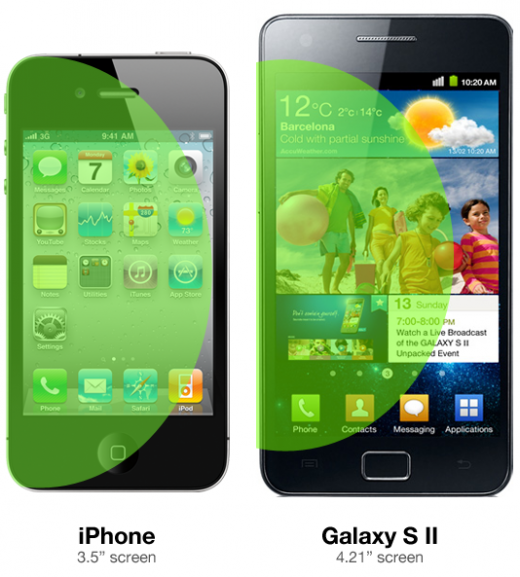
fourinches 520x577 Why the iPhones screen is 3.5 and will most likely never be bigger than 4To illustrate the point of the 'subtle inconvenience' I'll call upon an interesting article written by Matthew Panzarino on 'The Next Web'. He stated that designer Dustin Curtis had done a test in which he found that the disparate display sizes of both the iPhone 4 (3.5 inches) and the Galaxy S II (4.27 inches) made a genuine difference in terms of their usability and could perhaps pose a niggling issue for the Galaxy S II through time. He found that the display size of an iPhone 4 allowed every icon on its home screen to be reached with the thumb whilst holding the phone with one hand, whereas the limited thumb span proved too small to reach to the further edges of the display when using the Galaxy S II. To the left is a diagram that designer Dustin made to complement his contention.

Sure, you have to make a few sacrifices if you want the big and the better. That's how life and nature works right...a little give there and a little take there. But I don't think that's how it works for phones - because a smartphone is meant to materialise a vision for easy, portable computing. And traditionally a phones have blessed us with the advantage and accessibility of quick one-handed operation; the fact that phones have increased in brain size and processing power shouldn't compromise this one distinctive trait. Smartphones need to retain their one-handed usability and size because it's the only characteristic that preclude the smartphone and tablet from convergence. It's the only reason why they're still different things. Heck, if I could grab a tablet and hold it in one hand and use it with that one hand with ease I wouldn't need my phone, because my phone would just be a smaller and more eye-straining version of something I already have.

So I'm here looking at the new Galaxy Nexus and its 4.65 inch display, and I'm thinking to myself 'how big are your hands?' You might think I'm overreacting and these seemingly minor nitpicks are all in for the sake of a more spacious experience. But more than you think it's the insignificant things that leave an otherwise perfect product completely smitten - thumb hyper-extension and unnecessary two hand use are just a couple of those things. I use a 3.8 inch HTC Trophy daily and for me and my average sized hands that's just about the limit. Again, this is all completely subjective and for some of you this large screen size may suit your needs, and your hand-span, but strictly from my own personal vantage and I'm sure that of many others anything above 4 inch is a heck of a size, and anything larger than the Galaxy S II is really really pushing it.

Super size? Are you really lovin' it?

Tuesday, October 18, 2011

TECHGEEK.com.au - Design Talks - For the iPhone 4S critics

But it still looks the same...
Be sure to check out my article on TECHGEEK.com.au discussing the importance of product design and its applications to the somewhat ill-received and unexciting iPhone 4S. 

"Perhaps one of the most important lessons that Steve Jobs taught us in his tenure is that design is important. In fact, design is often more important than the very things inside that make the magic happen. That’s not to say that you’re better off having an aesthetically marvellous rock than a turd-shaped phone, but it’s saying that from a very very direct and impressionistic stand point, design talks to an audience much more than specs and inner hardware ever can..."

Thursday, October 6, 2011

Rest In Peace Steve Jobs - You Changed the World

title

There are people in this world that either love or hate Apple, and there are people in this world that either love or hate Steve Jobs, but I know that there is not a single person in this world who doesn't respect Steve Jobs for not only his achievements, but with what heart and passion that he has managed to achieve them. Jobs' is the embodiment, a personification of unparalleled genius. His incredible foresight and vision for seeing how products interweave into the very cobweb of our lives has made this place we live in a better place. With this genius, and creativity he has brought us products that have revolutionised markets, the technology industry and the way people live their lives. Without any connotations or mockery, to describe Steve Jobs' leadership as 'magical' is truly justified.

These are all in the making of what makes Steve Jobs so incredible, but without a doubt the greatest thing that Steve Jobs takes with him, is the simplest, the most obvious and the most primal of his traits - and that is his passion. To meet a man with such love, and such enthusiasm for the things he does is rare, and with this, Steve Jobs has inspired us to pursue our dreams not for secondary and reactionary means as finances and stature, but purely for the satisfaction close at heart - because it makes us happy. 

To put it in his own words - 'The only way to do great work is to love what you do. If you haven't found it yet, keep looking. Don't settle. As with all matters of the heart, you'll know when you find it.'

Steve Jobs story is almost a fairy tale of where passion and love can take us, and his love and passion augments and provides for the immeasurable genius and creativity that the man has been blessed with. We can all be happy knowing that Steve Jobs died doing what he loved the most. Even with his diagnosis of cancer several years back, Steve Jobs' love for Apple never waned, and he was there at Apple for as long as he could possibly be, with the baby he crafted and nurtured himself. And if getting fired from his own company came to prove anything, it was that Apple only truly has one father. 

So here we are, typing away on our Macbooks, slicing fruit on our iPhones and tapping away on our iPads - embracing ourselves in the magic that Steve Jobs has provided us. We're all saddened by the news of his passing, the world only ever gets one Steve Jobs and it's such a shame that the appreciation has only really been expressed openly once it's all gone. But Steve Jobs probably wouldn't have it any other way, loving our Apple products is our way of saying a subtle thanks, and thank you Steve Jobs so very much.

It feels strange imagining the tech industry without a Steve Jobs, but how much stranger and how much different would it be had he never even come around. So to quote the wise words of Dr. Seuss, 'Don't cry because it's over, smile because it happened'. And Mr. Jobs, the radiance of your innovation makes us all smile, every, single, day.

Friday, September 30, 2011

Sly social

Lawsuit Against Mark Zuckerberg. Mark Zuckerberg


Facebook's F8 event event and it's subsequent announcements marked a major turning point in social media. Mark Zuckerberg announced a slew of new features at the event which all put hands into one resounding theme - sharing. Netflix and Spotify integration are all about sharing our media and content, the new Facebook timeline is all about sharing our past, the new profile 'cover photo' is all about sharing a bit of who we are and new application permissions make it easier for third party apps to share some little things about ourselves. But what is it with Facebook's plain obsession with making us users share as much of our lives as possible, and why do we so contently oblige to such seemingly unhealthy amounts of transparency?

Myspace, before the rise of Facebook was insanely popular simply because it allowed us to take full control of our image on the internet. People didn't spend the time pimping up the Myspace profiles and adding the auto-playing song onto their page because it was fun, it was because it would contribute to the way that they wanted their friends to see them. Our Myspace spoke a lot about our character, and through the way we're inescapably wired, getting ourselves out there is very important to us. Ironically, social is a predominantly solipsistic medium that is driven almost purely by our self-obsession. As users, we are so blindly content with sharing every aspect of our social lives on Facebook because we feel the need to inform others of the kind of person we are because hey, we're important. Why do we people bother checking into places? We do it because its important that our friends know that we're not a hopeless low-life who leaves the house less than the trash can - and perhaps checking in at a library will help us build our character as an intellectual or checking in at a football stadium will help us build our character as 'the sports fanatic'.

Facebook is taking all the steps to make sure they foster and provide for this growing online culture of self-obsession; they're adding the features to make sharing and individualistic behaviour that much easier.  The announcement that apps will only be required to ask once before posting activities to our walls breaks down that fence that has so long separated the virtual technological world to the real organic world that we live in.

Let's take this fictitious, though entirely plausible scenario for an example - perhaps we're going for a run and there's an app on our smartphone that tracks and monitors our run with contextual metadata like calories burnt, distance and speed. This app connects to our Facebook and allows us to post this information on our walls to share with our friends. In the past, this would require a prompt in which the app asks us permission to do this, but now it only has to ask once, the very first time. Essentially, the things that happen in the real world become immediately synchronised with the virtual word of Facebook, in a sense making the service a deeply connected attachment to ourselves. Facebook now becomes a parallel and always up-to-date technological porting of our lives.

So, what's the significance of Facebook's timeline feature? The timeline feature simply augments and manifests upon the idea of 'the Facebook second life', because when utilised to its absolute fullest the timeline becomes practically our life story. We're currently living in an age where it's not ridiculous for a new-born baby to have a Facebook profile. Naturally, Mark Zuckerberg encourages this, particularly with the release of the new 'expected child' feature. However, it's not solely because Mark Zuckerberg wants to endlessly increase Facebook's user base, but it's because he wants to connect with the user base. He wants Facebook to connect to the user base in such a manner that deleting a Facebook profile would be almost equivalent to semi-suicide. By unethically, albeit cleverly taking advantage of clueless new-borns, Facebook is hoping to inaugurate a generation of Facebook users who will have timelines that really do begin with their lives. Imagine growing up as one of these infants and trying to delete your Facebook profile in 15 years time - an archive of your life story that you've had with you since the day you were born? Yes, it is semi-suicide.

By cleverly leveraging upon the idea of user self-obsession, Zuckerberg will have locked us users into his service in such a deep personal way that we can't ever quit. And what better time to force the loyalty of users than now, a time when Google+ appears genuinely threatening.

Sure, it's easy to say I won't get hooked on Facebook and I won't get trapped, but the simple fact is that most of us already are. How many of you could quickly and easily delete your Facebook profile and tell yourself honestly that this decision will be entirely regret-free? It's time to just stop and have a look at the direction Zuckerberg is leading us in social media, we can't allow ourselves to be turned into mindless zombies for transparency living an inescapable second life that we never even asked for.

Wednesday, September 21, 2011

As Windows 8 propels Post-PC


Not too long ago, Microsoft pulled the wraps off the developer preview of its next generation operating system. I say 'next generation' intentionally as opposed 'next' because Windows 8 truly does signify a revolution for not only Microsoft, but personal computing as a whole. With Microsoft's pre-beta release of Windows 8, I can say without hesitation that computing is without doubt driving head-on into the age of direct manipulation computing, or 'Post-PC' if you like.

Anybody who counts Microsoft out as being an influential figure for the next decade of computing would have to be incredibly short-sighted. Eric Schmidt pointed out earlier this year that he considered his gang of the four most influential consumer technology companies to be Google (naturally), Apple, Amazon and Facebook. Microsoft did not make it into his little clique. This itself would seem almost a mathematical impossibility when you account for Microsoft's market share in the PC arena and also a direct affront to the 'chain of command' given the many ways that Microsoft indirectly and directly affects the lives of people and companies around it. Sure, Microsoft doesn't have the strong-hold it had on multiple markets 5-10 years back, but heck, Microsoft has commanding, monopoly-enabling market share in PCs – and market share means power.

We've all seen Microsoft's success as an underdog, and their success has always coalesced with the idea of 'slow and steady wins the race'. And perhaps slow and steady manifests Microsoft itself as a corporation, an influential giant completely devoid of the agility of its start-up days. The world was sceptical about the Xbox when it launched, it took time to gain traction but Microsoft eventually broke through with the product and it is now the best-selling console in the United States. Windows Phone still sits at the bottom of the smartphone pack with a single digit market share to boast, but Microsoft are in no position to give up on Windows Phone (I'm glaring at you, HP). With Nokia paving multiple new pathways and opening new doors for the platform, there isn't much to justify the opinions of anyone who believes Windows Phone is going down. I can see why analysts are bullish on their prospects for the platform.

At that, there's no reason why we as the consumers shouldn't be bullish on Microsoft and its Windows 8 project either. By all intents and purposes if Microsoft decides to dump the Windows monicker in the same way that they dumped 'Windows Mobile' for 'Windows Phone' it would not be completely out of line. After all, the new OS does not look, or more importantly, feel like Windows at all. It's touch-friendly, it's intuitive, it's animated...it's fun. Microsoft made a big case for touch technology at its BUILD 2011 event, slanting heavily towards an ideology that touch is the future of computer interaction, and I agree wholeheartedly.

As we all are fully aware, Microsoft's approach to slates and tablets has always appeared as half-hearted, not bothering to put in the full effort to have an OS optimised for iPad-like devices with the belief that a powerful operating system could justify the poor ease of use. Consumer reception has likewise been half-hearted. Microsoft obviously overlooked the fact that the power factor of the full Windows experience is only sufficiently augmented with the presence of a keyboard and mouse. So when it comes to slates, looking at Windows 8, despite its often frustrating switches between interfaces it's relieving to see that Microsoft has managed to acknowledge the writing on the wall and subsequently put their heart in the right place.

I guess we can thank the iPad for its applications as an impetus for a stagnating PC market. I believe that people and innovators are the creators of their own fate - yeah I know it's corny and it's cliche, but it's true. The technology market, or automotive market or any market that thrives on innovation isn't and should not be bounded by the perceived limitations of eras or times. I get the feeling that people believe that things have to remain a certain way until a specific time comes that rings a bell for a revolution or an overthrow of the current. Perhaps a good example to illustrate this very point would be flexible display technology - we'd all love to see flexible displays right now and the prospects are exciting but there's always going to be the consensus that the concept is simply too far ahead of its time. I'm glad that Microsoft has shown the gut to propel the industry with a revolution in Windows 8, instead of yet another evolution of Windows 7 which would only vitiate the industry's implacable transition into touch and 'post-PC'.

Windows 8 is not a perfect operating system, it's far from perfect and will most likely take a generation or two to eradicate legacy requirements which are by far its biggest gripe. I'm not predicting that Windows 8 will sell like hot cakes, will be insanely successful or by all means, not be a Vista. The developer preview of Windows 8 though is purely representational of Microsoft's trajectory, and the most I can say is that Microsoft have pointed their unwieldy ship in the right direction. They have proven themselves in the past that they are more than capable of winning a game slow and steady and have proven their ability to successfully leverage their assets and integrate tightly their cobweb of products and services. As far as I can see, these are a few crucial underpinnings for imminent success.  

Monday, September 5, 2011

Categorising Samsung's Galaxy Note


No doubt, one of the most talked about unveilings at IFA is the Galaxy Note. A 5.3 inch Android 'device'. Categorising this device into smartphone or tablet is becoming an interesting dilemma - too big to be a mainstream smartphone, too small to be a tablet, and too advanced to fit into the PDA crowd. Hear me out as I provide my insights into what Samsung's Galaxy Note really is and what it means to us.

This year, I believe that the world of consumer technology has created and embraced what I see as the three musketeers of our computing lifestyles - PC, tablet and smartphone. All these devices augment the experiences of each other, and thus far none are capable of fully replacing one another. I couldn't possibly replace my phone with a tablet, and my tablet is simply not powerful enough nor practical enough to replace this laptop I'm typing on at this very moment. I think that one of the main things that holds back any of these devices from convergence or replacement of each other, is something that by its very nature simply cannot be fixed - its size. If people could comfortably fit an iPad, or even a Blackberry Playbook into their pockets and hold it to their ears during a phone call, people would very well do away with phones.

Unless you're the highly materialistic type like I who simply loves to bathe in collections of electronic devices, the lesser the number of devices that you have to deal with and manage is better. Hence the popularity of smartphones because they take on the purpose of a multitude of devices. All of this makes the unveiling of Samsung's potentially category pioneering Galaxy Note at IFA in Berlin all the more interesting. Cutting back from the trivial matters of detailed specifications, the Galaxy Note is a 5.3 inch 'device' with an incredible high resolution Super AMOLED display. As you can probably see from the image above of DJ Lee holding the Galaxy Note, the device is larger than Samsung's already large Galaxy S II smartphone but without looking entirely out of proportion. It's hard to believe that what is in his hands is a 5.3 inch display, which is certainly workable for a pocketable mobile workspace.

So, can this Galaxy Note succeed in converging tablet and smartphone for those who want to be burdened by less? It's certainly a compromise. Personally, the pockets of my jeans will only just hold a device of this size with a convincing shove. And then, it's not the greatest feeling (or look) walking around feeling a huge rectangle in my pocket pressing against my leg. On the other end of the spectrum, its size can also be considered to be too small. Even the Blackberry Playbook was criticised by many as being an inch or two below adequacy for a great web experience. Sure, the Note is great for the people who are willing to make the compromise to streamline their own device portfolio, but for the users looking for the best end to end experience, it's not going to happen here.

We can't look at the Galaxy Note and attempt to categorise the product simply based on its size. It comes with a stylus, which has been shunned by Apple but in actuality has some really useful practicalities. We've already seen such a stylus implementation in HTC's 7-inch Flyer tablet. The stylus was used to draw at a level of accuracy that fingers alone do not permit and also to highlight, circle and make notes on the screen at any time. The concept was great because it emulated the way we like to manipulate content in the traditional way of pen and paper and how we often highlight and underline things. The stylus of the Galaxy Note takes this idea and integrates the stylus deeper into the product as such allowing us to use the stylus to navigate the device as well instead of just drawing. From use cases demonstrated in the official promotional video we can really get a sense of the wide-ranging possibilities of the underrated technology of touch-pen input.

Perhaps, Samsung isn't looking at the convergence of the devices, but rather creating something...semi-new. It could be called a tabphone? Meh. Or perhaps a smartlet - that's cute. The point I'm trying to make is that I personally don't see this as a really really big smartphone for really really big people.

As the name suggests, the Galaxy Note is perfect for such use cases like note-taking which is something that is actually abominably hard on touch keyboards. It's funny how we often don't notice these little things that we want until someone shoves it into our faces. That's what Samsung have done here; taking notes on any touch screen keyboard of any size isn't a situation we dream of being in, let alone having to take such notes in speed. The stylus merges the benefits of both traditional handwriting and the digital capabilities of mobile devices - given the Galaxy Note is able to handle accuracy and speed simultaneously, we could have a really capable 'jotting down' PDA-like contraption with unprecedented versatility. The problem with pen and paper is that once you finish writing things down, that's really all you can do with it. For it to be digitised, the convoluted process of scanning must be endured, and even then the simple image file that it becomes is limited in its capabilities. The Galaxy Note can change this simply through its digital nature.

I know you're thinking that a stylus isn't a huge innovation, in fact it's really not an innovation at all as styli are considered by many as previous generation technology for when we didn't have effective capacitive touch displays with big meaty buttons for our big meaty fingers. But the stylus isn't dead and it was never dead, it's just that everyone is simply so engrossed in the smartphone spec war to embrace true innovation and forward thinking.

The Galaxy Note is certainly not for everyone, but for those who are blessed with large hands and don't often wear skinny jeans will probably love the practicalities that this 'little' contraption provides. Living with a tablet for a month (Blackberry Playbook), I can't imagine my life without one, it is honestly the most liberating feeling being able to take almost the whole quota of my digital lifestyle with me everywhere without being weighed down. With Galaxy Note, if one embraces what this device offers I'm sure it will eventually morph into an essential in much the same way.

So is the Samsung Galaxy Note the start of a new trend? The return of the PDA? To be frank, it's niche factor is too large for it to be embraced by other manufacturers. I still stand by my digital trio of smartphone, tablet and PC. The Galaxy Note probably won't be purchased on its merits as a note-taking device or a PDA if you like, but for anyone that has pockets capable of housing 5.3 inches of Super AMOLED goodness and is looking for a smartphone - meet 'smartlet'.