My 2 Cents on Google Search Plus Your World - on my Tumblr 'A Pony For President'.
Just some thoughts on the antitrust debate surrounding Google's new personalised search feature.
"I’m definitely one that is a fan of competition, count me in for that, but I also run under the belief that corporations who have worked hard to gain their position as a leader should be able to leverage their position in the industry. Google have worked hard to maintain their position as the number one search engine, they’ve earned their spot not through sly tactical means, but for the pure fact that they have a better product.
I believe that claims for anti-competitive behaviour by not including Twitter and Facebook in personalised search results are unfair to Google."

Showing posts with label Google. Show all posts
Showing posts with label Google. Show all posts
Sunday, January 15, 2012

Monday, November 21, 2011
The Social Factor

So, what is the social factor? The social factor is a collective term I like to use to describe a service or product that embraces active user engagement. User engagement not in the sense of poking and prodding said item physically, but personal engagement with a product and personal engagement between users. Thus, commenting and reviewing apps and music on iTunes can be coined as a product of the the social factor, communicating with Youtubers in a comment flame war is an element of the social factor and of course Twitter and Facebook among other social networks are examples of the social factor in its purest form - social networking.
The social realm has received a generous ignition recently, with the release of Google's own Google+ service as well as the revealing - not unveiling - of Microsoft's oddly named Socl service. It's a completely different landscape from not too long ago when the heavenly abode of social was occupied almost exclusively by Facebook and Twitter. Myspace was descending precipitously with the accolade of an also-ran.
Fast forward a few years, to now, and for the most part the social realm paints a fairly similar picture when looking at the colours of the raw hard numbers. Facebook dominates the social networking space with upwards of 800 million active users, and Twitter with a user base of more than 100 million still trumps that of a fast growing Google+. That's all not to mention actual user engagement, an aspect that Google+ has struggled to maintain following the pre-release hype.
Numbers don't count for everything though, and despite Facebook's considerable lead, Google+ isn't out of the game, and Microsoft Socl isn't dead on arrival. Far from it.
The term social networking is a particularly deceitful monicker given the image that most people have of what a social network is. To most people, a social network is simply what Facebook is - a platform for interacting with friends, and sharing content with friends. At that, Facebook's greatest value proposition isn't in the service itself, but the users that inhabit it. In such a business where the most effective way to get users, is to have users, anyone attempting to beat Facebook at its own games playing by the same rules will end up with a slap on the face and a disheartening, unsurprising disappointment.
Google+ and Microsoft Socl are both great platforms by their very own merits, they're not trying to be Facebook killers, and if they were, then they would quite literally be throwing an untrained army of 50 million against a heavily armed pack of 800 million. It's not possible. It will never work. It will never happen. Let's talk about Google+, and what this element of social plays for Google.
Jolie O'Dell of Venturebeat published a comprehensive article recounting Google's Bradley Horowitz's views on their very own 'social network', Google+. Initially, I assumed his general carefree aura on the, I wouldn't say failure, but perhaps under-performance, of Google+ could be none more than the typical cavalier executive talk. But, Horowitz revealed a vision for Google+ that not only negated my impulse expectations, but his trajectory for the Google+ was elegant and clever, bringing to light that the social factor has implications far beyond the superficiality of people interaction.
Google+ is all about an online identity, an online persona that we have - a virtual porting of our real selves. When you're able to put yourself into the products and services that you use, the seeming triviality of technology is put into perspective and given context. It transforms technologies that are passive, into an actively intricate emulation of our real social communications and inner selves. Essentially, even if social interactions form the core of what constitutes social networking and the social factor, it's greater purpose is to make technology that much more personal.
You see, it's basic human nature that we hold much more sentimental value to the things that are closest to our hearts. For most non-cyborg human beings, the 'things' that we are most emotionally attached to are the people around us, our friends, our family, our boyfriends, our girlfriends. Sure I'd cry if I dropped my phone off the balcony but I'd cry a heck of a lot harder if my mom died. I have a mate who was driving himself half bonkers because he misplaced a pen his girlfriend had given him despite that fact that there were many smoother and inkier pens lying around.
Taking into account this hierarchy of sentimental importance, it makes sense to integrate our personal lives into our products because it allows for a much greater degree of emotional attachment - a sly, but clever tactic to keep consumers loyal.
Microsoft Socl in many ways aims to pursue this same vision of a more personal technology, however aims to add more practical benefits to this.
I, as many are am a little spacey on the tid-bits and details of Microsoft's 'maybe not even coming into market' social network, after all, the only half-decent look we've had at it was when The Verge was granted some much appreciated hands on time. The interface design is fairly standard, calling upon the three column layout shared by Facebook and Google+. And Microsoft were not very creative with the colour scheme either with an eerily similar blue to that of Facebook's, though with a slightly lighter and perhaps more pleasant tinge.
A stand out feature though was something dubbed 'social search'. No, it's far from a revelation, but it shows what social is capable of, and why social is so important to completing a product ecosystem. Social search simply allows your friends to see the queries that you throw at search engines, with the hope that they'll be able to chip in too.
As experience should teach us, it's much easier to extract information out of knowledgeable humans than a knowledgeable website. Hence why we have teachers in classrooms as opposed to a Google homepage. With social search, a Microsoft Bing search has potential to provide better results than a Google search.
What's more, for Microsoft, social search finally allows them to put that tortured little Bing to good use, and as a moral boost, Microsoft can finally start telling people that their foray into search wasn't completely absent of fruits. Microsoft have reiterated that search is an important field that they needed to be involved in, and social search certainly does give it something to show for - a fully integrated Microsoft experience. Without Google. And social search gives Microsoft's Bing a reason to be, because currently, aside from the flashy backdrop of good photography - which, let's be honest is only remotely interesting for those who don't know what they're searching for before they arrive at Bing - Google's a better bet anyway.
The social factor is inarguably invaluable in providing a good ecosystem. Apple tried and failed with iTunes Ping, which demonstrates that even Apple is aware of the capabilities that the emotional and personal attachments of social can have on a consumer.
Aside from providing an online identity as Google+ aims to provide, Google+ unifies Google's too-many-laned highway of products into a flowing single vertical. By having a basic identity tied into all that Google provides, it allows the consumer to act as an umbrella over all the Google services they use and leaves them less chance to drop one, forgotten in the rain. It gives the user more control. Furthermore, Socl social search exemplifies the single greatest thing about the social factor by allowing a company to tap into their single greatest asset - the users themselves.
Fast forward a few years, to now, and for the most part the social realm paints a fairly similar picture when looking at the colours of the raw hard numbers. Facebook dominates the social networking space with upwards of 800 million active users, and Twitter with a user base of more than 100 million still trumps that of a fast growing Google+. That's all not to mention actual user engagement, an aspect that Google+ has struggled to maintain following the pre-release hype.
Numbers don't count for everything though, and despite Facebook's considerable lead, Google+ isn't out of the game, and Microsoft Socl isn't dead on arrival. Far from it.
The term social networking is a particularly deceitful monicker given the image that most people have of what a social network is. To most people, a social network is simply what Facebook is - a platform for interacting with friends, and sharing content with friends. At that, Facebook's greatest value proposition isn't in the service itself, but the users that inhabit it. In such a business where the most effective way to get users, is to have users, anyone attempting to beat Facebook at its own games playing by the same rules will end up with a slap on the face and a disheartening, unsurprising disappointment.
Google+ and Microsoft Socl are both great platforms by their very own merits, they're not trying to be Facebook killers, and if they were, then they would quite literally be throwing an untrained army of 50 million against a heavily armed pack of 800 million. It's not possible. It will never work. It will never happen. Let's talk about Google+, and what this element of social plays for Google.
Jolie O'Dell of Venturebeat published a comprehensive article recounting Google's Bradley Horowitz's views on their very own 'social network', Google+. Initially, I assumed his general carefree aura on the, I wouldn't say failure, but perhaps under-performance, of Google+ could be none more than the typical cavalier executive talk. But, Horowitz revealed a vision for Google+ that not only negated my impulse expectations, but his trajectory for the Google+ was elegant and clever, bringing to light that the social factor has implications far beyond the superficiality of people interaction.
Google+ is all about an online identity, an online persona that we have - a virtual porting of our real selves. When you're able to put yourself into the products and services that you use, the seeming triviality of technology is put into perspective and given context. It transforms technologies that are passive, into an actively intricate emulation of our real social communications and inner selves. Essentially, even if social interactions form the core of what constitutes social networking and the social factor, it's greater purpose is to make technology that much more personal.
You see, it's basic human nature that we hold much more sentimental value to the things that are closest to our hearts. For most non-cyborg human beings, the 'things' that we are most emotionally attached to are the people around us, our friends, our family, our boyfriends, our girlfriends. Sure I'd cry if I dropped my phone off the balcony but I'd cry a heck of a lot harder if my mom died. I have a mate who was driving himself half bonkers because he misplaced a pen his girlfriend had given him despite that fact that there were many smoother and inkier pens lying around.
Taking into account this hierarchy of sentimental importance, it makes sense to integrate our personal lives into our products because it allows for a much greater degree of emotional attachment - a sly, but clever tactic to keep consumers loyal.
Microsoft Socl in many ways aims to pursue this same vision of a more personal technology, however aims to add more practical benefits to this.
I, as many are am a little spacey on the tid-bits and details of Microsoft's 'maybe not even coming into market' social network, after all, the only half-decent look we've had at it was when The Verge was granted some much appreciated hands on time. The interface design is fairly standard, calling upon the three column layout shared by Facebook and Google+. And Microsoft were not very creative with the colour scheme either with an eerily similar blue to that of Facebook's, though with a slightly lighter and perhaps more pleasant tinge.
A stand out feature though was something dubbed 'social search'. No, it's far from a revelation, but it shows what social is capable of, and why social is so important to completing a product ecosystem. Social search simply allows your friends to see the queries that you throw at search engines, with the hope that they'll be able to chip in too.
As experience should teach us, it's much easier to extract information out of knowledgeable humans than a knowledgeable website. Hence why we have teachers in classrooms as opposed to a Google homepage. With social search, a Microsoft Bing search has potential to provide better results than a Google search.
The social factor is inarguably invaluable in providing a good ecosystem. Apple tried and failed with iTunes Ping, which demonstrates that even Apple is aware of the capabilities that the emotional and personal attachments of social can have on a consumer.
Aside from providing an online identity as Google+ aims to provide, Google+ unifies Google's too-many-laned highway of products into a flowing single vertical. By having a basic identity tied into all that Google provides, it allows the consumer to act as an umbrella over all the Google services they use and leaves them less chance to drop one, forgotten in the rain. It gives the user more control. Furthermore, Socl social search exemplifies the single greatest thing about the social factor by allowing a company to tap into their single greatest asset - the users themselves.
Thursday, November 10, 2011
How to win in television

As a backdrop to the all too common mobile device war, TVs are starting to capture the attention of technology enthusiasts with the rumours of an Apple television set possibly appearing sometime in 2013. The recently unveiled biography of Steve Jobs has revealed a vague trajectory of Apple's plans in an entrance to the television market. In the meantime, Sony warned investors a fortnight ago of an imminent 2.2 billion dollar loss on its bleeding television business, making it the fourth consecutive year in which Sony's television division has remained unprofitable.
There's a powerful demarcation to be made here - why would investors and pundits be potentially excited over the notion of Apple television when Sony, a long time and trusted manufacturer in this business isn't even capable of hauling in a profit themselves? Most of us, would have never pictured Apple building their very own in house television set, the Apple TV always looked about as far as they would be willing to dip their toes into the deep television pond. The deep television pond infested by manufacturers willing to reap the slimmest margins to undercut competitors.
You see, that's the biggest problem with the television business for Apple, and even Sony, - it's heavily commoditised and highly competitive. With its vast manufacturing scale and supply chains, Samsung is more capable than most other manufacturers of profiting from television, and even their performance remains modest at best.
You see, that's the biggest problem with the television business for Apple, and even Sony, - it's heavily commoditised and highly competitive. With its vast manufacturing scale and supply chains, Samsung is more capable than most other manufacturers of profiting from television, and even their performance remains modest at best.
Apple as a newcomer to the competition couldn't possibly expect to be able to develop in-house and manufacture quality televisions at the same scale as Samsung or even Sony and be able to deliver an affordable product to the end consumer. On the flip side of the coin, if Apple were to outsource production and buy flat panels from existing manufacturers - like Samsung - then they wouldn't exactly be innovating with their product would they, which by all accounts would most likely oppose Apple's ethic entirely.
Television is a business where it's very hard to differentiate or maintain an exclusive, Sony's Phil Molyneux even criticised the nature of television labelling this monotonous line of similar products as the 'sea of sameness'. Given product differentiation is so difficult to achieve, price differentiation is the only remaining resort, turning television into the bleeding, painful and low margin business that it is today.
Television is a business where it's very hard to differentiate or maintain an exclusive, Sony's Phil Molyneux even criticised the nature of television labelling this monotonous line of similar products as the 'sea of sameness'. Given product differentiation is so difficult to achieve, price differentiation is the only remaining resort, turning television into the bleeding, painful and low margin business that it is today.
Apple doesn't like playing the game that way. Historically speaking, Apple enjoys exclusivity around their products - a business model that doesn't always equate to leading market share, but always pulls in a huge profit, brand loyalty and evidently a glorious stock price. A sweeping dichotomy from conformist television manufacturers. So how do you work around this? How can you win in a business when it's hard to even break even?
First off it's important to evaluate the importance of television in an overall vision, or perhaps more importantly, the role of television in the the direction of the technology industry as a whole. It's fair to say that the whole industry is leading towards an almost universally pursued four screen strategy involving smartphones, tablets, personal computers and of course the television.
When Google and Apple begin hinting at entrances into certain markets, you know things are about to get real, and for television, Google's already waddling in the water albeit with a little uncertainty and we're expecting Apple to take a fully committed chunky dunk. Apple revolutionised the music industry with its ubiquitous iPod. Apple almost single-handedly crafted the modern smartphone, and Google made it big. Apple created and revolutionised a practically non-existent tablet market and Google made sure there was a little more variety to suit everyone. There's no reason that in their monstrous tandem, these two will be able to revolutionise the plateauing television business as well.
Consumers aren't going to be prepared to pay anymore than they are already for a television, especially given the state of the economy. Even if manufacturers gathered to form a pact that ensures a handsome profit for every unit sold, consumers wouldn't buy, even if they had no choice. Televisions are costly, low replacement devices, so consumers typically only replace televisions when they really need to. And a steep price increase for already rather steeply priced televisions would only push consumers to eBay and second hand items. To pursue this current business model in selling televisions as passive displays is not a feasible model, it never was, but now, we have better options.
The analogue age was a time when devices could thrive even when operating on a shallow and superficial microcosmic level. Devices were sold on the merits of their hardware capabilities, the quality of its parts and its physical design, as opposed to its potential for customisation and expansion. That analogue era, was long ago, but for the most part, television is still there - with picture quality and hardware quality still very much on the priority list for TV buyers. To win in television, we must relay our focus completely from commoditised hardware and aim to sell on the merits of potential expansion, integration, connectivity and content. Aim to emulate Amazon's business model for the Kindle Fire tablet - make a small loss or just break even on the hardware, and aim to cover that cost in packaging good software and selling content.
Google TV was initially poised to be the redefining of television but I think it's fair to say that we all misjudged, or more suitably, over-judged it's potential. Logitech's CEO went so far to state that the company had made 'a mistake of implementation of a gigantic nature', and the company had no plans to release a second generation Revue set top box. Sony hasn't achieved much success with their Google TV either.
Google TV never took off and still hasn't largely because it simply doesn't offer anything exclusive in the way of content, it contains Netflix and Pandora among other video and music subscription services but these services are all accessible through other mediums. And with all these content services being provided by third parties, once again we're not making much money on selling content and therefore unable to afford reaping negative or neutral margins on TV units.
But securing profits directly from selling content isn't the key, because most of the revenue is inevitably turned over in royalties to the content owners. In fact, the most popular online music store, iTunes, earned $1.9 billion dollars in revenue in 2007 according to Ed Christman, the retail columnist for the Billboard. However, taking into account royalties and operational expenses, Apple took away less than $400 million on its music store that year. Google recently sent out invitations to a Los Angeles event on November 16 which appears to be hinting at a music store, if Google has indeed struck a deal with the major labels I'll be damned if they're going to make as much dough per song purchase as Apple's iTunes store.
The idea though, in operating content stores is to provide a little extra change to allow for more flexibility when pricing television sets, after all, you can expect to subsidise at least some of the losses on unit sales with profits from content stores. Additionally, content stores that integrate well within an established ecosystem are just another incentive for consumers to want in - a core reason why Google TV has failed to catch on. Google currently has no music or video store and therefore no genuine reason for Android users to invest further in Google's ecosystem; adding insult to injury, the assortment of Google's cloud services like Docs, Gmail and Reader have no meaningful integration in Google TV.
The Google TV saga also serves to teach us that evidently, it's not enough to simply throw in some apps, integrate subscription services and allow native Youtube and web browser access to 'revolutionise' television. That's not enough because a consumer savvy enough to even adopt a young platform in Google TV would most likely be in possession of a tablet; and why compromise the display real estate of the television when you could be web browsing, Facebook-ing and Twitter-ing right from your tablet while watching TV. Essentially, the additions Google TV provides are more novel than genuinely useful.
You see, if Apple had simply thrown in a well-performing web browser, some fun apps and deep music store integration into a basic Blackberry form factor, would Apple still have revolutionised entirely the smartphone industry? No, not at all. Not even a little bit. So it's no surprise that Google hasn't done so with the television.
Apple revolutionised the smartphone because they changed the way we interacted with and used our phones. Apple turned scrolling into flicking, and pushing into pinching. Google on the flip side has only added quasi-useful functionality to television and we're still stuck with the same basic interface model of remote controls and navigational D-pads. Apple is now poised on the precipice of perhaps another revolution, and now couldn't possibly be a more timely hour for Apple given they've created a potentially revolutionary new way to interact with our devices, Siri. Siri, the voice interaction engine more human than anything we've seen before. Or heard before. If Steve Jobs' message to his biographer - 'I finally cracked it' a TV that is 'completely easy to use' - is anything to go by, then Siri is an almost certain implementation.
A lot of the time, it's not alterations in what we use a device for that cause excitement, but how we use it that strikes a certain spark in our fickle emotions. Take the Playstation Move and Xbox Kinect as a classic example, serving the same purpose but in two completely different ways. Sales figures can speak for this story. Siri can be our new remote control, and even then, it could probably do so much more.
We're standing on the very edge, the dividing line, the stepping stone to a new generation of television. And if any company believes that right now is a good time to depart the painful television business, then, well, bad move. Television is a crucial element in the completion of our technological circle, we'll always have living rooms - and to simply exit the business soully because of non-profitability is a little short sighted.
Previously, in the analogue age where products were sold largely on the merits of themselves, as opposed to their integration with other devices, television would have been a poor business. But today, television isn't heading towards being a lucrative business that rakes in an abundance of dough, but rather a crucial business which provides a little chump change. The rise of the 'ecosystem' and cross device integration has allowed for the creation of the 'prison', though more often than not this prison is one that we, as consumers voluntarily move into. Locking consumers in is priceless for those corporations hoping to capitalise on their existing user base, and of course, force loyalty from the consumer.
Apple TV was never enough for Apple because it's simply not enough to add your ecosystem to a television set when you're merely a 'connection' as opposed to the real deal.
This is why I am almost certain that Apple will make a television set, one which has unsurpassed integration with Apple's ecosystem as its highest value proposition. Because a great ecosystem and great software is the only viable path in an industry infested with competitors who are inevitably capable of making better hardware and selling it for less.
Having said that, Apple's not going to be reaping huge profits on television, in fact, television for Apple may very well end up being a loss leader. Apple will probably sell a television set at an enticing price point coupled with revolutionary interaction models (Siri), invoking an almost impulse purchase and naturally building a large user base for Apple's televisions. Sure, they've lost money on selling the television sets at such a price but they can subsidise that loss partially with content sales on the device, via iTunes. To place the cherry on the cake, one more Apple product in the hands of consumers, is just one more reason to invest further and deeper into Apple's ecosystem, equating essentially to subsequent profits from selling more iPods, iPhones, iPads and Macs.
It's a plan for the long term, and that's how you win in television.
First off it's important to evaluate the importance of television in an overall vision, or perhaps more importantly, the role of television in the the direction of the technology industry as a whole. It's fair to say that the whole industry is leading towards an almost universally pursued four screen strategy involving smartphones, tablets, personal computers and of course the television.
When Google and Apple begin hinting at entrances into certain markets, you know things are about to get real, and for television, Google's already waddling in the water albeit with a little uncertainty and we're expecting Apple to take a fully committed chunky dunk. Apple revolutionised the music industry with its ubiquitous iPod. Apple almost single-handedly crafted the modern smartphone, and Google made it big. Apple created and revolutionised a practically non-existent tablet market and Google made sure there was a little more variety to suit everyone. There's no reason that in their monstrous tandem, these two will be able to revolutionise the plateauing television business as well.
Consumers aren't going to be prepared to pay anymore than they are already for a television, especially given the state of the economy. Even if manufacturers gathered to form a pact that ensures a handsome profit for every unit sold, consumers wouldn't buy, even if they had no choice. Televisions are costly, low replacement devices, so consumers typically only replace televisions when they really need to. And a steep price increase for already rather steeply priced televisions would only push consumers to eBay and second hand items. To pursue this current business model in selling televisions as passive displays is not a feasible model, it never was, but now, we have better options.
The analogue age was a time when devices could thrive even when operating on a shallow and superficial microcosmic level. Devices were sold on the merits of their hardware capabilities, the quality of its parts and its physical design, as opposed to its potential for customisation and expansion. That analogue era, was long ago, but for the most part, television is still there - with picture quality and hardware quality still very much on the priority list for TV buyers. To win in television, we must relay our focus completely from commoditised hardware and aim to sell on the merits of potential expansion, integration, connectivity and content. Aim to emulate Amazon's business model for the Kindle Fire tablet - make a small loss or just break even on the hardware, and aim to cover that cost in packaging good software and selling content.
Google TV was initially poised to be the redefining of television but I think it's fair to say that we all misjudged, or more suitably, over-judged it's potential. Logitech's CEO went so far to state that the company had made 'a mistake of implementation of a gigantic nature', and the company had no plans to release a second generation Revue set top box. Sony hasn't achieved much success with their Google TV either.
Google TV never took off and still hasn't largely because it simply doesn't offer anything exclusive in the way of content, it contains Netflix and Pandora among other video and music subscription services but these services are all accessible through other mediums. And with all these content services being provided by third parties, once again we're not making much money on selling content and therefore unable to afford reaping negative or neutral margins on TV units.
But securing profits directly from selling content isn't the key, because most of the revenue is inevitably turned over in royalties to the content owners. In fact, the most popular online music store, iTunes, earned $1.9 billion dollars in revenue in 2007 according to Ed Christman, the retail columnist for the Billboard. However, taking into account royalties and operational expenses, Apple took away less than $400 million on its music store that year. Google recently sent out invitations to a Los Angeles event on November 16 which appears to be hinting at a music store, if Google has indeed struck a deal with the major labels I'll be damned if they're going to make as much dough per song purchase as Apple's iTunes store.
The idea though, in operating content stores is to provide a little extra change to allow for more flexibility when pricing television sets, after all, you can expect to subsidise at least some of the losses on unit sales with profits from content stores. Additionally, content stores that integrate well within an established ecosystem are just another incentive for consumers to want in - a core reason why Google TV has failed to catch on. Google currently has no music or video store and therefore no genuine reason for Android users to invest further in Google's ecosystem; adding insult to injury, the assortment of Google's cloud services like Docs, Gmail and Reader have no meaningful integration in Google TV.
The Google TV saga also serves to teach us that evidently, it's not enough to simply throw in some apps, integrate subscription services and allow native Youtube and web browser access to 'revolutionise' television. That's not enough because a consumer savvy enough to even adopt a young platform in Google TV would most likely be in possession of a tablet; and why compromise the display real estate of the television when you could be web browsing, Facebook-ing and Twitter-ing right from your tablet while watching TV. Essentially, the additions Google TV provides are more novel than genuinely useful.
You see, if Apple had simply thrown in a well-performing web browser, some fun apps and deep music store integration into a basic Blackberry form factor, would Apple still have revolutionised entirely the smartphone industry? No, not at all. Not even a little bit. So it's no surprise that Google hasn't done so with the television.
Apple revolutionised the smartphone because they changed the way we interacted with and used our phones. Apple turned scrolling into flicking, and pushing into pinching. Google on the flip side has only added quasi-useful functionality to television and we're still stuck with the same basic interface model of remote controls and navigational D-pads. Apple is now poised on the precipice of perhaps another revolution, and now couldn't possibly be a more timely hour for Apple given they've created a potentially revolutionary new way to interact with our devices, Siri. Siri, the voice interaction engine more human than anything we've seen before. Or heard before. If Steve Jobs' message to his biographer - 'I finally cracked it' a TV that is 'completely easy to use' - is anything to go by, then Siri is an almost certain implementation.
A lot of the time, it's not alterations in what we use a device for that cause excitement, but how we use it that strikes a certain spark in our fickle emotions. Take the Playstation Move and Xbox Kinect as a classic example, serving the same purpose but in two completely different ways. Sales figures can speak for this story. Siri can be our new remote control, and even then, it could probably do so much more.
We're standing on the very edge, the dividing line, the stepping stone to a new generation of television. And if any company believes that right now is a good time to depart the painful television business, then, well, bad move. Television is a crucial element in the completion of our technological circle, we'll always have living rooms - and to simply exit the business soully because of non-profitability is a little short sighted.
Previously, in the analogue age where products were sold largely on the merits of themselves, as opposed to their integration with other devices, television would have been a poor business. But today, television isn't heading towards being a lucrative business that rakes in an abundance of dough, but rather a crucial business which provides a little chump change. The rise of the 'ecosystem' and cross device integration has allowed for the creation of the 'prison', though more often than not this prison is one that we, as consumers voluntarily move into. Locking consumers in is priceless for those corporations hoping to capitalise on their existing user base, and of course, force loyalty from the consumer.
Apple TV was never enough for Apple because it's simply not enough to add your ecosystem to a television set when you're merely a 'connection' as opposed to the real deal.
This is why I am almost certain that Apple will make a television set, one which has unsurpassed integration with Apple's ecosystem as its highest value proposition. Because a great ecosystem and great software is the only viable path in an industry infested with competitors who are inevitably capable of making better hardware and selling it for less.
Having said that, Apple's not going to be reaping huge profits on television, in fact, television for Apple may very well end up being a loss leader. Apple will probably sell a television set at an enticing price point coupled with revolutionary interaction models (Siri), invoking an almost impulse purchase and naturally building a large user base for Apple's televisions. Sure, they've lost money on selling the television sets at such a price but they can subsidise that loss partially with content sales on the device, via iTunes. To place the cherry on the cake, one more Apple product in the hands of consumers, is just one more reason to invest further and deeper into Apple's ecosystem, equating essentially to subsequent profits from selling more iPods, iPhones, iPads and Macs.
It's a plan for the long term, and that's how you win in television.
Friday, July 22, 2011
Facebook - Stop changing, start improving

I'm the kind of guy that embraces change. I believe it's safe for me to say that I'm an early adopter of new technology, I love the excitement. What Facebook is doing isn't change for the better, but change for the sake of it, and nobody likes alterations in things they're accustomed to when it doesn't bring anything of notable value to the table. The first time that a so called improvement really bugged me was when Facebook decided to combine arbitrary matters like my friends 'likes' with the all-important status updates and wallposts in the news feeds. The term 'news feeds' immediately became redundant because it was no longer a stream of my friends connections but a water slide of spam and junk. Scavenging for the social networking aspects amidst all of the 'likes' was parallel to finding a needle in a haystack. Little did I know, this very event augured a landslide of alterations and tweakings in Facebook of use to bloody no one. Suddenly, a glance at the Facebook interface doesn't quite give you a clear picture as to what the service is. Underneath all of the scum, 'social' seems to have become an afterthought.
The simple fact is nobody really cares what pages someone likes, and I don't personally care who changes their profile pictures or who becomes friends with who. I admit, some of the like pages are pretty funny, but there's the burning question of why. Why do we have these like pages? We get a brief laugh, and then when we realise that we can relate them to our life we give them a like, and then someone else sees that we liked it and then they like it. It's a cyclical process with no higher destination. The only person that wins is the page owner who gets the satisfaction of seeing his stats fly. Personally, I don't like these 'like' pages anymore because I know that the only cause I'll be serving is spamming someone else's news feeds, and nobody wants that. Sure, I can hit 'top news' and filter my news feeds to a collection of popular statuses and wall posts, but it doesn't provide me with recent content, just popular content. Why won't Facebook just give us a function that allows us to filter out the spam? Why won't Facebook fulfil the desires of people like me, who want to use Facebook for what it was meant to be - sharing with friends instead of inadvertently sharing junk.
This Facebook rant wouldn't be complete without the glaring topic of the dislike button. The haunting dream of every single user, that Facebook simply refuses to acknowledge. Why? Because they don't have to. There could be issues of cyber-bullying revolving around disliking, but really, what has this world turned to? Expressing disapproval for a topic, thought or event is not hurtful or harrassing, and if you think it is, then you shouldn't be on Facebook because swear words which run rampant in 'like' pages and comments are far worse than simply saying no. By not providing users with a dislike button, Facebook are breeding a culture where its expected to simply say yes and accept, and they're closing the door on another means of expressing ourselves which is the central point of what a social network is meant to be.
Facebook's behaviour seems like a public but subtle display of arrogance. Facebook knows that we are trapped in their service because in social we can only go where our friends go. I get the feeling that we, the users are nothing more than just subjects for experimentation, Facebook makes a change and they observe how we react. But we're ultimately powerless. The users want a new feature, but Facebook doesn't deliver because heck, they don't have to. We have no viable alternatives to shift to, and if there were alternatives it would take monumental leadership to move a whole friendship community to an entirely new service.
 |
| Even Gizmodo knows that the new chat is a complete abomination |
Finally, there are the little tweaks too, that aren't necessarily game-changingly bad but vitiate needlessly the experience and familiarity users have with the interface. The more salient of such offences was when Facebook decided to make the font of the whole interface just a hair smaller. I thought there was some issue with my display resolution or the zoom of the webpage but it was just Facebook, being, well, Facebook. We've all adapted to the font size now but the change was never necessary in the first place and hasn't added anything to the service. It's a perfect example of the restless engineer bored of seeing stats fly.
If Google+ is here to prove anything, then it's the fact that Facebook is doing it all wrong. They're spamming our news feeds, annoying the users and just not being social enough. Let's hope that Google+ will act as an impetus for improvement for Facebook, because these last two years have just been one major digression, changing this and changing that to create the illusion of progress and improvement where we're really not moving anywhere. All I'm requesting of Facebook isn't anything new, more importantly, it's back to the old.
Monday, July 11, 2011
Breaking down LG's smartphone troubles

There are hundreds of Android phones on the market right now, and no reasonable person would question why. After all, who wouldn't take a smartphone platform connected with services by the most important internet company in the world, surrounded by an immense ecosystem of apps if it was handed to them for free? LG's one of these 'people' who have chosen to adopt Android to launch themselves into the smartphone world. However the adoption of Android has seen LG fall victim to what I like to call: Androiditis. The issue of Androiditis is a simple one, you have a really good platform on your phone, with great services, plenty of apps, but everyone else is just as good as you. It's like being prime minister in a room full of presidents. All of LG's competitors who have joined the Android party have access to the same apps and to the same services. Essentially, if you have exactly the same software as your competitors then you're not really competing in that respect anymore are you?
Which brings LG down to its biggest issue, LG's inability to produce decent hardware. I'm yet to see an LG smartphone that has legitimately impressed me. When I walk into a phone shop and have a play around with an LG, nothing strikes me as being awesome or worth noting. Their phones have been receiving lackluster reviews not because they're bad phones per se, but because they're simply not better than their competitors and have nothing of value to distinguish themselves in an Android crowd chock-a-block with 'me toos' and 'pick me's'. There's also something to say about LG's apparently low standards in regards to hardware design. There was a billboard at a bus stop in Melbourne I saw that showed an attractive model holding an LG Optimus 2X in typical ad-like fashion with a tag line boasting the device's svelte hardware design. But, in contrast we see the Samsung Galaxy S II with its absolutely astonishingly, timeless and in my opinion, better hardware design which isn't even being advertised as a fashionable phone as such.
Design is a topic that's subjective, many people will say that LG's current smartphones are relatively pleasing to the eye. I'm not going to counter that, but I think it's right to say that LG has certainly lost some of its design flares from back in the days of the Chocolate and the Prada. To say the least, LG phones had a design that was not only attractive, but unique. Heck, the Chocolate BL40 (main image) still remains in my opinion the most attractive cellphone ever made. Full stop. It was beautiful, and unique. And I think that word is the key representation of where LG has lost touch.
LG needs something unique to separate themselves from the shadow of generic Android manufacturers. Samsung and HTC are undoubtedly the two most successful Android manufacturers because that's exactly what they have, something unique. It feels weird to be saying this since due to my own personal idiosyncrasies I hate Samsung, but Samsung have amongst the best smartphone hardware around. It's not just the design of their devices, but the succulent quality of their displays, particularly the Super AMOLED ones. HTC likewise have set themselves apart with their distinctive Sense UI, which is a hybrid of beauty and brains. Many manufacturers skin their Android handsets with the hope of giving them a distinctive look and feel, but none are more effective than Sense UI. When you use Sense, you just know that you're holding an HTC. Sometimes it's just that simple...you just know.
Despite having a design that it quite uniform across LG's smartphones, it's not unmistakeably LG in the same way that slim, blocky, rectangular designs are unmistakeably Samsung, and the distinctly shaped silver navigation buttons below Sony Ericsson phones just scream Sony Ericsson.
LG simply needs to find out where they belong, and create products that cater for their vision. Right now, bland hardware design and non-unique software aren't giving LG any legs to run away from the congested Android crowd. For a well-established brand like LG they need to do better than simply being another option for consumers. How about being the option? Everything aside, LG isn't in big trouble, no matter how far their sales fall they're still essentially on the same playing field as their Android competitors, they're sharing an ecosystem that others are assisting to maintain. They don't have an ecosystem to defend. That's the advantage of Android, LG need to capitalise by creating beautiful and unique hardware that I know they're capable of. It's time to make Life Good again.
Which brings LG down to its biggest issue, LG's inability to produce decent hardware. I'm yet to see an LG smartphone that has legitimately impressed me. When I walk into a phone shop and have a play around with an LG, nothing strikes me as being awesome or worth noting. Their phones have been receiving lackluster reviews not because they're bad phones per se, but because they're simply not better than their competitors and have nothing of value to distinguish themselves in an Android crowd chock-a-block with 'me toos' and 'pick me's'. There's also something to say about LG's apparently low standards in regards to hardware design. There was a billboard at a bus stop in Melbourne I saw that showed an attractive model holding an LG Optimus 2X in typical ad-like fashion with a tag line boasting the device's svelte hardware design. But, in contrast we see the Samsung Galaxy S II with its absolutely astonishingly, timeless and in my opinion, better hardware design which isn't even being advertised as a fashionable phone as such.
Design is a topic that's subjective, many people will say that LG's current smartphones are relatively pleasing to the eye. I'm not going to counter that, but I think it's right to say that LG has certainly lost some of its design flares from back in the days of the Chocolate and the Prada. To say the least, LG phones had a design that was not only attractive, but unique. Heck, the Chocolate BL40 (main image) still remains in my opinion the most attractive cellphone ever made. Full stop. It was beautiful, and unique. And I think that word is the key representation of where LG has lost touch.
LG needs something unique to separate themselves from the shadow of generic Android manufacturers. Samsung and HTC are undoubtedly the two most successful Android manufacturers because that's exactly what they have, something unique. It feels weird to be saying this since due to my own personal idiosyncrasies I hate Samsung, but Samsung have amongst the best smartphone hardware around. It's not just the design of their devices, but the succulent quality of their displays, particularly the Super AMOLED ones. HTC likewise have set themselves apart with their distinctive Sense UI, which is a hybrid of beauty and brains. Many manufacturers skin their Android handsets with the hope of giving them a distinctive look and feel, but none are more effective than Sense UI. When you use Sense, you just know that you're holding an HTC. Sometimes it's just that simple...you just know.
 |
| The Sony Ericsson Xperia buttons. Courtesy Jon Choo |
LG simply needs to find out where they belong, and create products that cater for their vision. Right now, bland hardware design and non-unique software aren't giving LG any legs to run away from the congested Android crowd. For a well-established brand like LG they need to do better than simply being another option for consumers. How about being the option? Everything aside, LG isn't in big trouble, no matter how far their sales fall they're still essentially on the same playing field as their Android competitors, they're sharing an ecosystem that others are assisting to maintain. They don't have an ecosystem to defend. That's the advantage of Android, LG need to capitalise by creating beautiful and unique hardware that I know they're capable of. It's time to make Life Good again.
Thursday, April 28, 2011
Competing in a fat tablet market, and why Android is the culprit.

Nonetheless, Sony's entrance into the tablet space is well, just another tablet. Just another Android tablet.
I wanted to discuss the overflow of products in this segment with this article, it has been discussed many times before but it simply gets all the more prominent every passing day. Almost everyday, when I hang out on tech blogs, there's bound to be a new post with a table, displaying a new tablet's specifications, display size, processor, Honeycomb no doubt. And possibly a release date. Ok, cool. Forgotten. Another new tablet: Wow, Tegra 2, 1ghz dual-core! Cool story bro. Another one? The point is that all these devices are flooding in, and most of them don't manage to take hold and are just dropping in like dead fish into the sea of sameness. Instead of being, a glorious and vibrant emerging market, the tablet segment is becoming a breeding zone for 'me too' devices. We're not seeing a great collection of products that scream innovation and freshness, but rather a pile of cheap devices made simply with the mentality of 'I can do that too'.
I can sum it up pretty well in this rather clever analogy, the tablet market isn't expanding in a good way, too many devices of no value or differentiation don't add value to magnitude, rather the tablet market is becoming much like an obese person, filled with fat and excess, with little muscle.
If I was to pick someone to blame for this shocking outcome, you'll be surprised at who I'm pointing my finger at: Android.
This is certainly not a bad thing, and given some of my previous articles you might be deceived into thinking that I'm not a fan of Android. In actual fact, speaking as a consumer, we can never really get enough options or choices and Android has provided us virtually limitless choices. Speaking from a vendor's point of view however, Android's benefits have been countered almost equally by a set of growing disadvantages. There's no doubting that the sole benefit that Android has provided to its OEM's is a very good operating system with a vast app store, to compete sufficiently with the iOS app store. Additionally, OEM's will not have to spend time and funds to build their own operating system which would inherently be inferior due to the initial lack of third party applications. Sounds great at first glance, but what is most disadvantageous, is that all potential OEM's have access to this operating system, thus creating an enormous environment of virtually identical devices made by different manufacturers.
This creates the quite grand problem of finding a way to make your product exclusive amongst almost indistinguishable competitors. It's impossible to stand out in terms of app selection. It's possible to stand out in terms of user experience, but Android can only be skinned so much until it becomes loaded and impractical. Simply, in terms of the devices software, there is no way to give it enough exclusivity to warrant a no-brainer purchase over other Android competitors nor is there enough exclusivity to warrant a significant price gap over competitors as well. Thus, competing purely with software, the only hole-proof way to win in the Android space is via competitive pricing. And because bare-bones products with rock bottom prices is not feasible to many licensees, it is evident that many vendors have decided that in order to attract consumers, they must win in the hardware space. It's very obvious: high end processors, better graphic capabilities, more RAM, and faster 3G or 4G internet access. Instead of placing an emphasis on a great user experience, it appears that the focus is now on the fact that it's fast, it's light and possibly more physical connectivity to peripherals. Maybe even an attachable keyboard.
These are all good things but at the end of the day the consumer makes a decision based on four fundamental factors: how enjoyable something is to use, how easy it is to use, how customisable the device is and how attractive the product design is. Of these four major factors, only one corresponds directly to the quality of the hardware.
It's common knowledge that in a digital and connected age, the software takes precedence over the hardware. TV's are no longer purchased primarily on the quality of the picture, phones are no longer focused on call quality, nor are tablets made or broken by the specifications of the components inside. The software is what consumers experience and feel and 'connect' with, if the software isn't up to scratch, there's no way hardware can save that. This is why the Xoom was so astoundingly underwhelming at launch, and more importantly its sales volume was vastly disappointing. The Xoom was just another Honeycomb tablet, albeit the first one, and it didn't quite strike a home run with its hardware either. Despite its Tegra 2 and powerful innards, the display quality disappointed.
It's difficult, and more or less a Catch 22 situation for Android OEM's. Either win in the hardware arena or create a cheap no-frills Android tablet. None of these options is optimal in winning back market share from Apple. Through my eyes, I see two ways out of this quagmire: either introduce an exclusive service, or go out on a limb and just create an innovative and entirely new product. Possibly even start up a sub-market within the tablet segment. Neither of these are as simple as it sounds. However if there's one company off the top of my head that has the framework to achieve both of these, it's Sony.
The Playstation brand is much like a stepping stone for everywhere that Sony decides to go, and I understand and I encourage that since it would be wasteful to not utilise such a strong brand. Unfortunately though they've decided to ruin the potential exclusivity of 'Playstation Certified' by allowing it to be used by all Android vendors. However, Qriocity is still an exclusive Sony only service presently and represents the first way out of the Android dilemma: introducing an exclusive service. Like I said it's not as simple as just implementing the service into Sony devices. Qriocity is not yet a strong enough brand in its own right, and iTunes still has the immense trust and loyalty of its consumers. Also speaking of trust and reliability, Qriocity's reputation has already been damaged by the hacker predicament from the last week involving credit card access and service shut downs. Qriocity is still in relative infancy and requires time to grow, and just as importantly more funds need to be directed into marketing.
Additionally, in regards to 'creating an innovative and entirely new product' Sony has the building blocks for this too, and it was just announced this week. I'm referring to the S2 tablet, the dual-screen sun glasses case looking contraption. In my next article I will be talking more deeply about the advantages and disadvantages of the dual-screen concept. What I can say now is that dual screen has great potential if executed correctly. I don't think I've seen any manufacturer quite nail the two screen idea yet, apart from Nintendo. And even though the Nintendo DS has been a winner in the sales department, there's certainly room for improvement.
All the same, you've probably inferred it's becoming increasingly difficult for manufacturers to compete in an ever expanding tablet market. Each time a new generic Android device pops up, no matter how poor it is, everyone takes a hit. The Android arena has more or less been split into two major segments: low end no frill tablets for the simple minded and high end power tablets for the tech savvy. Here, the high end manufacturers are putting all their eggs into the hardware basket in an attempt to fend off competing Android tablets but are mindlessly missing the bigger picture. iPad. In essence, despite their obviously smaller ecosystems, platforms like webOS, and Blackberry tablet OS are in a better position, merely because they don't have to compete against generic rivals in a price battle. They can consequently put their focus into slaying the monster (iPad), not their 'allies'. Being exclusive has these advantages.
My analysis concludes that the availability of Android is become as much of a problem as it as an advantage. Given the immense scale of the Android ecosystem, manufacturers of Android tablets therefore have to deal with two battles: the battle against competing Android vendors and the more important battle against the iPad. If the race continues this way, individual Android OEM's will never be winners unless of course they can create a winning formula in either two methods I described earlier: introduce exclusive services or create entirely new products.
Wednesday, March 30, 2011
Chrome OS, defining an era. Too limited to ever become successful

This whole internet and 'have everything everywhere' era has simply occurred so quickly, I remember a time when taking your files around meant making sure it was on your laptop hard drive or a USB stick, and doing some random internet searches meant crashing at home or the library where you can get a connection and checking something on the computer. Only a mere five or so years ago, there was no iPhone or Android, and when we thought of smartphone, we thought of a suit dressed gentleman with a Blackberry. Today, consumers are laden with devices and connectivity, hop on a train and more than half will be carrying smartphones, updating their Facebook status 'sitting next to fat guy who takes up the whole seat', checking up the train timetables, or simply killing the time on the train by watching some videos on YouTube. And suddenly, if you're carrying a dumbphone, you're...you're the odd one out.
You're probably wondering what all this has to do with Chrome OS, the thing is, Chrome OS takes this general concept one step further. Instead of only checking up on things and updating your Facebook status through the net though, now Google have decided that it's a good idea to simply put everything on the net, your documents, photos, videos, you name it. The general idea, is you can log in to your Google account on any Chrome notebook, anywhere, and wallah! There you have it, all your files and applications in front of you. It simply stores your content on the web.
In theory, this sounds like an astonishing and marvellous idea, however, burdened by its limitations, Chrome OS looks destined for failure, or at best, dissolution. Its hard to counter the fact that netbooks are simply being bulldozed by the popularity and scale of the new but saturated tablet market, for their prime purpose, netbooks were perfectly adequate however tablets could do the same things in a far more personal and efficient way. Chrome OS takes a step back and brings us back to the sad old days of netbooks. However, Chrome won't be sluggish like typical netbooks, since the OS is really light and efficient, we can expect Chrome to be fast even with a slow processor. Sounds good and all, however consumer attention has shifted, low end computers are no longer high on the buy list, but tablets are easily top spot. There is nothing particularly wrong with netbooks, but the trend has shifted, and Google should follow.
Which brings me to my next point, with Android all guns firing, why would they bother with Chrome OS? Google insists that Chrome OS and Android will suit different markets, but both are no doubt going for low end computing, I doubt we will ever see a Chrome notebook running Crysis or doing any heavy video editing, as far as we can see, tablets won't be doing any of that any time soon either. Hypocritically, Sergey Brin says that in some point in the future, Android and Chrome OS will most likely merge anyway. Android can be customised and upgraded easily to do the exact thing that makes Chrome OS unique, syncing files with the cloud. Additionally, with Android and its vast ecosystem of applications, tailored collection of devices and brands and of course, the more efficient and personal tablet form factor, there is absolutely no compelling reason to pick up Chrome OS over an Android tablet.
There is an old saying that goes - 'Don't fix it if it ain't broke' . I'm not going to lie, I think this is a very stupid saying since things don't have to be broken to be fixed or improved. Thus if we all lived by this saying, we would never progress. However, I think this phrase applies appropriately to what Google is doing here with Chrome OS, being able to sync all your files over the web and to be accessed on any Chrome computer isn't going to be a major selling point.
Don't get me wrong, I do believe that the 'cloud' is the way of the future, however as a primary selling point, it's simply not enough.
On paper, it's a great idea, however its real world practicality and usefulness is questionable. With a brief look on the Chrome OS website, Google keeps telling us that even if we lose our computer, we can simply log onto another Chrome notebook and our files are safe and sound. I don't think there are many people who can actually proudly say that they've 'lost a computer'. Additionally, I hope Google realises that people actually don't mind having hard copies of their files stored on the hard disk, and the comfort of knowing that we can access them without a constant internet connection as is required on a Chrome notebook is worth noting. Also, knowing that our files are tangible and not just ghosts floating in a cloud also provides subtle assurance. Presently, the cloud is great, however it's not yet an essential. Thus selling Chrome OS simply with its cloud capabilities is much like saying that the main selling point of an apple is the colour of its skin. Consumers need more than that.
Put simply, Chrome OS is a brilliant concept, grabbing your files and applications on the 'cloud' sounds like a fun, efficient and inviting experience. However, its limitations far exceed its usefulness. As a stand alone OS, Chrome will never make it, but combining Android and the general cloud concept of Chrome OS, Google could have a winner.
Sunday, February 27, 2011
About time someone built a real competitor to Apple’s iPad.
There's no denying Apple is the king of the tablets with an enormous and phenomenal 93% market share. With a year or so head-start, Apple is finally starting to get some competition in the Motorola XOOM and Samsung Galaxy Tab. But, with the iPad 2 about to be released in a week to much fanfare, I simply cannot see the iPad going down anytime soon.
The iPad’s success has been attributed to two important factors, exclusivity and the fact that Apple’s competitors are simply playing catch-up.
If there's one thing that Apple has been really great at this past decade, it's been making their products exclusive. People would buy a Mac, not because it's necessarily better than the competition, but because you get the Mac experience, people buy an iPod because they get the iPod experience and they can tell people they have an iPod.
The problem with both of the iPad’s current main competitors (Samsung and Motorola) is that despite their superior hardware offerings, they’re both just another two Android tablets floating in what we call, ‘the sea of sameness’.
Phil Molyneux, president of Sony Electronics spoke briefly in a press meeting about avoiding the ‘sea of sameness’. He spoke of entering an electronics store and being confronted by a wall of LCD TV’s of different brand and sizes and wondering how to decide which to purchase, this is what he referred to as the ‘sea of sameness’.
I’m going to take this a step further - walk into any electronics store and you’ll see a line of computers and then a Mac section, you’ll see a line of MP3 players, and then an iPod section, and soon enough I reckon we will be seeing a line of Android tablets, and then an iPad section. This is exactly what I’m talking about when I refer to exclusivity, Apple products aren’t necessarily better, but they are different in a good way.
Both the Galaxy Tab and Xoom are both superior devices on a pure spec front, but how many consumers really care about the amount of RAM inside or the processor used. In the end, the Galaxy Tab and Xoom are just another two Android tablets essentially worth forgetting. Apple products on the other hand target the average consumer market, not the consumer who will go ‘Oh dam a Tegra 2! I’m sold’ or ‘’Goddammit, why do you have to use Android 2.1 and not 3.0 Honeycomb’. Apple targets the consumer that will walk into the store and look at a product and say, ‘Whoa, that’s cool’, and say it after trying the product, not after looking at the spec sheet. It’s the exclusive Apple experience that sells a product.
I’ve always been a firm believer of one of my own sayings,
The iPad’s success has been attributed to two important factors, exclusivity and the fact that Apple’s competitors are simply playing catch-up.
If there's one thing that Apple has been really great at this past decade, it's been making their products exclusive. People would buy a Mac, not because it's necessarily better than the competition, but because you get the Mac experience, people buy an iPod because they get the iPod experience and they can tell people they have an iPod.
The problem with both of the iPad’s current main competitors (Samsung and Motorola) is that despite their superior hardware offerings, they’re both just another two Android tablets floating in what we call, ‘the sea of sameness’.
 |
| Galaxy Tab and Xoom chilling in the sea of sameness. |
I’m going to take this a step further - walk into any electronics store and you’ll see a line of computers and then a Mac section, you’ll see a line of MP3 players, and then an iPod section, and soon enough I reckon we will be seeing a line of Android tablets, and then an iPad section. This is exactly what I’m talking about when I refer to exclusivity, Apple products aren’t necessarily better, but they are different in a good way.
Both the Galaxy Tab and Xoom are both superior devices on a pure spec front, but how many consumers really care about the amount of RAM inside or the processor used. In the end, the Galaxy Tab and Xoom are just another two Android tablets essentially worth forgetting. Apple products on the other hand target the average consumer market, not the consumer who will go ‘Oh dam a Tegra 2! I’m sold’ or ‘’Goddammit, why do you have to use Android 2.1 and not 3.0 Honeycomb’. Apple targets the consumer that will walk into the store and look at a product and say, ‘Whoa, that’s cool’, and say it after trying the product, not after looking at the spec sheet. It’s the exclusive Apple experience that sells a product.
I’ve always been a firm believer of one of my own sayings,
‘don’t sell what a consumer is buying, sell what a consumer wants’.
Right now, iPads, clearly are what consumers are buying, it’s time that someone built a tablet that is a real competitor to the iPad, not just an imitation. Unless one is willing to take a risk and take a path entirely perpendicular to Apple’s, there’s absolutely no reason why your average consumer would purchase anything over an iPad.
Tuesday, January 4, 2011
Perhaps Android not the way to go?
A lot of people have been eagerly anticipating more Android devices from Sony, particularly a tablet and the eagerly awaited rumoured Playstation Phone. With torrents of Android tablets and devices flooding the market though, I'm left wondering whether Android is still the way to go for Sony.
I'm a long time Sony fan and have always respected Sony as an innovator, never letting themselves fall into the spiral of imitation and generic products, it is the innovating spirit that birthed the Trinitron television and brought Sony out of post-war Japan into the international market.
If Sony enters the now crowded tablet market with an Android powered device, there would be almost nothing to differentiate it with its competition especially with more Android tablets expected to come in droves at CES 2011. Of course a Sony Android tablet would carry brand name prowess and superior design and build quality, but in the digital age, like I mentioned in my previous post, it is the software that matters, and all in all, the software would be fundamentally the same with only a custom skin of some description to differentiate.
If I were Sony right now, I would focus more on the OS used on the Playstation Portable or PS3, though I'm sure that they've already developed an Android tablet.
Utilising an optimised version of the Playstation OS (I don’t know the specific name of the operating system used on Playstation systems so that’s what I’m going to call it from now on) on an upcoming PSPhone, Tablet and other portable devices would serve several useful purposes.
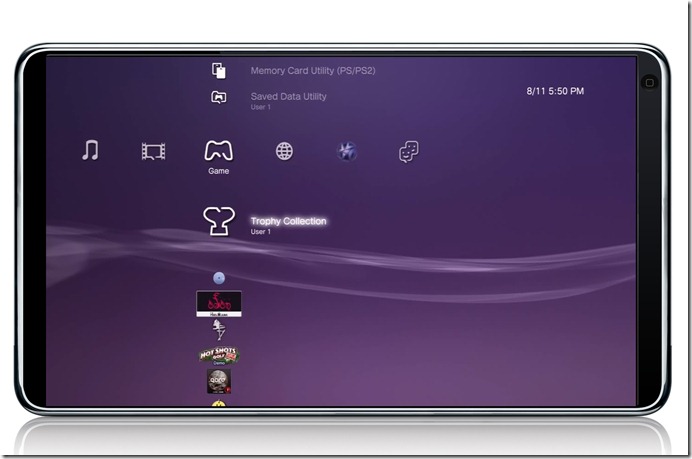
What the XMB Interface will look like on a tablet display
Most importantly it would be exclusive, just like Apple devices and means that only Sony products will utilise the OS. This would of course maintain Sony's gradually disintegrating reputation of innovation and uniqueness and increase Sony's brand value. Also given that Sony is the builder of the Playstation OS, it would be easier for them to update and provide services relevant to consumers demands, rather than relying on Google updating their Android Platform in ways that might not match up to what Sony is wanting.
Also, very importantly it would help create a unified experience (XMB Interface) across all of Sony’s products, which like Apple, will keep consumers coming back for more and also establish a certain experience synonymous with the Sony name.
The Playstation platform is extremely popular, with millions of users worldwide, so gaining a loyal consumer base shouldn’t be a problem, particularly if the device is able to connect to Playstation Network and other Playstation devices.
A crucial thing that needs to be done though, is possibly to make the device compatible with Playstation Portable titles, if that isn’t possible then open up the Playstation Platform more widely to developers which I had suggested long ago in one of my earlier posts: http://thesonypony.blogspot.com/2010/11/thinking-what-im-thinking-apps-on.html. Given the popularity of the Playstation, third party developers will be coming in droves and in no time we will see a wealth of Apps and mini-games available on the platform.
Of course it will be quite costly, in optimising a button based OS into an intuitive touch screen interface and obviously opening up an app store and hopefully integrating PSP title compatibility (download only obviously). However this is a solution for the long term and I see incredible potential in it, rather than taking the easy short term solution of adopting Android and just being another ‘me too’ device. If Sony can do this, and nail it, then not only are they taking the right step into unifying and networking all their devices but they’ve found themselves a legitimate and capable iOS and Android competitor. And most importantly, it will be Sony exclusive.
I'm a long time Sony fan and have always respected Sony as an innovator, never letting themselves fall into the spiral of imitation and generic products, it is the innovating spirit that birthed the Trinitron television and brought Sony out of post-war Japan into the international market.
If Sony enters the now crowded tablet market with an Android powered device, there would be almost nothing to differentiate it with its competition especially with more Android tablets expected to come in droves at CES 2011. Of course a Sony Android tablet would carry brand name prowess and superior design and build quality, but in the digital age, like I mentioned in my previous post, it is the software that matters, and all in all, the software would be fundamentally the same with only a custom skin of some description to differentiate.
If I were Sony right now, I would focus more on the OS used on the Playstation Portable or PS3, though I'm sure that they've already developed an Android tablet.
Utilising an optimised version of the Playstation OS (I don’t know the specific name of the operating system used on Playstation systems so that’s what I’m going to call it from now on) on an upcoming PSPhone, Tablet and other portable devices would serve several useful purposes.

What the XMB Interface will look like on a tablet display
Most importantly it would be exclusive, just like Apple devices and means that only Sony products will utilise the OS. This would of course maintain Sony's gradually disintegrating reputation of innovation and uniqueness and increase Sony's brand value. Also given that Sony is the builder of the Playstation OS, it would be easier for them to update and provide services relevant to consumers demands, rather than relying on Google updating their Android Platform in ways that might not match up to what Sony is wanting.
Also, very importantly it would help create a unified experience (XMB Interface) across all of Sony’s products, which like Apple, will keep consumers coming back for more and also establish a certain experience synonymous with the Sony name.
The Playstation platform is extremely popular, with millions of users worldwide, so gaining a loyal consumer base shouldn’t be a problem, particularly if the device is able to connect to Playstation Network and other Playstation devices.
A crucial thing that needs to be done though, is possibly to make the device compatible with Playstation Portable titles, if that isn’t possible then open up the Playstation Platform more widely to developers which I had suggested long ago in one of my earlier posts: http://thesonypony.blogspot.com/2010/11/thinking-what-im-thinking-apps-on.html. Given the popularity of the Playstation, third party developers will be coming in droves and in no time we will see a wealth of Apps and mini-games available on the platform.
Of course it will be quite costly, in optimising a button based OS into an intuitive touch screen interface and obviously opening up an app store and hopefully integrating PSP title compatibility (download only obviously). However this is a solution for the long term and I see incredible potential in it, rather than taking the easy short term solution of adopting Android and just being another ‘me too’ device. If Sony can do this, and nail it, then not only are they taking the right step into unifying and networking all their devices but they’ve found themselves a legitimate and capable iOS and Android competitor. And most importantly, it will be Sony exclusive.
Subscribe to:
Posts (Atom)