Showing posts with label Smartphones. Show all posts

Monday, January 30, 2012

Running On Fumes

Despite reporting an operating loss of over 1 billion dollars, Nokia managed to pull off a feat to mollify the investors - 1 million Lumia Windows Phone device sales. That’s actually quite a respectable result considering the device has yet to make a showing in markets such as North America and Australia.
But aside from that, Nokia’s future doesn’t appear to be looking any brighter than it was a year ago, in fact maybe it’s even a little bleaker. What Nokia use to have in the market was exclusivity and scale. The tandem of those two factors ultimately led to Nokia’s commanding success. 
Nokia has neither of these two factors today, aside from the exclusivity of being a 100% committed Windows Phone partner, but really that’s only working for Microsoft. The N9 running Meego Harmattan was certainly an exclusive, but with the promised commitment to run full steam with Windows Phone, Meego Harmattan’s potential may never be realised, or at most, a peripheral pursuit. 
Of course, it’s not like Meego Harmattan had a big chance anyway.
And scale, is something Nokia simply can’t obtain given the R&D required to build any good smartphone, especially if you’re Nokia and really trying to deliver with a bang. Nokia’s now signature polycarbonate shell in the N9 and Lumia 800, 900 models is a feat of engineering that simply couldn’t have been achieved if the company had floored it and delivered a tsunami of Windows Phones in generic form factors and hardware variations. 
The only segment where any economy of scale is possible, is in feature phones, once Nokia’s money-reeling gem but now declining precipitously in developed markets. Of course, there’s still money to be made there, and with most cellphone vendors relaying their focus to encompass smartphones 100%, Nokia is really in a position to take full control of the feature phone market. But there’s a reason why the world and the industry is stepping with both feet into the smartphone pool, it’s because not doing so would be committing to a world that will cease to exist in a very short time.
For Nokia, it’s even more crucial than this. As a company undergoing a brand image overhaul, investing excessively into feature phones would do nothing but hamper Nokia’s planned course to become viewed as a forward thinking company. Consumers can’t think of Nokia and see number keypads anymore.
Aside from the fact that Nokia no longer has significant leverage in the development chain to pump their business anymore, there’s also the issue of getting consumers to sign a contract to their phones which run on a platform that hasn’t gained the amount of traction that the company probably thought it would. Aside from getting the nod from reviewers, consumers are yet to see the great value proposition in Windows Phone.
Sure, 1 million sales exhibits promise, but it’s early days. The company has most likely skimmed the piece of market that gravitated towards Nokia in the first place, but from now on, it’s war and Nokia needs to pose some real fight - not only to lure consumers away from the eminent iOS and Android, but also to funnel them away from the other Windows Phone vendors in HTC, LG and Samsung among others.
The latter, an easy task that the company should win, but the former being a spectacularly tall order.
It stands to beg the question of why Nokia didn’t pursue the Android paved path in the first place. I can imagine it being an appealing option, Nokia’s acclaimed hardware quality and design paired with an OS that has solidified its position in the marketplace. It’s always nice to be on a winning team. But Nokia took a risk with Windows Phone, as a consumer I applaud the path they’ve taken, and from Nokia’s vantage, I would’ve done the exact same thing. 
Success in Windows Phone will yield a significantly greater reward that would be irksome to supplant, whereas success with Android would simply be providing another option, as opposed to a different option. 
It’s an uphill climb from here, and by sucking dry their loyal customer base in the first million sales, Nokia is essentially running on fumes. But since when is business not an uphill battle?  Build beautiful things, make sure people know about it and you can’t really go wrong. 

Sunday, January 15, 2012

Sony's big opportunity

CES 2012 has come and gone and if there was one thing that really stood out, it was perhaps surprisingly the smart TV and what it means as companies work harder to integrate their sparse hardware offerings. Samsung impressed, but Sony, of all the exhibitors at CES demonstrated the cuts to make this ecosystem thing really happen.

Samsung on the most superficial level was the ecosystem warrior at CES 2012, making a noise about its television sales numbers, which are objectively impressive and their focused strategy consisting of the three verticals - content, service and connectivity. With the reach of Samsung's TV user base, the reach of its enormous smartphone user base and the reach the company obtains by providing not only consumer electronics but home appliances, Samsung, in every possible way appears set to take the ecosystem war against Apple by storm.

By not conforming to the Google TV bandwagon, Samsung are playing their chances on the TV revolution alone. With a thriving developer community, popular smart TV platform and a successful consumer electronics business to leverage, why wouldn't they? Well because Samsung along with most of the industry are wrong about the Smart TV, and only Sony seems to get it.

Let's back up a little. Televisions are simply not like smartphones, and therefore applying the same principles that have made the smartphone a raging success simply won't work. Smartphones and the app approach have been a ground breaking success simply because smart, simple, streamlined apps are what's necessary to achieve anything when on the go. Minimise the number of button presses as possible, make things as simple, quick and engaging as possible and you have a big winner.

Do any of these values apply to television? Sure.

Sure it would preferable to have smart, simple and streamlined television apps, but looking at the broader picture, is apps really what's going to drive the TV revolution forward? To put it bluntly, no. Unlike mobile where things need to be snappy and fast, television is lazy and passive. Television is about content consumption, not content creation or content engagement. Although apps will be a hit gimmick sell, television will always be about consuming content - an area that Samsung simply isn't addressing with nearly enough punch and where Sony is flying high and mighty.

Sony Entertainment Network, a major talking point at Sony's press event may very well be Sony's big break. With significant leverage from the company's Playstation products, and the foundations of Android and Google TV rooted into its latest products, the company has the groundwork to make the content ecosystem its own.

The addition of cross-platform support in Sony Entertainment Network will not only allow the company to deliver highly compelling tablets, smartphones and connected products, but with SEN's unique placement as a single unified source for entertainment, Sony has the potential to turn its entertainment network into a cash cow.

Despite Samsung's breadth and sales, why Samsung isn't poised to take advantage of the TV revolution as well as Sony is, is simply because Samsung is placing too much of their efforts in their own hands. By developing every single facet of its own Smart TV and trying to be the be all, end all approach, the company can't use those same resources towards what really matters - deliver a truly compelling content delivery system.

Sony on the other hand, are taking advantage of Google's already established Google TV platform to gain them instantaneously what Samsung are working so hard to maintain whilst placing their own efforts into delivering an unsurpassed content platform with the deep cross device integration that the Japanese company promises.

Speaking from my own personal vantage, the ecosystem has always been something desirable, yet something I can never really obtain given the fickle nature of my technology desires. I own a Vaio PC, yet also own a Mac. I own a Windows Phone, yet use a Blackberry Playbook for my tablet needs. Hence, I've never had the coveted opportunity to be truly invested in any ecosystem.

iTunes never stuck with me because despite owning a Mac and a PC, my distinct lack of Apple mobile products eliminated much of iTunes' value proposition (besides, I'm more a fan of streaming). I trialled Zune Pass for 14 days when I purchased my Windows Phone, I loved the service but the fact that I couldn't use it on my Blackberry Playbook, TV or Walkman didn't prove it to be a worthy investment. The ability to help people like me is Sony's remarkably big opportunity.

No company has thus far delivered a single unified media distribution platform. If Sony plays their cards right, SEN could end up being just that. With support for all Android phones, upcoming support for iPhone and presumably iPad and of course, built in support with all Playstation products, Sony have formed the underpinnings for this master plan.

Deliver the service onto every platform imaginable (Windows Phone, Blackberry, Blackberry QNX, webOS etc...) and Sony have themselves an impossible to say no to, content 'sub-ecosystem' empire. Pair that with the advantages of owning a content studio (Sony Pictures) and it's hard not to envision a phenomenally compelling service.

While Samsung pays lip service to the success of its Smart TV offerings and integrated ecosystem trajectory, the inability to envision the larger picture may eventually have Samsung scrambling into the open arms of Google TV and have companies like Sony reign supreme in the TV revolution simply with their ability to deliver what it's really all about - content.

Tuesday, January 3, 2012

TECHGEEK.com.au - Windows Phone 7 is far from dead

Check out my article on TECHGEEK.com.au in response to 'Is Windows Phone's Consumer Focus Killing It?' published on Wired Epicenter.


"Wired Epicenter recently published an article on Windows Phone titled 'Is Windows Phone's Consumer Focus Killing It?' It's certainly reasonable to propose that the consumer focus is a reason for Windows Phone's less than spectacular adoption, but to say that Microsoft's will to satisfy the end consumers to the highest degree possible will be a prominent cause in the platform's possible demise is pushing it much too far.

That's obviously not to plainly suggest that Microsoft taking a very Apple-like approach with smartphones isn't holding them back even slightly. It's a large reason for Windows Phone's general lack of awareness amongst phone shoppers, and the obvious lack of sparkle in Microsoft's Windows Phone lineup. Unlike Google with its Android operating system, Microsoft places strict hardware guidelines on manufacturers developing Windows Phones. OEMs are not permitted to have a screen resolution that is beyond or below 800 X 480 and processor requirements remain particularly strict and unmoving..."

Saturday, December 17, 2011

Open sourcing webOS changes nothing


A couple of months after the company announced the death of webOS, HP's new CEO Meg Whitman has thrown the OS a lifeline in the form of the open source community. The greatest takeaway from this announcement is the fact that webOS is not dead. It's now vastly in the hands of passionate developers to build upon and improve efficiently whilst being freely distributed for anyone to use.

From the outset, we couldn't have possibly gotten it better, open source developers as a collective can make changes and improvements much more quickly and efficiently than the vast bureaucratic corporate structure of HP ever could. And speaking from a consumer's own vantage, we have another free operating system to contribute to the highly valued element of choice. As well as being a free operating system, webOS exhibits polish, the kind of quality you'd generally expect to pay for.

Looking past the thin veil of optimism, none of this changes the fact that HP webOS failed tremendously, such to the point that it was actually dead for a period of time. It doesn't change the fact that there is yet to be any worthy complementing hardware for webOS and in no way does it contribute to the operating system's relatively minute app developer community. It offers no succour for the fact that iOS, Android and even Windows Phone already have significant market share to leverage whilst webOS has virtually none to boot. Most importantly, it doesn't change the fact that HP is still yet to find any significant value proposition in webOS to gain hardware partners.

It's quite clear that keeping webOS as a proprietary OS in the hands of HP was no longer a viable option. The fledgling operating system was already skating on thin ice even before HP's immense Touchpad failure, and the heat of the competition from Apple and Google was slowly melting away at HP's chances of even minor success. The Touchpad, as the inaugural HP/webOS tablet had to be pretty darn good, but it wasn't.

I've always believed that it takes multiple subsequent impressions to eliminate the sentiments from a single first impression, and HP's first efforts at a truly mobile operating system in webOS left consumers and pundits with a sour sour taste. It would take the bare minimum of two years to manufacture sufficient subsequent efforts to try and clean the taste, and even then, imminent slow sales could hamper the webOS image even further and render the $1.2 billion acquisition essentially worthless. It would be too risky. Leo Apotheker wasn't completely out of his mind to cancel HP's webOS project altogether.

So, as much as persevering with webOS would have been a desirable trajectory, the plan was ultimately destined for failure. HP had various other options including licensing and selling the operating system off. Both these options I believe would have been higher on HP's priority list given their capabilities of monetization. But licensing was always an unreachable dream given the free availability of an operating system in Android with a lot more to offer, and there simply isn't a discernible target market large enough for those hardware manufacturers wanting webOS purely for diversity. To add insult to injury, clearly nobody was interested in buying webOS from HP.

By the looks of it, open sourcing was just a last resort for an HP that had completely run out of ideas. They couldn't make it work for themselves, they couldn't license it, they couldn't sell it so they've decided simply give it away.

HP is a profit-seeking corporation, they certainly wouldn't want to open source and wouldn't have made the decision had they not be in a position that forced it. The soul reason that Google voluntarily open-sources Android is because they have an ecosystem to tie users into so they can profit from users consequentially by putting their services into as many hands as possible.

All HP has is a lonesome operating system, tied into an ecosystem with little value, and no web services aside from a fairly deserted sandpit of an app store attached to it. Open sourcing doesn't cater to HP's personal vantage aside from the distant goal that perhaps they could capitalise on webOS in any way in the future if it ever gains any traction - but that's a far-fetched dream with various apples and green robots obstructing the path to the gold medallion.

Despite the aura of optimism and excitement shrowding the open sourcing of webOS, webOS is still in a poor position to compete. I hate to be the pessimist, in fact, I'm usually the optimist - I believed for a long time that if Sony played it right they could compete against Apple's iPod, I still believe that RIM can get right back into the smartphone game and I believed that HP had a shot at tablet market share if the Touchpad hadn't been a year out of date.

webOS has polish, it has a clean interface, it works darn well but that's not enough for a world so invested in apps, content and cross device integration. HP's open source plan will maintain webOS as a niche platform for a community of passionate webOS die-hards, but it will never find the mainstream traction HP were hoping for simply because it doesn't have the ecosystem lever that companies like Google, Apple, Amazon and Microsoft possess.

Monday, December 5, 2011

Carrier IQ isn't tracking you, it's helping you

With a class action lawsuit and the whole world against them, Carrier IQ have found themselves in a place they never thought they'd be in - a target for litigation with the torch of the public eye shining right in their faces.

Trevor Eckhart, a 25 year old man from Connecticut discovered a mysterious piece of software by the name of 'IQRD' installed on his HTC Android smartphone. It wasn't seen in his running programs list in task manager, but it was always running, and virtually impossible to stop. Through investigation, Eckhart discovered that this humble little software was capable of much more than any other application on his phone. It could see what he was doing.

Carrier IQ has software installed on almost 150 million phones, software which has the capability of tracking your every activity - your keystrokes, your text messages, your calls and even your browsing history. The company didn't do themselves any favours by sending a cease and desist letter to Eckhart. After all, telling someone to shut up, albeit in a orderly and business-like manner isn't too different from telling the rest of the world that you have something very sinister to hide. But this ill-informed perception multiplied by the sensationalist media is quite contrary to reality, Carrier IQ have nothing to hide. And surely nothing sinister to hide.

The whole scandal has been in most part an enormous public relations disaster, with what is genuinely a small issue being blow exponentially out of proportion. The phrase 'your phone is tracking you' has an unnecessarily dire ring to it and unsurprisingly it's been a phrase that the media has overused countless times throughout the duration of this scandal. The truth is, even though your phone is capable of tracking your every move, is it really? And to be entirely pragmatic, why would the carrier have even the slightest concern on the content of your text message or browsing history?

Sure, Carrier IQ, along with the carriers may have stumbled into a moral grey area by not clearly informing consumers of the presence of the tracking software on phones. But the basic use case of Carrier IQ's software doesn't deem it as a necessity. Despite the fact that Carrier IQ can see everything you're doing, the software acts a lot like a drug sniffing dog. It sniffs into every nook and cranny but only barks when it finds drugs. Carrier IQ reads everything, but only records abnormal or undesired behaviour - like a dropped call, unloading webpage or a failed text message. The software discards everything else almost as soon as it comes in.

At that, Carrier IQ is really just a mandatory process, another gear in the whole working mechanics of the carriers and your phones. Your carrier contract doesn't inform you that your calls and texts operate by sending signals to satellites and that your phone operates by passing electronic currents through wires and complicated circuit-boards. Why then, would it be necessary to inform users that their phone occasionally picks up abnormal data in order to ultimately better their phone experience? It's just part of the process.

By the hard stencilled writing of the law, the company have potentially acted illegally, breaching federal wire-tapping law. But to what good is the law when it can't account for crucial contextual detail, and in this case Carrier IQ have engaged in unlawful activity but whilst benefiting everyone involved. What they're doing simply isn't a bad thing.

To give the company what they've been handed in the past week is unquestionably unfair. As the world shoots at the company for immoral and unethical behaviour, this destructive negativity itself is in breach of ethics. It's unethical to throw metaphorical faeces at an innocent company simply doing their job.

Nobody's reading your text messages, nobody's looking at your web history, nobody is stalking you. Carrier IQ is helping you, while the media attempts to earn the ad dollars by selling the lopsided hyperbole they're here to write.

It's time that people got a look at the broader picture of the Carrier IQ 'scandal', instead of spreading the word that Carrier IQ is 'tracking you', 'stalking you', 'watching you' and a bunch of other bull excrement that the media put into their mouths. 

Saturday, October 22, 2011

When things start to get a little out of hand

'Super size me,' is what the smartphone told the world. And so we did.

The inexorable rise of the mega-phone, or the super-phone or the jumbo-phone pretty much sums up the trajectory of the majority of smartphone vendors - Power = bigger and bigger = better. I talk a lot about the superficial and non-pragmatic spec wars that so many Android vendors are focused on, attempting to make their phone that 1% faster for succeeding generations instead of making the basic phone experience better. It now seems that this focus for more powerful, more 'mega' and more 'super' is now translating to the phone's physical size - in a way saying 'I made this phone faster, but since specs are nothing more than a whole lot of coded tech jargon to most, I'm just going to make the screen bigger so you can easily see what I've done.' And yes, we can see what you've done, because now your phone is that much harder to grasp in the hand.

Whatever happened to small and chic? 6 or so years ago when there was no iPhone or big touch screen phones and the only successful smartphone was a Blackberry, small was in. Small was hip, and miniaturisation was definitive of high-tech. People were amazed that you could fit so much awesome into something so small. The whole line of Siemens phones comes to mind, a market failure no doubt but still undeniably cool. As a kid I didn't know a friend who wouldn't have pounced on a Siemens handset had they the cash - which is unfortunately something that elementary school kids inherently lack. Successful examples of handset miniaturisation are the Sony Ericsson W880i - a supermodel handset and the Motorola RAZR both emphasising their merits for both thin and small.

Fast forward several years and at the rate we're going we'll have six inch phones in a couple of years, and I hate to be the one to break it but the human race won't have hands big enough to account for such gargantuan gadgets in 2 years time - evolution is not that fast. Evolution isn't running a 1.2ghz dual-core, in fact it's probably running the same piece of junk hiding shamefully inside my graphics calculator.

I claim no hatred against these 'larger' phones nor do I consider myself a Luddite desperately clinging onto the simplistic past, but perhaps I do long for a society and a technology industry that embraced more the notion of holding a cute little pebble to my ear as opposed to a pancake to the side of my face. Times change implacably though and the altering physical form factor and size of smartphones is the most obvious simulacrum of the new way in which we communicate with our phones.

The iPhone augured a significant shift in phones, the paradigm shift in phones from passive to active. Phones used to be the passive device, a device that alerted us when someone wanted to contact us but was otherwise expect to remain discreet - seen but not heard. Hence, why make a phone big when we're meant to pretend it's not even there, why make it big when the only time we're meant to have it with us is when someone wants to contact us or when we want to contact someone else. Phones were passive and discreet, so they got smaller and smaller. Enter smartphone - a phone that we're always meant to have with us, and one that we're always using. Phone call or not, we're always on them because we can do so much more from them - we can browse the web efficiently, we can play worthwhile games and we can keep updated on the latest. With these smartphones, we're not waiting for them to surprise us with a phone call, we're not waiting to see what it's going to throw at us because we're hoping that it handles the tasks that we want to throw at it. Smartphone has to be a superlative in power and size to handle our growing demands, so it's getting bigger and bigger.

But something's got to give and these immense display sizes are actually subtle inconveniences in real world use. This preternatural display growth has got to find its limit, before it becomes borderline tablet.

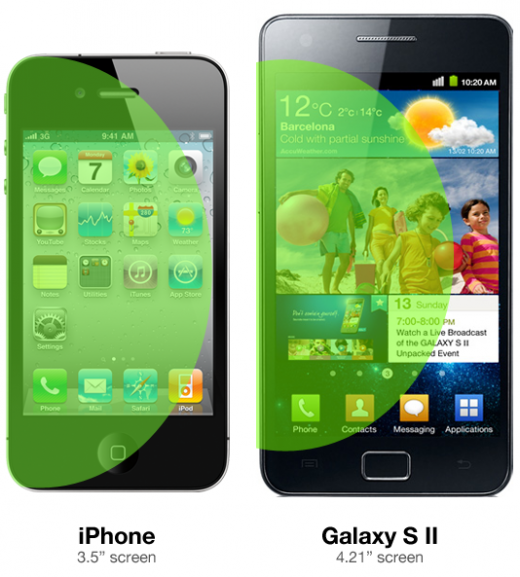
fourinches 520x577 Why the iPhones screen is 3.5 and will most likely never be bigger than 4To illustrate the point of the 'subtle inconvenience' I'll call upon an interesting article written by Matthew Panzarino on 'The Next Web'. He stated that designer Dustin Curtis had done a test in which he found that the disparate display sizes of both the iPhone 4 (3.5 inches) and the Galaxy S II (4.27 inches) made a genuine difference in terms of their usability and could perhaps pose a niggling issue for the Galaxy S II through time. He found that the display size of an iPhone 4 allowed every icon on its home screen to be reached with the thumb whilst holding the phone with one hand, whereas the limited thumb span proved too small to reach to the further edges of the display when using the Galaxy S II. To the left is a diagram that designer Dustin made to complement his contention.

Sure, you have to make a few sacrifices if you want the big and the better. That's how life and nature works right...a little give there and a little take there. But I don't think that's how it works for phones - because a smartphone is meant to materialise a vision for easy, portable computing. And traditionally a phones have blessed us with the advantage and accessibility of quick one-handed operation; the fact that phones have increased in brain size and processing power shouldn't compromise this one distinctive trait. Smartphones need to retain their one-handed usability and size because it's the only characteristic that preclude the smartphone and tablet from convergence. It's the only reason why they're still different things. Heck, if I could grab a tablet and hold it in one hand and use it with that one hand with ease I wouldn't need my phone, because my phone would just be a smaller and more eye-straining version of something I already have.

So I'm here looking at the new Galaxy Nexus and its 4.65 inch display, and I'm thinking to myself 'how big are your hands?' You might think I'm overreacting and these seemingly minor nitpicks are all in for the sake of a more spacious experience. But more than you think it's the insignificant things that leave an otherwise perfect product completely smitten - thumb hyper-extension and unnecessary two hand use are just a couple of those things. I use a 3.8 inch HTC Trophy daily and for me and my average sized hands that's just about the limit. Again, this is all completely subjective and for some of you this large screen size may suit your needs, and your hand-span, but strictly from my own personal vantage and I'm sure that of many others anything above 4 inch is a heck of a size, and anything larger than the Galaxy S II is really really pushing it.

Super size? Are you really lovin' it?

Monday, September 5, 2011

Categorising Samsung's Galaxy Note


No doubt, one of the most talked about unveilings at IFA is the Galaxy Note. A 5.3 inch Android 'device'. Categorising this device into smartphone or tablet is becoming an interesting dilemma - too big to be a mainstream smartphone, too small to be a tablet, and too advanced to fit into the PDA crowd. Hear me out as I provide my insights into what Samsung's Galaxy Note really is and what it means to us.

This year, I believe that the world of consumer technology has created and embraced what I see as the three musketeers of our computing lifestyles - PC, tablet and smartphone. All these devices augment the experiences of each other, and thus far none are capable of fully replacing one another. I couldn't possibly replace my phone with a tablet, and my tablet is simply not powerful enough nor practical enough to replace this laptop I'm typing on at this very moment. I think that one of the main things that holds back any of these devices from convergence or replacement of each other, is something that by its very nature simply cannot be fixed - its size. If people could comfortably fit an iPad, or even a Blackberry Playbook into their pockets and hold it to their ears during a phone call, people would very well do away with phones.

Unless you're the highly materialistic type like I who simply loves to bathe in collections of electronic devices, the lesser the number of devices that you have to deal with and manage is better. Hence the popularity of smartphones because they take on the purpose of a multitude of devices. All of this makes the unveiling of Samsung's potentially category pioneering Galaxy Note at IFA in Berlin all the more interesting. Cutting back from the trivial matters of detailed specifications, the Galaxy Note is a 5.3 inch 'device' with an incredible high resolution Super AMOLED display. As you can probably see from the image above of DJ Lee holding the Galaxy Note, the device is larger than Samsung's already large Galaxy S II smartphone but without looking entirely out of proportion. It's hard to believe that what is in his hands is a 5.3 inch display, which is certainly workable for a pocketable mobile workspace.

So, can this Galaxy Note succeed in converging tablet and smartphone for those who want to be burdened by less? It's certainly a compromise. Personally, the pockets of my jeans will only just hold a device of this size with a convincing shove. And then, it's not the greatest feeling (or look) walking around feeling a huge rectangle in my pocket pressing against my leg. On the other end of the spectrum, its size can also be considered to be too small. Even the Blackberry Playbook was criticised by many as being an inch or two below adequacy for a great web experience. Sure, the Note is great for the people who are willing to make the compromise to streamline their own device portfolio, but for the users looking for the best end to end experience, it's not going to happen here.

We can't look at the Galaxy Note and attempt to categorise the product simply based on its size. It comes with a stylus, which has been shunned by Apple but in actuality has some really useful practicalities. We've already seen such a stylus implementation in HTC's 7-inch Flyer tablet. The stylus was used to draw at a level of accuracy that fingers alone do not permit and also to highlight, circle and make notes on the screen at any time. The concept was great because it emulated the way we like to manipulate content in the traditional way of pen and paper and how we often highlight and underline things. The stylus of the Galaxy Note takes this idea and integrates the stylus deeper into the product as such allowing us to use the stylus to navigate the device as well instead of just drawing. From use cases demonstrated in the official promotional video we can really get a sense of the wide-ranging possibilities of the underrated technology of touch-pen input.

Perhaps, Samsung isn't looking at the convergence of the devices, but rather creating something...semi-new. It could be called a tabphone? Meh. Or perhaps a smartlet - that's cute. The point I'm trying to make is that I personally don't see this as a really really big smartphone for really really big people.

As the name suggests, the Galaxy Note is perfect for such use cases like note-taking which is something that is actually abominably hard on touch keyboards. It's funny how we often don't notice these little things that we want until someone shoves it into our faces. That's what Samsung have done here; taking notes on any touch screen keyboard of any size isn't a situation we dream of being in, let alone having to take such notes in speed. The stylus merges the benefits of both traditional handwriting and the digital capabilities of mobile devices - given the Galaxy Note is able to handle accuracy and speed simultaneously, we could have a really capable 'jotting down' PDA-like contraption with unprecedented versatility. The problem with pen and paper is that once you finish writing things down, that's really all you can do with it. For it to be digitised, the convoluted process of scanning must be endured, and even then the simple image file that it becomes is limited in its capabilities. The Galaxy Note can change this simply through its digital nature.

I know you're thinking that a stylus isn't a huge innovation, in fact it's really not an innovation at all as styli are considered by many as previous generation technology for when we didn't have effective capacitive touch displays with big meaty buttons for our big meaty fingers. But the stylus isn't dead and it was never dead, it's just that everyone is simply so engrossed in the smartphone spec war to embrace true innovation and forward thinking.

The Galaxy Note is certainly not for everyone, but for those who are blessed with large hands and don't often wear skinny jeans will probably love the practicalities that this 'little' contraption provides. Living with a tablet for a month (Blackberry Playbook), I can't imagine my life without one, it is honestly the most liberating feeling being able to take almost the whole quota of my digital lifestyle with me everywhere without being weighed down. With Galaxy Note, if one embraces what this device offers I'm sure it will eventually morph into an essential in much the same way.

So is the Samsung Galaxy Note the start of a new trend? The return of the PDA? To be frank, it's niche factor is too large for it to be embraced by other manufacturers. I still stand by my digital trio of smartphone, tablet and PC. The Galaxy Note probably won't be purchased on its merits as a note-taking device or a PDA if you like, but for anyone that has pockets capable of housing 5.3 inches of Super AMOLED goodness and is looking for a smartphone - meet 'smartlet'.

Monday, July 11, 2011

Breaking down LG's smartphone troubles


A few days LG announced that it would be cutting their 2011 smartphone sales targets by 6 million and reducing their overall handset shipments from 150 million to 114 million. The news isn't quite as serious as RIM's struggles in a similar market but its worth commenting on. LG has certainly been struggling in the new smartphone market. With budget phones and super phones spilling endlessly into the smartphone pit, LG is struggling to find its own.

There are hundreds of Android phones on the market right now, and no reasonable person would question why. After all, who wouldn't take a smartphone platform connected with services by the most important internet company in the world, surrounded by an immense ecosystem of apps if it was handed to them for free? LG's one of these 'people' who have chosen to adopt Android to launch themselves into the smartphone world. However the adoption of Android has seen LG fall victim to what I like to call: Androiditis. The issue of Androiditis is a simple one, you have a really good platform on your phone, with great services, plenty of apps, but everyone else is just as good as you. It's like being prime minister in a room full of presidents. All of LG's competitors who have joined the Android party have access to the same apps and to the same services. Essentially, if you have exactly the same software as your competitors then you're not really competing in that respect anymore are you?

Which brings LG down to its biggest issue, LG's inability to produce decent hardware. I'm yet to see an LG smartphone that has legitimately impressed me. When I walk into a phone shop and have a play around with an LG, nothing strikes me as being awesome or worth noting. Their phones have been receiving lackluster reviews not because they're bad phones per se, but because they're simply not better than their competitors and have nothing of value to distinguish themselves in an Android crowd chock-a-block with 'me toos' and 'pick me's'. There's also something to say about LG's apparently low standards in regards to hardware design. There was a billboard at a bus stop in Melbourne I saw that showed an attractive model holding an LG Optimus 2X in typical ad-like fashion with a tag line boasting the device's svelte hardware design. But, in contrast we see the Samsung Galaxy S II with its absolutely astonishingly, timeless and in my opinion, better hardware design which isn't even being advertised as a fashionable phone as such.

Design is a topic that's subjective, many people will say that LG's current smartphones are relatively pleasing to the eye. I'm not going to counter that, but I think it's right to say that LG has certainly lost some of its design flares from back in the days of the Chocolate and the Prada. To say the least, LG phones had a design that was not only attractive, but unique. Heck, the Chocolate BL40 (main image) still remains in my opinion the most attractive cellphone ever made. Full stop. It was beautiful, and unique. And I think that word is the key representation of where LG has lost touch.

LG needs something unique to separate themselves from the shadow of generic Android manufacturers. Samsung and HTC are undoubtedly the two most successful Android manufacturers because that's exactly what they have, something unique. It feels weird to be saying this since due to my own personal idiosyncrasies I hate Samsung, but Samsung have amongst the best smartphone hardware around. It's not just the design of their devices, but the succulent quality of their displays, particularly the Super AMOLED ones. HTC likewise have set themselves apart with their distinctive Sense UI, which is a hybrid of beauty and brains. Many manufacturers skin their Android handsets with the hope of giving them a distinctive look and feel, but none are more effective than Sense UI. When you use Sense, you just know that you're holding an HTC. Sometimes it's just that simple...you just know.

The Sony Ericsson Xperia buttons. Courtesy Jon Choo
Despite having a design that it quite uniform across LG's smartphones, it's not unmistakeably LG in the same way that slim, blocky, rectangular designs are unmistakeably Samsung, and the distinctly shaped silver navigation buttons below Sony Ericsson phones just scream Sony Ericsson.

LG simply needs to find out where they belong, and create products that cater for their vision. Right now, bland hardware design and non-unique software aren't giving LG any legs to run away from the congested Android crowd. For a well-established brand like LG they need to do better than simply being another option for consumers. How about being the option? Everything aside, LG isn't in big trouble, no matter how far their sales fall they're still essentially on the same playing field as their Android competitors, they're sharing an ecosystem that others are assisting to maintain. They don't have an ecosystem to defend. That's the advantage of Android, LG need to capitalise by creating beautiful and unique hardware that I know they're capable of. It's time to make Life Good again. 

Thursday, June 30, 2011

An inside look at RIM's bumbling business

Well, RIM has been in all the news for the past month for all the wrong reasons: lackluster sales, sales estimate cuts and a plummeting share price, you name it. It's always sad to see a once great brand that builds great products diminish in such a way and in such proportions. I obviously wasn't old enough, or perhaps not even born but many will remember when Apple in the late 80s to the mid 90s began to lose its feet and if it wasn't for Steve Job's return to the company he created we mightn't be seeing the iPhone and Mac as they are that have influenced and helped to greatly shape consumer electronics. Sony, currently are elbow deep in a similar sort of decline, in which once ubiquitous and world changing products they created are struggling to even be noticed in a tidal wave of competition. For many, the advent of the Apple iPhone and rise of Google Android marked a beginning of a rapid decline for the maker of the Blackberry.


WHERE RIM STUMBLED:
Perhaps it is only suitable to begin this here editorial with a discussion of how Research In Motion have found themselves in this precarious conundrum. Let's face it, RIM were breezing before the iPhone came around. They had a clear vision for their products and their devices were selling well to both their two distinct consumer groups at the time: the social savvy and the enterprise consumer. I believe that much of the reason that made their vision so straightforward was the fact that the concept of the smartphone itself was so uniform back then. Smartphone was deemed as a device with exclusive features for people who needed them, not wanted them for mindless time consumption or...fun, for want of a better word. Having said that, there was ultimately nothing truly fun about a smartphone when the 'Berry was king, at least not to the extent to which it could be considered more entertaining than the average dumb-phone.

There were several things that made Blackberry unique, and thus, far superior to their competitors: the keyboard, BES services, BBM and of course just the unmistakeable look and feel of a Blackberry. BES services and BBM are the two key points here and they really serve to highlight what went so right with RIM, and subsequently with the arrival of Apple and Google, what went so wrong. Essentially, RIM knew who their products were for and therefore delivered appropriately. A potent combination of a high-quality keyboard and the acclaimed Blackberry Messenger sealed the deal for a solid product for the social consumers. Additionally, BES (Blackberry Enterprise Server) provided a secure and powerful experience for the business consumers, completing once again, a flawless offering.

So what went wrong? The introduction of the Apple iPhone, initially laughed off by Steve Ballmer (don't get me wrong, I love Steve Ballmer) augured a significant shift in the smartphone landscape. The iPhone didn't just bring the smartphone concept to the mass market, but it shifted the entire form factor of the traditional smartphone entirely. Suddenly, the things that had made the Blackberry unique, were undermined significantly. The novelty of the capacitive touchscreen iPhone diminished the appeal of RIM's small display and keyboard combination. Not only this, but the introduction of the now enormous App Store raised the iPhone's after-market appeal enormously and more importantly widened the devices' potential use cases. Blackberry users began to question 'hey, why can't my phone do that?'

Fast-forward three years later, and we see RIM as it is now. Stumbling badly and thus far unable to create a product that truly sticks. What's most saddening isn't that Apple, subsequently Google and potentially Microsoft beat RIM at the smartphone game, but how little RIM did to stop it. The technology industry is a bit like quicksand, the further down you go the progressively harder it gets to climb back up. And I don't mean this in an 8 steps down 8 steps up kind of respect, but more an exponential relationship. Had RIM capitalised on the loyalty of their consumers rather than purely relying on them, the Blackberry's market share probably wouldn't be sliding to quite the extent it is now. Perhaps not sliding at all.

RIM separated themselves somewhat from the emerging smartphone pack and focused on continuing to deliver brilliant messaging and enterprise services whilst the 'fun' factor and user experience so prevalent in competitors slipped by the wayside. This short-sighted decision making was driven by one thing, and one thing only: overconfidence. With the prior success of their products, RIM were simply too confident in their own ways and their own purpose to consider rethinking their products. Consequently, with too much focus to their traditional ways, BBM became the only thing keeping the social savvy consumers attached to their Blackberry's, but the sacrifices that had to be made to obtain this service continued to build to a certain breaking point where the scales tipped out of RIM's favour. Because of this, the Blackberry's market share continues to slip. It reminds me a lot of my situation with my Walkman. The same can be said for the enterprise customers, though certainly to a lesser extent. To many of these business consumers, Blackberry isn't just a phone, it's a way of life. It's so rare and special to be able to boast such exceptional brand loyalty. But if RIM can't deliver products that can simply do more things...well they're going to lose them too.


WHY RIM STILL MATTERS:
This is not just another RIM bashing article, because I strongly believe that RIM still definitely has the assets to get themselves back on track. RIM has not sunk completely into a deep realm of despair and irrelevance. Actually, quite the opposite, to the average Joe's consumer the Blackberry still represents professional and quality handsets and devices.

As much as you can try to convince yourself that it's not, the simple fact is: brand matters. Brand matters a lot. And despite all of RIM's problems, their greatest asset, the intangible 'Blackberry' name is still almost entirely intact. It is arguably the only thing keeping RIM's head above the water. Ask around, and you'll find that most Blackberry users with the exception of the business consumers don't have much in defence of their purchase aside from the fact that 'Bro, it's a Blackberry'. And rightly so, if it's a Blackberry then it must have something going for it. Such a ubiquitous and powerful brand is so rare to see in any industry. In the mobile market the Blackberry name is only rivalled by the iPhone, and from my perspective, is still unmatched. Just the pure delight of telling people that you have a 'Blackberry' goes a very long way. The contributing factors that build this brand though are equally as important to RIM, and these are the things that they can effectively leverage to get themselves back on track. So far, they've made all the right steps towards this redemption.

One thing I've noticed is that there is still something unmistakeably RIM about their products. I had a chance to play with the Blackberry Playbook over the weekend and it was everything that I dreamt it would be: solid, fast and it exhibited a kind of professional polish unparalleled by any Android tablet that I have ever tried. With mobile devices like tablets, even the slightest of lags or missed touches can detract from the user experience significantly because these imperfections are very obvious in touchy-feely devices like this. Having said this, the Playbook ran unbelievably smoothly. Multitasking on the Playbook was brilliant, better than any tablet currently on the market. Most importantly, in just holding, grabbing and using the device I could immediately tell that 'This is a Blackberry'. Such significant brand awareness is enormously hard to achieve, and to have such a powerful asset at their disposal is healthy proof that RIM still matters.

One of the hardest things to achieve in this viciously crammed tablet market is finding ways to differentiate your products from the competition. I outlined this quandary in an older article where I discussed that the accessibility and availability of Android has definitely given consumers choices, but vendors are finding themselves providing virtually identical products to their competitors. RIM has an advantage here, despite their vastly smaller ecosystem, with the acquisition of QNX, RIM decided that it would take the challenging but rewarding path to exclusivity as opposed to the easy path to mediocrity via the Android wave. RIM's announcement that the QNX platform would be used in the company future smartphones is promising in two very important respects: not only are they laying down the foundations for their own platform with their own ecosystem of apps and services but also, given how well QNX works on the Playbook, well, I can only imagine good things.

The Playbook can arguably be considered as RIM's first step to a new beginning. A new platform, a new form factor and a brilliant web experience take a great diversion from the traditional RIM that we have known in the past, the same one that has failed to adapt and is struggling currently. It has been a wobbly first step, no doubt and the continual flooding of Android tablets has offered little succour for a Playbook struggling in a price battle. But I can't help but contemplate whether the Playbook I used over the weekend  was the same Playbook receiving lackluster reviews on many tech sites across the net. It certainly didn't feel like it. It's such a shame then that RIM brought the Playbook to market half-baked and essentially killed off the hype that could have surrounded a potentially exceptional product at launch. Having said this, the Playbook is still a work in progress, but once the omissions are filled (as promised) and the Playbook is able to reach its full potential, I have not an inkling of doubt that the Playbook with its exceptional design, stellar performance and Blackberry name prowess can conquer the shallow 7 inch tablet market.

HOW WOULD I FIX RIM:
So where do we take it from here? The key now, as it always is, is to build an ecosystem around the Blackberry platform and the products and integrate them. Direct integration between the Playbook and Blackberry smartphones is rather lacking currently. Blackberry Bridge perhaps is mildly useful for enterprise consumers but I can't imagine it being very useful for consumers and it would be useless for those without a Blackberry smartphone. RIM need to know that they can't simply lock their consumers in anymore, particularly since their prison is no longer the pleasant stay it used to be. RIM has to realise that ecosystems aren't a selling point of a product but merely a way of providing more integrated services for consumers and furthermore enticing them to buy further into the ecosystem. Thus, a poor product line-up and great ecosystem is of no help since there is no stand out product to effectively lure consumers in in the first place. Engadget 'Switched On' writer Ross Rubin stated 'if you're going to lock in consumers, it's best to build a prison that people want to move into anyway'. I couldn't possibly put it better myself.

RIM in the past thrived on created services and products exclusively for their own devices. But I believe RIM now has to warm up to the idea of working with others and integrating their products with other services out there. For example the Playbook video calling app only works with other Playbooks. Wouldn't it be nice if it talk to other devices too? You could argue that Apple's Facetime is also proprietary, however for Apple it's excusable because they've reached a certain level of ubiquity with their products that it's an unnoticeable hindrance. An owner of a Playbook on the other hand would be hard pressed to find a mate with one too. Even the popular BBM is beginning to lose its popularity as consumers are beginning to find that they can find comparable services that have the ability to converse with other platforms too. With a declining market share, sticking by their proprietary ways would simply convert into a deathly spiral for RIM. They simply no longer have a large enough customer base to make proprietary services useful. It's time for RIM to play nice with others, it's no longer everyone living in RIM's world, it's RIM living in everyone else's world.

That's probably the most important thing I would change at RIM, because proprietary is only really useful if they can leverage a large market share, which is something that RIM has undeniably lost. It's also important that RIM doesn't stop chasing the consumer business. I've read many articles saying that RIM should stick to investing more in enterprise services and providing for enterprise consumers which is traditionally what they've been known for. But the fact is, the Blackberry does mean something to average consumers and it would be wasteful to not take advantage of such a powerful brand. Furthermore, a pursuit of the consumer business is definitely a safer option because, hey, business people like to browse app stores and use 'fun' apps too. If RIM invest solely in the enterprise market and the consumer competitors are able to match or even come close to them in this market, then the competitors' advantage in more 'consumerised' products and services would guarantee a death to RIM's one-trick pony.

Amidst all the negativity, I feel like I'm the only one that has any confidence in RIM. But I think RIM still has plenty of potential. If RIM utilise QNX appropriately and efficiently, I personally do think they have a gem in their possession.

How would you fix RIM?

Friday, June 3, 2011

Why I love you, Sir Windows Phone


I'm going to keep this intro short, sharp and shiny. An untimely and most unbidden event occurred to me a couple of weeks ago, my Walkman lost its ability to charge. Often, it's quite difficult to forget instinctive life procedures, however I've got to hand it to my Walkman X1060, she just forgot. And what's more, she's also blatantly refusing to talk to my computer. I've just ordered a new cable off eBay just in case it's a cable problem and I'm still waiting for that to arrive, just hopefully that will fix my Walkman's most unfortunate disorder. Despite this, I know my Walkman won't last forever so I've been searching for alternatives to replace my mobile device shortage, I've decided to settle on the fact that Sony won't ever release a decent Walkman ever again.

The sheer immensity of available devices on the market was simply astounding, I went in with the expectation of landing on my dream device within a day or two, however only a fortnight later have I come to a really solid conclusion. This might surprise you, but I have fallen head over heels for Windows Phone 7. It's disappointing that this operating system is often frowned upon in the tech world for its lack of...well tech geeky features. The lack of customization is probably the OS's biggest claim to shame. Windows Phone 7 has taken a different approach than some of its competitors, and even Microsoft themselves in the past has taken, an entirely different approach. Making an operating system easily accessible and customisable places the nerd in heaven, but often too much freedom and too many options leads to inconsistent and unreliable experiences. Windows, and the previous Windows Mobile have a reputation for being highly technical, at least more so than its competitors. However this time round, I support Microsoft's new approach and strict hardware guidelines for Windows Phone devices, because boy does it pay off.

Microsoft's UI design philosophy
User interface is one of the prime factors of a great mobile experience, and this is the area where Windows Phone 7 truly delivers. It doesn't just deliver because of its visual appeal, nor is it because of its mind-blowing animations, but it is extraordinarily fun to use. The UI experience of Windows Phone really succeeds in taking a big jump away from traditional UI designs epitomised by the likes of iOS and Android. The multiple home screen and widget design of Android simply looks outdated when laid side by side with a Windows Phone. It allows us to beg the question of why we honestly need so many home screens, Windows Phone makes do with one beautifully scrolling collection of 'live tiles'. To be brutally honest, I've never met anyone who actually uses more widgets than the music player, clock, calendar, weather and news feeds; let alone use up all of their home screens. It also shows us why Apple haven't bothered with a widget implementation on their iOS platform yet, though competitive pressure somewhat obliges Apple to do so with their iOS 5.

Live tiles: Another winner for Windows Phone. To be honest I haven't had much experience with the live tiles, as you really have to own the phone for a period of time to evaluate its real world practicality and usefulness. But the concept is brilliant and far as my 10 minute trial of it went, my god its amazing! It really does add to create a really pleasurable mobile experience. The idea of Live Tiles is you can pin the things that matter to you most onto the start screen, and it will show you any updates that occur live. For example, I'm an avid Facebook user, so the Facebook Live Tile will show me any notifications that I receive without the need to access the application. And also without any irritating notification pop-ups. Same goes for Twitter and many many other applications. Heck, I can even pin people to my Live Tile display. Stalking just got a whole lot easier.

Music + Video Hub and the general WP7 sliding interface
Another thing I noticed when using Windows Phone is the feeling that things just really flow. Mind you, I'm not referring to a 'no lag' or 'high-speed' experience here but the design of the 'Metro UI'. Take the Music and Video hub or Zune as an example. When you first open the application it presents you with a list of essentially what you can do: music, video, podcast etc. But if you simply swipe to the right it will present you with your media history of all the tracks you last listened to, swipe to the right again and it will show you new additions to your library of media. This exceptional interface design is really successful in challenging and taking a jab at the concept of navigational buttons (non-tactile obviously). If you're in the music menu, there is no need to tap at anything to switch between the metadata you're viewing, rather swipe to the left or right to switch between artist or album or genre. Microsoft's Windows Phone 7 UI feels natural and intuitive - a theme I discussed in my previous article about the fate of the PC and evolving technologies.

It can be said that the umbrella reason why Windows Phone provides such a pleasurable experience - for me at least - is that it feels like a phone designed for you and adapted to your needs. Most consumers don't like having to adapt and learn their technologies, but rather in essence have technology learn the way they want to do things. This is an area where Windows Phone has hit a home run, perhaps even two home runs with one ball.

UI design is severely underrated, tech analysts have made a big deal about how many apps are available on a platform, how highly featured it is and what not. At the end of the day though, the user interface is what you feel, touch and experience and this should be the thing that makes or breaks a purchase. It's not to say the UI of competing platforms is poor, but this is an element where Windows Phone absolutely delivers. The application range of Windows Phone measures poorly against some competing platforms, but it is sufficient and will continue to grow. I'm going to throw my eggs into the Microsoft basket, and I'll be damned if the platform never gains traction.

Who has a Windows Phone and what are your thoughts on it?

*Next week, I will be doing an in-depth discussion behind the potential of Windows 8 and what it means for consumers and the tech industry.*

Wednesday, February 23, 2011

Why the Xperia Play is overhyped junk and Qriocity is underhyped gold.

Yes. I said it. I called it junk.

I'm sure that if you've read any of my previous posts, you've noticed I'm definitely not a fan of the Xperia Play. I've received a couple emails from people who keep telling me how awesome the Xperia Play will be and it's the first real gaming phone and what not. But, the real reason for my Xperia Play hatred is that it's a sweet product based on a half baked concept.

As a gaming phone, the Xperia Play is clearly a winner, but it's a middle of the market product that doesn't really appeal to anyone. When thinking of the Xperia Play, one question comes up. Why do you exist?
Sights are deceptive, with all the comments I'm seeing on Sony Ericsson's facebook page and popular tech sites by people who are excited about the Playstation Phone, it is not surprising if Sony Ericsson has been deceived into thinking that the Xperia Play is a good idea (yes, strong words). But really, it is just a product that doesn't need to exist.
With the upcoming Playstation Suite, PS games will be made available to all Android devices which almost immediately renders the Xperia Play useless. Apart from the dedicated gaming controls and I'm going to take a hunch here, superior graphics performance, the Xperia Play offers nothing of value in comparison to other Android handsets available.

Let's do a step by step cancellation of the Xperia Play's potential customers: first off, humans are the only organisms who will buy an Xperia Play, for further clarification this excludes cheetahs, praying mantis's and all varieties of trees.
As a general rule, females and gaming don't normally fit in the same sentence unless it's a Facebook group about a girlfriend who is forced to make sandwiches while her boyfriend plays on his XBOX, so that eliminates approximately half of the human population.
Now down to business, of all males, how many will want to be seen carrying around a phone with gaming controls? Well, certainly not businessmen who want to be taken seriously. Certainly not your everyday person. Let's face it, only gaming enthusiasts will be carrying around dedicated gaming phones, but then again, wouldn't real gaming enthusiasts just opt for the NGP instead which has real analog sticks and PS3 graphics?


So, ultimately, the Xperia Play doesn't really appeal entirely to any section of the market, and Sony Ericsson are hyping it like it matters to everyone. 

On the other hand, Qriocity (VOD and Music Unlimited) is a service that has real potential, and shows us where the world is heading in terms of digital media. Qriocity is where Sony's focus should be, not some half-assed gaming phone that will most likely not see a second generation.
It's become quite evident of recent, that the success of hardware is dependent on the availability of complementing software and vice - versa. I've mentioned this several times, but the reason for Apple's success recently has been due to the almost perfect synergy between their hardware and software offerings, and the immediately availability of software on their devices, whenever, wherever you are.

Qriocity can finally get Sony there, to this heavenly abode that Apple has inhabited for 10 years.

What astounds me however, is the lack of marketing, even subtle promotional efforts of this new service by Sony. It is really quite astonishing and perplexing that the Xperia Play gets to take the limelight on Sony Ericsson's site homepage when the launch of Music Unlimited by Qriocity doesn't even get a spot in one of those measly four tab areas below Sony's site.
What the hell are you doing here? Get out of my life.

If Sony really want to turn Qriocity into the next iTunes, which I hope they are because they really shouldn't be aiming any lower, then two things need to happen:
1. It needs to go mobile, and Sony have already announced plans of an android version so that's sorted (unless they mess it up with some laggy failware).
2. People need to know it exists.

Number 2, is obviously what this whole post is referring to. Stating the obvious, there's no point making something if nobody knows that it even exists. I'm genuinely disappointed and mildly shocked when I ask my friends:

'Hey dude, you hear about the new Qriocity music service? It's like iTunes but you pay 13 bucks and you can eat up all the music you want for 30 days."
And they would respond with a half-hearted nod subtly hiding their ignorance on the subject matter.

But then, I don't blame them at all. Sony have done a shocking job at making Qriocity known. Qriocity hasn't been advertised at all, let alone made an appearance on any of Sony's sites.

Basic point of this post is, Sony and Sony Ericsson need to sort out their priorities. The Xperia Play is a doomed device that is being promoted insanely, which could only end up one way - embarrassment. Qriocity on the other hand, is where I personally see Sony's future is at. Sony's software has never been quite a strong point, however  Qriocity is a great concept, executed rather well, now they've got to let it out there, get it known.

Synergy has been talked about since the early Columbia days, this is their first real crack. Make this the next iTunes, not the next Connect.