Showing posts with label Apple. Show all posts

Sunday, January 29, 2012

Apple and Foxconn's Working Conditions

This is not an issue for Apple, it’s Foxconn’s problem and no consumer electronics company that sources their production to Foxconn can do a thing about it. 
It’s not Apple’s job to make sure that worker conditions in production facilities is acceptable, the fact that the company audits these factories at all is already generous. And, if from the goodness of their own heart (heh, doubt it) Apple really does give the slightest care about worker conditions in China, they’re not in a position to dictate terms. Apple can beg and beseech, but poke the bear and you’re treading on super thin ice.
Apple relies solely on Foxconn to make their nut. The majority of Apple’s supply and manufacturing, as with many other consumer electronics companies, is sourced to Foxconn. No other company in the world exists that can manufacture to quite the scale, speed and efficiency that Foxconn does. 
Foxconn relies on almost the entire industry to make their nut, so really, Apple, though of course a cash cow of a customer, doesn’t mean nearly as much to Foxconn as Foxconn does to Apple. The Chinese monster knows this, and permits themselves to cut corners and cross moral lines knowing that Apple really isn’t going to do anything about it, aside from throw a few unsubstantial ‘demands’ for better working conditions. It’s all PR.
As long as the company doesn’t significantly attract government attention or that of rights activists, Foxconn really does have the freedom to hire as many under-age workers as they want, have as many 12 hour workers as they want, and ignore as many safety regulations as they want. Chi-ching. Money, money, more money.
Even then Foxconn has the Chinese government in a strangle hold too, why would the Chinese government dare hamper the growth of such a lucrative corporate gem? They’re probably sitting there in their spin around chairs going, ‘Dayum our economy good’. And who’s to blame them, their economyis good.
To point fingers at Apple, or Sony or Dell or Microsoft as acting immorally and permitting torturous slave like conditions in Foxconn is akin to blaming your professor for poor grades, not their problem.
They’ve done their job, Apple has done their job in R&D, their job is to dream the ideas and create beautiful products for an end user. Foxconn’s job is to make it, and all the unfair blood, pain and suffering that goes into the birth of an Apple product is weighted on the manufacturing side of things.
Don’t blame Apple, blame Foxconn, it’s their job and they’re the ones doing it wrong. They’re the ones acting immorally on so many different fronts, not only by providing abysmal worker conditions but by abusing their monopoly position to permit themselves to do it even more.
Foxconn has a history of issues, a mainstay in which was the fourteen suicides in late 2010. The company resolved the problem by installing suicide prevention netting, like that was totally attacking the source of the problem. Not only does it show that Foxconn doesn’t get the staggering effect of their actions, but that they simply don’t care. 
But that’s business, and that’s capitalism. When someone makes some killer cash, somebody has to be on the other end of the trigger. When we look for something that is both awesome and affordable, and seek the best of everything, somebody has to end up with nothing.
The world is full of compromises, all we’re doing is shifting them, playing with the economics of life. I’ll just drop by my carrier store and get an iPhone that doesn’t quite burn the bank, while you, get no iPhone and pay for my cash savings through your weary eyes, swollen leg and back pains. 
The worst thing is, we’re all just like each other, I’m just like everyone else. While I do care about the workers, when its buying time I’ll do everything to nail that Mac at the best price possible.  
It doesn’t have to be this way though, Foxconn just needs to show a little heart. But shit, who am I kidding, it’s all money and vested interest.


Also on A Pony For President

Tuesday, January 24, 2012

Beneath the Excitement of iBooks 2

Last week, Apple pulled the wraps off its latest offerings, iBooks 2 and iBooks author in a publicised event in New York City. Whilst the announcement has proved exciting and potentially world changing, digging a little deeper, there's probably just as much to be concerned about as there is to be contented about.

I'm just going to start by stating the shallowest of my sentiments - this announcement is darn exciting and will no doubt change the state of education and of course, reading as a whole. But, , whether it will change education and reading for the better or for worse is something we can't be entirely sure of.

Ebooks are certainly the next big thing in reading, but I doubt they'll ever fully replace paper, not in our lifetime. We will always want books, I will always want the option of an actual book, libraries will never just be online catalogues. It's not about nostalgia at all, well maybe a little, but certainly not all of it. The reason why books have lasted so many centuries as a technological medium for knowledge distribution is because they simply provide so many practical benefits which are irreplaceable through technological innovation.

Dieter Bohn of The Verge recently published a lengthy feature titled 'Sorry iBooks,paper books still win on specs', which outlines all the books practical benefits which can't be ported digitally due to the very limitations of technology itself. Here's a few crucial ones: books don't crash, books don't run out of power, books have a consistent user interface, books are compatible with every nook and cranny of our daily lives.

Sure eBooks exhibit traits that are impossible for paper to ever adopt, but that's how it is, books and ebooks are just compromises of an impossible optimum which is why we still need both.

To play the nostalgia card by saying that there is a nothing quite like curling up with a good book, turning paper pages and the smell of an old book isn't really worthy of awarding a point to the good old traditional book. For the most part, these claims are distorted by a desire to cling onto the past.

People are always afraid of adopting unproven things and letting go of the past, especially when it's something like the binded book which has served us so well for countless years. In the hypothetical situation that the world regressed from iPads to paper books, we'd look nostalgically back at the swift beauty of swiping to turn a page and puke at the thought of touching paper.

But then again, I feel that eBooks do have the capacity to devalue intellect. Despite being a grace to the spread of knowledge, the fact that it is now so easy to publish books with iBooks author and distribute them freely, it is no longer really special to have a book published under your name. Additionally, it potentially makes it harder to find genuinely good books, and easier to stumble across one that someone may have simply published for a school project.

In many ways, it's comparable to what email has done to letters, making it easier to receive and dispatch letters, yet also a lot easier for spammers to get to you. And perhaps also what blogging has done to traditional paper journalism.

On the education side of things, I can't be one hundred percent certain that interactive iBook textbooks is truly what education has been looking for. iBook textbooks are indisputably a preferable alternative to the fat textbooks of today - interesting, useful, engaging, it's all there for the iBook textbook. What's concerning is having the iPad in class at all.

There's a reason why cellphones are generally not permitted for use in class despite their potential utility as a learning tool. It's because electronics are distracting; pair that with the fact that learning subjects that a student dislikes is boring and you have a fairly tasty recipe for procrastination, in class texting, and Facebook-ing. Interactive books will never make a student interested in a subject that inherently bores them in the same way that playing Halo won't make me a fan of guns.

Apple's interactive textbook is a double edged sword, empowering engaged students to learn in new and better ways, but for the kids who aren't really engaged in the first place, it's just a brand new way to get away from class. By trying to emulate the quick access and fast paced immediacy of current technology in the new interactive textbooks, we're also emulating the negatives – the constant contingency to lose focus.

If we want to fix education, we can't simply implement books that move and talk, we need to change the curriculum so that students don't have to do science or math if they simply don't give a sh*t.

Interactive textbooks aren't a step forward for education, but more like a step to the side. IBooks and eBooks are a step to the side for reading too, another alternative that is appropriate for certain use cases but can't replace paper books which are appropriate for other use cases. I can't really sum this up any better than Dieter Bohn did in his article on The Verge, but if we ever want digital to become the dominant medium for books, we need to make sure we can try recreate at least some of the better things about paper into electronics.  

Monday, November 21, 2011

The Social Factor


So, what is the social factor? The social factor is a collective term I like to use to describe a service or product that embraces active user engagement. User engagement not in the sense of poking and prodding said item physically, but personal engagement with a product and personal engagement between users. Thus, commenting and reviewing apps and music on iTunes can be coined as a product of the the social factor, communicating with Youtubers in a comment flame war is an element of the social factor and of course Twitter and Facebook among other social networks are examples of the social factor in its purest form - social networking.

The social realm has received a generous ignition recently, with the release of Google's own Google+ service as well as the revealing - not unveiling - of Microsoft's oddly named Socl service. It's a completely different landscape from not too long ago when the heavenly abode of social was occupied almost exclusively by Facebook and Twitter. Myspace was descending precipitously with the accolade of an also-ran.

Fast forward a few years, to now, and for the most part the social realm paints a fairly similar picture when looking at the colours of the raw hard numbers. Facebook dominates the social networking space with upwards of 800 million active users, and Twitter with a user base of more than 100 million still trumps that of a fast growing Google+. That's all not to mention actual user engagement, an aspect that Google+ has struggled to maintain following the pre-release hype.

Numbers don't count for everything though, and despite Facebook's considerable lead, Google+ isn't out of the game, and Microsoft Socl isn't dead on arrival. Far from it.

The term social networking is a particularly deceitful monicker given the image that most people have of what a social network is. To most people, a social network is simply what Facebook is - a platform for interacting with friends, and sharing content with friends. At that, Facebook's greatest value proposition isn't in the service itself, but the users that inhabit it. In such a business where the most effective way to get users, is to have users, anyone attempting to beat Facebook at its own games playing by the same rules will end up with a slap on the face and a disheartening, unsurprising disappointment.

Google+ and Microsoft Socl are both great platforms by their very own merits, they're not trying to be Facebook killers, and if they were, then they would quite literally be throwing an untrained army of 50 million against a heavily armed pack of 800 million. It's not possible. It will never work. It will never happen. Let's talk about Google+, and what this element of social plays for Google.

Jolie O'Dell of Venturebeat published a comprehensive article recounting Google's Bradley Horowitz's views on their very own 'social network', Google+. Initially, I assumed his general carefree aura on the, I wouldn't say failure, but perhaps under-performance, of Google+ could be none more than the typical cavalier executive talk. But, Horowitz revealed a vision for Google+ that not only negated my impulse expectations, but his trajectory for the Google+ was elegant and clever, bringing to light that the social factor has implications far beyond the superficiality of people interaction.

Google+ is all about an online identity, an online persona that we have - a virtual porting of our real selves. When you're able to put yourself into the products and services that you use, the seeming triviality of technology is put into perspective and given context. It transforms technologies that are passive, into an actively intricate emulation of our real social communications and inner selves. Essentially, even if social interactions form the core of what constitutes social networking and the social factor, it's greater purpose is to make technology that much more personal.

You see, it's basic human nature that we hold much more sentimental value to the things that are closest to our hearts. For most non-cyborg human beings, the 'things' that we are most emotionally attached to are the people around us, our friends, our family, our boyfriends, our girlfriends. Sure I'd cry if I dropped my phone off the balcony but I'd cry a heck of a lot harder if my mom died. I have a mate who was driving himself half bonkers because he misplaced a pen his girlfriend had given him despite that fact that there were many smoother and inkier pens lying around.

Taking into account this hierarchy of sentimental importance, it makes sense to integrate our personal lives into our products because it allows for a much greater degree of emotional attachment - a sly, but clever tactic to keep consumers loyal.

Microsoft Socl in many ways aims to pursue this same vision of a more personal technology, however aims to add more practical benefits to this.

I, as many are am a little spacey on the tid-bits and details of Microsoft's 'maybe not even coming into market' social network, after all, the only half-decent look we've had at it was when The Verge was granted some much appreciated hands on time. The interface design is fairly standard, calling upon the three column layout shared by Facebook and Google+. And Microsoft were not very creative with the colour scheme either with an eerily similar blue to that of Facebook's, though with a slightly lighter and perhaps more pleasant tinge.

A stand out feature though was something dubbed 'social search'. No, it's far from a revelation, but it shows what social is capable of, and why social is so important to completing a product ecosystem. Social search simply allows your friends to see the queries that you throw at search engines, with the hope that they'll be able to chip in too.

As experience should teach us, it's much easier to extract information out of knowledgeable humans than a knowledgeable website. Hence why we have teachers in classrooms as opposed to a Google homepage. With social search, a Microsoft Bing search has potential to provide better results than a Google search.

What's more, for Microsoft, social search finally allows them to put that tortured little Bing to good use, and as a moral boost, Microsoft can finally start telling people that their foray into search wasn't completely absent of fruits. Microsoft have reiterated that search is an important field that they needed to be involved in, and social search certainly does give it something to show for - a fully integrated Microsoft experience. Without Google. And social search gives Microsoft's Bing a reason to be, because currently, aside from the flashy backdrop of good photography - which, let's be honest is only remotely interesting for those who don't know what they're searching for before they arrive at Bing - Google's a better bet anyway.

The social factor is inarguably invaluable in providing a good ecosystem. Apple tried and failed with iTunes Ping, which demonstrates that even Apple is aware of the capabilities that the emotional and personal attachments of social can have on a consumer.

Aside from providing an online identity as Google+ aims to provide, Google+ unifies Google's too-many-laned highway of products into a flowing single vertical. By having a basic identity tied into all that Google provides, it allows the consumer to act as an umbrella over all the Google services they use and leaves them less chance to drop one, forgotten in the rain. It gives the user more control. Furthermore, Socl social search exemplifies the single greatest thing about the social factor by allowing a company to tap into their single greatest asset - the users themselves. 

Thursday, November 10, 2011

How to win in television


As a backdrop to the all too common mobile device war, TVs are starting to capture the attention of technology enthusiasts with the rumours of an Apple television set possibly appearing sometime in 2013. The recently unveiled biography of Steve Jobs has revealed a vague trajectory of Apple's plans in an entrance to the television market. In the meantime, Sony warned investors a fortnight ago of an imminent 2.2 billion dollar loss on its bleeding television business, making it the fourth consecutive year in which Sony's television division has remained unprofitable.

There's a powerful demarcation to be made here - why would investors and pundits be potentially excited over the notion of Apple television when Sony, a long time and trusted manufacturer in this business isn't even capable of hauling in a profit themselves? Most of us, would have never pictured Apple building their very own in house television set, the Apple TV always looked about as far as they would be willing to dip their toes into the deep television pond. The deep television pond infested by manufacturers willing to reap the slimmest margins to undercut competitors.

You see, that's the biggest problem with the television business for Apple, and even Sony, - it's heavily commoditised and highly competitive. With its vast manufacturing scale and supply chains, Samsung is more capable than most other manufacturers of profiting from television, and even their performance remains modest at best. 

Apple as a newcomer to the competition couldn't possibly expect to be able to develop in-house and manufacture quality televisions at the same scale as Samsung or even Sony and be able to deliver an affordable product to the end consumer. On the flip side of the coin, if Apple were to outsource production and buy flat panels from existing manufacturers - like Samsung - then they wouldn't exactly be innovating with their product would they, which by all accounts would most likely oppose Apple's ethic entirely.

Television is a business where it's very hard to differentiate or maintain an exclusive, Sony's Phil Molyneux even criticised the nature of television labelling this monotonous line of similar products as the 'sea of sameness'. Given product differentiation is so difficult to achieve, price differentiation is the only remaining resort, turning television into the bleeding, painful and low margin business that it is today.

Apple doesn't like playing the game that way. Historically speaking, Apple enjoys exclusivity around their products - a business model that doesn't always equate to leading market share, but always pulls in a huge profit, brand loyalty and evidently a glorious stock price. A sweeping dichotomy from conformist television manufacturers. So how do you work around this? How can you win in a business when it's hard to even break even?

First off it's important to evaluate the importance of television in an overall vision, or perhaps more importantly, the role of television in the the direction of the technology industry as a whole. It's fair to say that the whole industry is leading towards an almost universally pursued four screen strategy involving smartphones, tablets, personal computers and of course the television.

When Google and Apple begin hinting at entrances into certain markets, you know things are about to get real, and for television, Google's already waddling in the water albeit with a little uncertainty and we're expecting Apple to take a fully committed chunky dunk. Apple revolutionised the music industry with its ubiquitous iPod. Apple almost single-handedly crafted the modern smartphone, and Google made it big. Apple created and revolutionised a practically non-existent tablet market and Google made sure there was a little more variety to suit everyone. There's no reason that in their monstrous tandem, these two will be able to revolutionise the plateauing television business as well.

Consumers aren't going to be prepared to pay anymore than they are already for a television, especially given the state of the economy. Even if manufacturers gathered to form a pact that ensures a handsome profit for every unit sold, consumers wouldn't buy, even if they had no choice. Televisions are costly, low replacement devices, so consumers typically only replace televisions when they really need to. And a steep price increase for already rather steeply priced televisions would only push consumers to eBay and second hand items. To pursue this current business model in selling televisions as passive displays is not a feasible model, it never was, but now, we have better options.

The analogue age was a time when devices could thrive even when operating on a shallow and superficial microcosmic level. Devices were sold on the merits of their hardware capabilities, the quality of its parts and its physical design, as opposed to its potential for customisation and expansion. That analogue era, was long ago, but for the most part, television is still there - with picture quality and hardware quality still very much on the priority list for TV buyers. To win in television, we must relay our focus completely from commoditised hardware and aim to sell on the merits of potential expansion, integration, connectivity and content. Aim to emulate Amazon's business model for the Kindle Fire tablet - make a small loss or just break even on the hardware, and aim to cover that cost in packaging good software and selling content.

Google TV was initially poised to be the redefining of television but I think it's fair to say that we all misjudged, or more suitably, over-judged it's potential. Logitech's CEO went so far to state that the company had made 'a mistake of implementation of a gigantic nature', and the company had no plans to release a second generation Revue set top box. Sony hasn't achieved much success with their Google TV either.

Google TV never took off and still hasn't largely because it simply doesn't offer anything exclusive in the way of content, it contains Netflix and Pandora among other video and music subscription services but these services are all accessible through other mediums. And with all these content services being provided by third parties, once again we're not making much money on selling content and therefore unable to afford reaping negative or neutral margins on TV units.

But securing profits directly from selling content isn't the key, because most of the revenue is inevitably turned over in royalties to the content owners. In fact, the most popular online music store, iTunes, earned $1.9 billion dollars in revenue in 2007 according to Ed Christman, the retail columnist for the Billboard. However, taking into account royalties and operational expenses, Apple took away less than $400 million on its music store that year. Google recently sent out invitations to a Los Angeles event on November 16 which appears to be hinting at a music store, if Google has indeed struck a deal with the major labels I'll be damned if they're going to make as much dough per song purchase as Apple's iTunes store.

The idea though, in operating content stores is to provide a little extra change to allow for more flexibility when pricing television sets, after all, you can expect to subsidise at least some of the losses on unit sales with profits from content stores. Additionally, content stores that integrate well within an established ecosystem are just another incentive for consumers to want in - a core reason why Google TV has failed to catch on. Google currently has no music or video store and therefore no genuine reason for Android users to invest further in Google's ecosystem; adding insult to injury, the assortment of Google's cloud services like Docs, Gmail and Reader have no meaningful integration in Google TV.

The Google TV saga also serves to teach us that evidently, it's not enough to simply throw in some apps, integrate subscription services and allow native Youtube and web browser access to 'revolutionise' television. That's not enough because a consumer savvy enough to even adopt a young platform in Google TV would most likely be in possession of a tablet; and why compromise the display real estate of the television when you could be web browsing, Facebook-ing and Twitter-ing right from your tablet while watching TV. Essentially, the additions Google TV provides are more novel than genuinely useful.

You see, if Apple had simply thrown in a well-performing web browser, some fun apps and deep music store integration into a basic Blackberry form factor, would Apple still have revolutionised entirely the smartphone industry? No, not at all. Not even a little bit. So it's no surprise that Google hasn't done so with the television.

Apple revolutionised the smartphone because they changed the way we interacted with and used our phones. Apple turned scrolling into flicking, and pushing into pinching. Google on the flip side has only added quasi-useful functionality to television and we're still stuck with the same basic interface model of remote controls and navigational D-pads. Apple is now poised on the precipice of perhaps another revolution, and now couldn't possibly be a more timely hour for Apple given they've created a potentially revolutionary new way to interact with our devices, Siri. Siri, the voice interaction engine more human than anything we've seen before. Or heard before. If Steve Jobs' message to his biographer - 'I finally cracked it' a TV that is 'completely easy to use' - is anything to go by, then Siri is an almost certain implementation.

A lot of the time, it's not alterations in what we use a device for that cause excitement, but how we use it that strikes a certain spark in our fickle emotions. Take the Playstation Move and Xbox Kinect as a classic example, serving the same purpose but in two completely different ways. Sales figures can speak for this story. Siri can be our new remote control, and even then, it could probably do so much more.

We're standing on the very edge, the dividing line, the stepping stone to a new generation of television. And if any company believes that right now is a good time to depart the painful television business, then, well, bad move. Television is a crucial element in the completion of our technological circle, we'll always have living rooms - and to simply exit the business soully because of non-profitability is a little short sighted.

Previously, in the analogue age where products were sold largely on the merits of themselves, as opposed to their integration with other devices, television would have been a poor business. But today, television isn't heading towards being a lucrative business that rakes in an abundance of dough, but rather a crucial business which provides a little chump change. The rise of the 'ecosystem' and cross device integration has allowed for the creation of the 'prison', though more often than not this prison is one that we, as consumers voluntarily move into. Locking consumers in is priceless for those corporations hoping to capitalise on their existing user base, and of course, force loyalty from the consumer.

Apple TV was never enough for Apple because it's simply not enough to add your ecosystem to a television set when you're merely a 'connection' as opposed to the real deal.

This is why I am almost certain that Apple will make a television set, one which has unsurpassed integration with Apple's ecosystem as its highest value proposition. Because a great ecosystem and great software is the only viable path in an industry infested with competitors who are inevitably capable of making better hardware and selling it for less.

Having said that, Apple's not going to be reaping huge profits on television, in fact, television for Apple may very well end up being a loss leader. Apple will probably sell a television set at an enticing price point coupled with revolutionary interaction models (Siri), invoking an almost impulse purchase and naturally building a large user base for Apple's televisions. Sure, they've lost money on selling the television sets at such a price but they can subsidise that loss partially with content sales on the device, via iTunes. To place the cherry on the cake, one more Apple product in the hands of consumers, is just one more reason to invest further and deeper into Apple's ecosystem, equating essentially to subsequent profits from selling more iPods, iPhones, iPads and Macs.

It's a plan for the long term, and that's how you win in television. 

Saturday, October 22, 2011

When things start to get a little out of hand

'Super size me,' is what the smartphone told the world. And so we did.

The inexorable rise of the mega-phone, or the super-phone or the jumbo-phone pretty much sums up the trajectory of the majority of smartphone vendors - Power = bigger and bigger = better. I talk a lot about the superficial and non-pragmatic spec wars that so many Android vendors are focused on, attempting to make their phone that 1% faster for succeeding generations instead of making the basic phone experience better. It now seems that this focus for more powerful, more 'mega' and more 'super' is now translating to the phone's physical size - in a way saying 'I made this phone faster, but since specs are nothing more than a whole lot of coded tech jargon to most, I'm just going to make the screen bigger so you can easily see what I've done.' And yes, we can see what you've done, because now your phone is that much harder to grasp in the hand.

Whatever happened to small and chic? 6 or so years ago when there was no iPhone or big touch screen phones and the only successful smartphone was a Blackberry, small was in. Small was hip, and miniaturisation was definitive of high-tech. People were amazed that you could fit so much awesome into something so small. The whole line of Siemens phones comes to mind, a market failure no doubt but still undeniably cool. As a kid I didn't know a friend who wouldn't have pounced on a Siemens handset had they the cash - which is unfortunately something that elementary school kids inherently lack. Successful examples of handset miniaturisation are the Sony Ericsson W880i - a supermodel handset and the Motorola RAZR both emphasising their merits for both thin and small.

Fast forward several years and at the rate we're going we'll have six inch phones in a couple of years, and I hate to be the one to break it but the human race won't have hands big enough to account for such gargantuan gadgets in 2 years time - evolution is not that fast. Evolution isn't running a 1.2ghz dual-core, in fact it's probably running the same piece of junk hiding shamefully inside my graphics calculator.

I claim no hatred against these 'larger' phones nor do I consider myself a Luddite desperately clinging onto the simplistic past, but perhaps I do long for a society and a technology industry that embraced more the notion of holding a cute little pebble to my ear as opposed to a pancake to the side of my face. Times change implacably though and the altering physical form factor and size of smartphones is the most obvious simulacrum of the new way in which we communicate with our phones.

The iPhone augured a significant shift in phones, the paradigm shift in phones from passive to active. Phones used to be the passive device, a device that alerted us when someone wanted to contact us but was otherwise expect to remain discreet - seen but not heard. Hence, why make a phone big when we're meant to pretend it's not even there, why make it big when the only time we're meant to have it with us is when someone wants to contact us or when we want to contact someone else. Phones were passive and discreet, so they got smaller and smaller. Enter smartphone - a phone that we're always meant to have with us, and one that we're always using. Phone call or not, we're always on them because we can do so much more from them - we can browse the web efficiently, we can play worthwhile games and we can keep updated on the latest. With these smartphones, we're not waiting for them to surprise us with a phone call, we're not waiting to see what it's going to throw at us because we're hoping that it handles the tasks that we want to throw at it. Smartphone has to be a superlative in power and size to handle our growing demands, so it's getting bigger and bigger.

But something's got to give and these immense display sizes are actually subtle inconveniences in real world use. This preternatural display growth has got to find its limit, before it becomes borderline tablet.

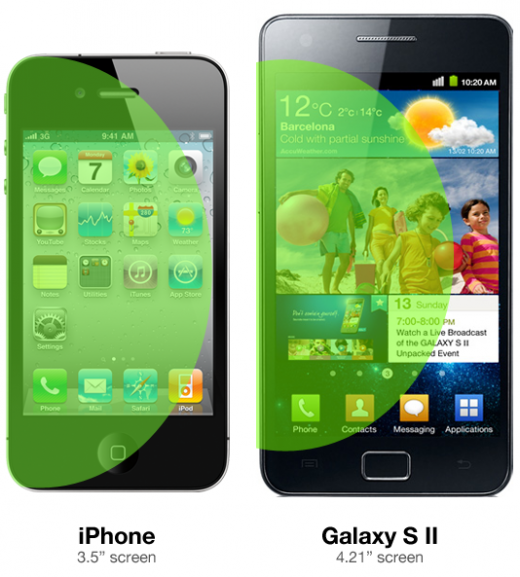
fourinches 520x577 Why the iPhones screen is 3.5 and will most likely never be bigger than 4To illustrate the point of the 'subtle inconvenience' I'll call upon an interesting article written by Matthew Panzarino on 'The Next Web'. He stated that designer Dustin Curtis had done a test in which he found that the disparate display sizes of both the iPhone 4 (3.5 inches) and the Galaxy S II (4.27 inches) made a genuine difference in terms of their usability and could perhaps pose a niggling issue for the Galaxy S II through time. He found that the display size of an iPhone 4 allowed every icon on its home screen to be reached with the thumb whilst holding the phone with one hand, whereas the limited thumb span proved too small to reach to the further edges of the display when using the Galaxy S II. To the left is a diagram that designer Dustin made to complement his contention.

Sure, you have to make a few sacrifices if you want the big and the better. That's how life and nature works right...a little give there and a little take there. But I don't think that's how it works for phones - because a smartphone is meant to materialise a vision for easy, portable computing. And traditionally a phones have blessed us with the advantage and accessibility of quick one-handed operation; the fact that phones have increased in brain size and processing power shouldn't compromise this one distinctive trait. Smartphones need to retain their one-handed usability and size because it's the only characteristic that preclude the smartphone and tablet from convergence. It's the only reason why they're still different things. Heck, if I could grab a tablet and hold it in one hand and use it with that one hand with ease I wouldn't need my phone, because my phone would just be a smaller and more eye-straining version of something I already have.

So I'm here looking at the new Galaxy Nexus and its 4.65 inch display, and I'm thinking to myself 'how big are your hands?' You might think I'm overreacting and these seemingly minor nitpicks are all in for the sake of a more spacious experience. But more than you think it's the insignificant things that leave an otherwise perfect product completely smitten - thumb hyper-extension and unnecessary two hand use are just a couple of those things. I use a 3.8 inch HTC Trophy daily and for me and my average sized hands that's just about the limit. Again, this is all completely subjective and for some of you this large screen size may suit your needs, and your hand-span, but strictly from my own personal vantage and I'm sure that of many others anything above 4 inch is a heck of a size, and anything larger than the Galaxy S II is really really pushing it.

Super size? Are you really lovin' it?

Tuesday, October 18, 2011

TECHGEEK.com.au - Design Talks - For the iPhone 4S critics

But it still looks the same...
Be sure to check out my article on TECHGEEK.com.au discussing the importance of product design and its applications to the somewhat ill-received and unexciting iPhone 4S. 

"Perhaps one of the most important lessons that Steve Jobs taught us in his tenure is that design is important. In fact, design is often more important than the very things inside that make the magic happen. That’s not to say that you’re better off having an aesthetically marvellous rock than a turd-shaped phone, but it’s saying that from a very very direct and impressionistic stand point, design talks to an audience much more than specs and inner hardware ever can..."

Thursday, October 6, 2011

Rest In Peace Steve Jobs - You Changed the World

title

There are people in this world that either love or hate Apple, and there are people in this world that either love or hate Steve Jobs, but I know that there is not a single person in this world who doesn't respect Steve Jobs for not only his achievements, but with what heart and passion that he has managed to achieve them. Jobs' is the embodiment, a personification of unparalleled genius. His incredible foresight and vision for seeing how products interweave into the very cobweb of our lives has made this place we live in a better place. With this genius, and creativity he has brought us products that have revolutionised markets, the technology industry and the way people live their lives. Without any connotations or mockery, to describe Steve Jobs' leadership as 'magical' is truly justified.

These are all in the making of what makes Steve Jobs so incredible, but without a doubt the greatest thing that Steve Jobs takes with him, is the simplest, the most obvious and the most primal of his traits - and that is his passion. To meet a man with such love, and such enthusiasm for the things he does is rare, and with this, Steve Jobs has inspired us to pursue our dreams not for secondary and reactionary means as finances and stature, but purely for the satisfaction close at heart - because it makes us happy. 

To put it in his own words - 'The only way to do great work is to love what you do. If you haven't found it yet, keep looking. Don't settle. As with all matters of the heart, you'll know when you find it.'

Steve Jobs story is almost a fairy tale of where passion and love can take us, and his love and passion augments and provides for the immeasurable genius and creativity that the man has been blessed with. We can all be happy knowing that Steve Jobs died doing what he loved the most. Even with his diagnosis of cancer several years back, Steve Jobs' love for Apple never waned, and he was there at Apple for as long as he could possibly be, with the baby he crafted and nurtured himself. And if getting fired from his own company came to prove anything, it was that Apple only truly has one father. 

So here we are, typing away on our Macbooks, slicing fruit on our iPhones and tapping away on our iPads - embracing ourselves in the magic that Steve Jobs has provided us. We're all saddened by the news of his passing, the world only ever gets one Steve Jobs and it's such a shame that the appreciation has only really been expressed openly once it's all gone. But Steve Jobs probably wouldn't have it any other way, loving our Apple products is our way of saying a subtle thanks, and thank you Steve Jobs so very much.

It feels strange imagining the tech industry without a Steve Jobs, but how much stranger and how much different would it be had he never even come around. So to quote the wise words of Dr. Seuss, 'Don't cry because it's over, smile because it happened'. And Mr. Jobs, the radiance of your innovation makes us all smile, every, single, day.

Sunday, August 28, 2011

iQuit - An Apple with Steve Jobs and an Apple without him


There aren't many times when we can look back at a CEO and say honestly that they changed the world. Sure, there are many CEOs who have changed their companies, improved operations and maybe even lead to some pretty successful product launches, but Steve Jobs I believe is the manifestation of true success. Not only did he revitalise Apple, but he managed to influence and even create several markets, when most leaders struggle to even touch one. 

Regretfully, due to poor health Steve Jobs has made the hard decision to resign as CEO of Apple. This very event has sparked a mass amount of praise and respect for Steve Jobs from people of all shapes and sizes, even from those who do not spend all their time reading technology blogs and playing with their Apple products. Strangely, it has even opened the hearts of some of the infamous Apple haters. But it has also sparked massive debates between pundits, analysts and the like regarding Apple's future. Is Apple capable of maintaining its success without Steve Jobs and sustaining the growth that it has experienced in the last decade? Can Apple still excite people and remain, well you know...cool? Or on the flip side, will Apple fall in the same fatal path subsequent to Jobs' initial departure?

Well, let me just say that the Apple that we see today will by and large be the same shining red Apple that we'll be seeing for at least the next 5 years. With products and strategies most likely laid out for the coming years, it's hard to imagine any plateauing in growth or anything that we wouldn't expect of the Steve Jobs Apple that we're well and truly accustomed to today. Tim Cook has assumed the role of CEO in the past during the events of Steve Jobs' health bouts, so it's safe to say that he's already well-versed in the operations and procedures of the captain's seat. Steve Jobs' resignation was simply reiterating in ink what was already written in pencil for Tim Cook. 

However, when the day comes that Steve Jobs actually isn't there, we definitely won't be speaking of Apple with this same assurance. It's not a bad time to start forecasting an Apple without Steve Jobs.

Allow me to just answer one budding question that has been foolishly debated - can Apple be the same without Steve Jobs? No. It is foolish to believe that Apple can remain the same without Steve, thus why the need for Steve? If his vision, his achievements, and his capabilities can and could have all been entirely replicated by someone else, Steve would have been a useless leader. Steve Jobs' became CEO of Apple because he had capabilities that no one else in the company had, thus his absence will leave a hole in the company's core. Steve Jobs leaves behind some enormous shoes that even a person of Tim Cook's calibre will have feet too small.

To me, Tim Cook has always felt like an emergency as opposed to a permanent solution. He would come in and keep the big boat afloat while Steve Jobs was away, and then Steve would come back and really propel the cruiser forward. The perceived permanence of this week's decision tells us that Steve probably won't be coming back to the helm, which only leaves me with an uneasy feeling regarding Apple's future under Tim Cook. There's just this little something that tells me that Cook is more of a numbers guy, a negotiator, or an operational guy as opposed to a creative and idea driven guy. Steve Jobs managed to create an unprecedented culture of innovation within his company, and if Cook is driven by entirely different motives it will only destroy the morale within Apple that has taken it to such peaks of success.

So how will Apple change? It's a big question with a big many answers. Perhaps it is only fitting to look back at the things that add up to what simply can't put any better than unprecedented genius.

This is quite a cliché statement but I'm going to repeat it because I believe it's one of the most monumental things that Steve Jobs will be taking away with him - his vision. I've always gone by one of my own sayings that vision is what separates those that make a profit from those that make an impact, and I can't think of a better illustration of this very idea than Steve Jobs. Sure, we can all be like Samsung and make multitudes of phones without thought and make a truck-load of money and earn market share, but will we look back on the age of smartphones and say that Samsung made a difference? I'll be damned. Steve Jobs didn't just sell his products, he sold his vision and that has made all the difference. 

Jobs has the uncanny ability to think ahead of the times and almost design the future like an architect, and then be willing to bet big on it. I'm sure we can all remember the semi-transparent iMac without the floppy drive which was insane at the time. In spite of that, this omission propelled Apple into the future of compact discs. More recently, the iPhone without a keyboard was laughed off by Steve Ballmer as being unsuitable for businessmen, it has proven a revelation. And the download-only Mac OS X Lion is only the very start of a rising era.  

Having said this, there's probably no greater exemplification of Steve Jobs' incredible forward thinking than the originality of the iPad. There are few people in this world who can look at people, live their lives and find the holes in which ideas and potential products could fit in. Whilst everyone else endlessly filled the vacancies with compromises, Jobs saw through this and without an inkling of market research he dreamt the iPad purely through the roots of his own creativity. Competitors are having a hard time fighting against the iPad because they're pursuing a vision that is not their own, but that of Steve Jobs, which is one they're not entirely sure of. If we look back in time at the most innovative and inspirational leaders and entrepreneurs, most did not believe in the 'effectiveness' of market research. Akio Morita, the co-founder of Sony Corp. famously said 'Carefully watch how people live, get an intuitive sense of what they might want and then go with it. Don't do market research.' The man created the Walkman which revolutionised our lifestyles and the music industry purely through intuition. Market research only tells us what people are buying, but not necessarily what they want, and Steve Jobs knew this. 

Oh yeah - did someone say Apple keynote without Steve? Not sure, because I can't imagine one. I simply can't imagine a keynote without Jobs up on stage in his trademark black turtleneck and junners with such subtle child-like excitement, love, and admiration for his own products. Who's going to be up there to say 'it's magical' or 'it's just fantastic' or 'one more thing'. Jobs' is a natural salesman. I could probably write a couple of thousand words on Steve Jobs' capabilities as a salesman, someone more intelligent could probably write a thesis, heck people have written books on how to be insanely great at speaking and persuading like Steve Jobs. Jobs' keynotes weren't him telling us features and specs that we could read ourselves, it wasn't him playing the commonplace PR game, nor was it him attempting to excite us over dreams he may or may not deliver. He spoke of the things that mattered to us at the most primal level - the magic of a product, how it changes 'everything' and he spoke about how things were beautiful and amazing without sounding like he fell out of a rainbow. We can only wait and see whether Tim Cook has charisma enough to get people waiting overnight in lines to get their hands on the next iPhone or the next iPad, or even the next Mac. 

So now what? What will happen to Apple? From where I stand, I have no doubt that Apple will continue to be successful for the next coming years, or even a few years after Steve Jobs takes the last step away from the company. But I hate to say that there will come a time when without a visionary like Steve Jobs at the helm or in the higher ranks, the company will stagnate when it comes that time for a revolutionary idea to keep the company in the limelight. That doesn't mean that the company will stop being successful, it simply means that the company will cease to become highly influential. 

Do all good things come to an end? Maybe. Unfortunately for Apple it seems that they've reached peaks so high that the only way for them to go is down. It's hard to imagine a visionary beyond Steve Jobs' calibre. With the culture that Apple have established within their company they're sure to find and attract talent but I doubt, I highly doubt we will find someone so talented in so many ways as Steve Jobs. Let me tell you now, Tim Cook is probably not going to cut it. It will be interesting to watch Apple's Steve-less evolution churn out. What's important for the people at Apple isn't to keep thinking 'what would Steve do?' Following a vision that is not your own is always, always second to following your own. In spite of everything I have confidence that Apple will be able to find someone who isn't quite Steve Jobs, but is just like him in a completely different way. 

Saturday, July 30, 2011

Second nature technologies for first class experiences.

By many, and notoriously for senior citizens, gadgets and tech has always been an area where years of experience and accumulated knowledge can sum up to practically zilch. What seems so obvious and almost natural for us late 80s to 90s generation sends senior heads whirling. How do I zoom in on this 'page'? What's this little scroll ball on the 'mouse'? And how do I get anything done? Basically, it's just a demoralising blankness once confronted by the display of a device. However to what will be the relief of many, technology is adapting in a way that is arguably more monumental than any other previous transformation, yet one we're hardly noticing.

What is it that makes a well designed tablet with a refined operating system an absolute joy to use? Of course it's portable and just, you know...fun, for want of a better word. But when we think about it, the pleasure of a tablet goes so much further than the initial novelty of a large touch screen. It's one of those things that affects us in the deepest but most subtle of manners. Put simply, tablets appeal to an instinctual need to connect and communicate directly with a device. When we touch or swipe, the effect of the action is instant and it feels natural. A PC plays second fiddle when compared to a touchy feely tab because it requires the mouse or keyboard as a middleman between us and our content. Example? When we zoom in on a PC we go Ctrl +, but when we zoom on a tablet, we physically touch our content and pinch our fingers and stretch, just like we would with items in the real world.

So essentially, the pleasure of a tablet lies in the simple fact that it's a product with a dangerously shallow learning curve. Why? How? It's all a simulation of the natural world we live in which we've all adapted to - swiping to scroll is a simulation of, well, the physics of nature and pinch to zoom does the same. Technologies like this don't require extensive manuals because heck, the skills required to use the product have been with us since the day we were born, they are the roots of our instincts. By allowing direct interaction, tablets bring us closer to our technology and content and thus breaking down the limiting technological wall. No wonder granny can use your iPad.

This 'instinct' factor is having applications all over the spectrum of technology, from computer OS's to social media. I was one of the first million to download Mac OS Lion on its day of launch, and by experiencing the simplicity of multi-touch gestures at first all I could muster was 'this is awesome!' Simon Sinek pointed out in his presentation regarding his Golden Circle model that our emotions and feelings are controlled by a completely different section of our brain than the one that controls rationality and language. That was the feeling I got when using Lion - it felt great, but aside from the joy of the swift motions of the multi-touch gestures I couldn't quite lay a finger on why, and all I could muster was 'this is awesome'. By appealing to natural humanly desires instead of the superficial elements of features and spec, Apple created a deeply pleasing experience, with what seemed like very little effort. 

In social media, Google+ has succeeded in creating a social networking service that emulates your real social life. The circles concept builds upon how our social life operates in our minds - we unwittingly create categories in which we organise certain friends and their importance to us. But only we're allowed to know. Google+ allows us to place these thoughts and inadvertent categorisations in a tangible form, thus realistically porting not only our friends, but the inner sanctum of our social lives onto the net. And in front page news on The Huffington Post, Randi Zuckerberg (marketing director, Facebook) stated 'anonymity on the internet has to go away'. Despite the context of her statement being in limiting cyber-bullying, anonymity online lends nothing to the growing trend of the 'instinct' factor. Nobody walks around behind closed doors, it's impossible to go out in public as an unidentifiable block of pixels, so why should it be on the internet? Google+ doesn't allow anonymity, not even fake profiles. 

I think we are at a certain cutting point in history, where we can demarcate the disparate separation between antiquated and somewhat complicated technologies and the current 'direct interaction' type of technology. We, currently, are the ones who have witnessed this change where traditionally buying a program or device means going through a lengthy set up process before 'excitedly' jumping onto the manual, up to now, where the status quo is quickly becoming installing a program through an efficient and hassle-free download process and learning the program or device through quick experimentation and prodding. Ironically, as it happens, the rate at which technology has progressed and become increasingly more complex on the inside has made technology easier on the outside. In five years time perhaps we will look at the tower desktop PC, or even a sleek all in one and award it the ignominy of the piece of gadgetry that a newbie can't just pick up and use. 

Doesn't it simply feel right when we can use technologies that are physically realistic, that respond the way we expect, behave the way expect and also act the way we act? I sure think so, and it's where the world is heading, definitely for the better. By creating technologies that are simply second nature, that understand, how we, as humans are programmed to behave not only makes technology more accessible to a wider range of differing user demographics but also creates a 'magical' first class user experience. 

Saturday, May 28, 2011

Where the PC stands in a Post-PC invasion

I thought I would discuss an interesting and also extremely debatable topic today. Currently, where does the traditional PC market stand and what is the outlook? Is it rainbows and flowery hills or murky and hellish depths? Or is it flat and unchanging, remaining a reliable segment of the consumer electronics market. Apple's iPad 2 event was quite some time ago, however there was one theme of the unveiling event that has implanted itself in my mind. Steve Jobs - the visionary, mentioned that we are living in the 'Post - PC' world now. The iPad is Apple's third post PC 'blockbuster', following the ubiquitous iPod and iPhone.

A lot of people will consider this nothing more than a clever marketing ploy, a healthy dose of Steve Jobs charisma and Apple's corporate sugar. After all, it would make logical sense to persuade consumers into the land of post-pc products if you, yourself are almost tyrannically in control of it. However the significance of Steve's statement go far beyond his desire to take your cash, but perhaps we do live in the post-pc world now. I know people who use their conventional PC multitudinously less because of the presence of their post-pc products.

Before one can even debate the future outlook of traditional PC's, it must be first defined what 'post-pc' really means. The prefix 'post' means 'after', so logically post-PC defines products that proceed PC's. This doesn't tell us much. What defines after? It can be argued that 'after' doesn't even have a significance in this instance as we can't be 'after' PCs if they still exist. As a general term, post-pc can be best defined as products that can capably replace our traditional personal computer. Smartphones for example, can do many things that PC does albeit in a smaller and more eye-straining way. This, in essence can be considered a post-pc product.

Having said that, to analyse why a shift in demand might be imminent we have to examine how the average consumer uses their computer. I once read a funny but staggeringly true statement: a computer without internet is like a bowl without fruit. This says a lot about how consumers use computers, it's abundantly clear that we spend the majority of our time on the internet. More than often we will word process, however often the things that we write are merely products of the things that we research. On the internet. We like to think that we use a lot of media software on our computers, but in all honesty a Facebook user would be hard-pressed to say that they spend more time doing other tasks on a computer than they are on Facebook. This is one of the reasons why PC's are getting bitten by our post-pc products, it's because tablets and smartphones browse the internet so well. It's all about user experience and pinching to zoom is significantly more efficient and fun than Ctrl +, using fingers to physically scroll a page rather than a scroll ball is appealing. And of course touching links rather than clicking is pleasingly natural.

I'm not a believer of dying technologies and dying trends. In consumer electronics, things never die, they merely evolve. And that is what I believe is going to happen to our PC. We will always have PC, but in 20 years time it may look a lot different than the one I'm typing on as I speak. There was once a time when technology was all about becoming more advance and gaining leaps and bounds in technicality. The feature-set and sophistication of an offering determined how good it was. However, now I believe we've reached an era where it's all about intuition. The aim now appears to be creating products that are natural and intuitive. But also experiences that successfully mimic the real, tangible products that they replace.

This might be hard to understand, but here's a scenario: Real magazines are so yesterday. It's all about the magazine subscription on your iPad. The flicking of the screen for page turning aims to mimic the experience of a real magazine, which dare I say will never be replaced. Ebook readers aim to do the same with the same flicking motion to turn pages and their paper like displays. This is also why I believe the stylus is up for a come back, the HTC Flyer has revealed its potential. People do not write with their fingers, people write with pens, and the Flyer successfully imitates the usefulness of taking notes and highlighting and circling important points. It's the only tablet on the market which can really act like one of man's timeless creations: pen and paper.

The unreleased Mac OS X Lion heads the PC transformation. The intuition factor of the iPad plays a huge part in the design of Lion. The advertised features are no longer about the inside workings and the intermediates, but rather it's about getting things done more naturally and easily. For example the new Airdrop feature removes the stigma of difficulty out of wireless file sharing. Sharing files shouldn't be a hard task, after all in the real world it would only require you to grab your paper, walk over to the person you want to give it to and physically hand it to them. It shouldn't be any harder than that on a computer. The concept of Airdrop succeeds in creating technologies as easy as nature, simply drag the file onto someone's name.

Having said this, PC will never become a tablet. The sheer feeling of productivity and power of using an actual computer will never be able to be emulated in a touchy-feely device like a tablet or a smartphone. I'm not a believer in keyboard slider tablets either, or the tablets of old with the spin around displays and touch-pen input. On paper, they are superior devices but they are merely a compromise. They neither offer the pure portability of a tablet, nor do they offer the full power of a dedicated personal computer. Nobody will ever be expected to get much work done on a tablet, they are by enlarge convenience devices which allow you to quickly touch up things. They've never been intended to be the device where you can start and complete projects. Tablet's lack of keyboard is one of the main reasons for this. So what about the Asus EeePad Transformer, or Samsung Slider? Yes, you could very well add a keyboard to a tablet, but it doesn't really measure up. If you truly wanted to be productive then I'm sure most people, and I personally would just buy a portable and capable notebook. Like a Macbook Air, for instance.

It's not about the convergence of devices, and it's not about how much a certain device can do but rather how well it does them. This is the philosophy that spells out the future of any of our devices. It's not logical to build a 5 inch smartphone/tablet, as just because it can be two devices at once, it doesn't mean that it's necessarily going to be good at them. Personally, I don't want my phone to be 5 inches, because its large screen real estate would eat into the portability factor. A tablet will supply for my large screen appetite, and personally I don't want my tablet to have a keyboard because guess what? That's what my laptop's for.

Phone, tablet, laptop: three products that serve their purpose fully and well.

Consumers don't want compromise, obviously. Nobody wants a compromise. However many manufacturers are willing to provide just that because they believe that the more devices they can combine into one determines its quality. Rather it is how well it performs its purpose that determines how good it really is. Tablets are defining the shift in consumer technology, their sales are strong because they do some of the things that PC can do in a far more natural and intuitive way. However it can't do the thing that makes PC so essential: efficiently complete work. PC will evolve and will definitely introduce more tablet like features and develop more natural and life-like experiences. But one thing's for sure -

The PC will never become a 'Post-PC' product. The PC is here to stay.

Saturday, May 14, 2011

Capturing the 'indecipherable' ladies market

Beyond stereotypical image of two women frolicking in their natural habitat
What is it that females look for in their consumer electronics? This is a puzzle that has baffled manufacturers for many years, and still no one has perfected the 'ladies' device. A brief look at the behaviours of your typical female and it's not difficult to see several traits that most of the species share: a love for fashion, shopping and social networking. And of course texting. Naturally, they are very social creatures.

Given this brief analysis of female interests, dedicated ladies electronics have generally been extremely stereotypical.  Most if not all dedicated ladies phones are jam packed with shopping applications, certain texting features, QWERTY keypads, crocodile skin aesthetics and often laden with that ghastly colour of hot pink. Perhaps throw in a free handbag in there too. None of these approaches have ever successfully completed the puzzle of consumer technology for females. I don't want to be stereotypical and say that all women are make-up obsessed, window shopping addicts, as thank god I have met many girls who are not like this. However, the general consensus is that there are many females that fit this description and a lot of consumer electronics vendors are trying to target just this. I'm going to explain why targeting females in such unimaginative ways will never work, and why targeting females at all is just an inefficient waste of time.

You might have noticed that the word indecipherable in the article title, is placed between apostrophes. This is because people assume that the ladies market is so confusing and unbreakable. We wonder if women want pink phones, or petite handbag sized netbooks. However in the end there is nothing to decipher at all. It's not as difficult as it is made out to be, there's no need to go into the deep complexities of female psychology. But rather, we just need to know one simple fact: women are just looking for a great experience. 

The fact that most women aren't as knowledgeable or interested in the tech field has forced manufacturers to blindly assume that women are to be targeted separately via alternative means. Instead of having normal products for normal people, there's suddenly a need to have modified phones for women. It's like they're not normal humans! However, piecing apart the overall market and providing tailored products for individual segments not only dilutes the value and unity of products in the lineup, but is essentially more costly. Piecing apart and spreading the target market also means spreading promotional expenditure and support expenditure. It's an inefficient way to do business. I'm not necessarily a supporter of small one product line-ups, since one product is often not enough to be able to encapsulate the entirety of the target market. However the ratio of products to consumers should always remain as small as possible. Apple has done well in this respect, though they represent an extreme in this philosophy. The iPhone is one product for all, it suits females, it suits males, it suits students and it suits business professionals.

I know there are many people and manufacturers that would aggressively counter this philosophy, Samsung is probably the most prominent of such offenders. In my opinion Samsung's smartphone line-up is excessive. Excessive to the power of 4. Daily, there is a new review of a Samsung handset: Infuse 4G, Galaxy S II, Droid Charge and plenty more. To be brutally honest, only one or two of these have a legitimate reason for existence. The Galaxy S II is a great phone, and most of the others are just cheap copies of the same device. Evidently, Samsung is trying to break the smartphone market through pure scale. Not much effort has gone into branding or exclusivity, however the 'shove in your face' factor forms the core of Samsung's smartphone effort. They want that obnoxious Samsung logo to be so ubiquitous that when picking a smartphone, the odds are that you'll end up with a Samsung. I can't say that this plan isn't effective, because I would be lying and the ubiquity of Samsung's smartphone effort is from what I've heard proving to be effective. And Samsung's strong hardware calibre has definitely earned the respect of technology enthusiasts. However speaking as a consumer and analyser of such technologies, this strategy offers little in terms of gaining brand value and consumer respect. Only time will tell Samsung's prospects.

Back on topic (consumer electronics for females), another factor that must be considered is a product's general ease of use and tech appeal. And by tech appeal, I'm referring to a lesser focus on tech appeal. A recent article that I wrote talked much about most vendors focus on hardware superiority in the tablet space, instead of aiming to excel in user experience. If technology nerds are the target market, this strategy is gold, however for everyone else and particularly ladies this strategy is far from effective. In this regard, I could say I'm much like a female, I couldn't care less about that 'ghz' and 'dual-core' junk. If it works well and smoothly then it works for me. This is why expert studies have shown that females have a strong preference for iOS over the geeky Android. iOS's omnipresence and 'I don't need a manual' interface has ensured that a lot of consumers are aware of iOS's great user experience. Android's geeky name, general geek appeal, and tailored user experience across difference devices has added confusion and complexity into Android purchases. For example, just because the Galaxy S II is a brilliant phone, I can't be guaranteed that Xperia Arc which runs on Android too will likewise be a great phone. On the flip side, I can be certain that the white iPhone 4 will be just as good as the black iPhone 4, and iPad 2 will definitely be an improvement over iPad 1. 

All up, I have shown two effective to captivate the minds of females. Being stereotyped as pink-loving window shoppers is not one of them. In actual fact, I believe that females dislike being patronised in such a way, the need to have devices specially tailored for them is somewhat degrading and evokes the feeling of deficiency. The most efficient way to capture females is to pull them into the company's overall target market, not aim for them individually by taking them out of the target market. Once again, females are just like males, looking for a great user experience, however, minus the hardware complexities.

What do you think about selling consumer electronics to women? Is it easier or harder than it looks?

Thursday, April 28, 2011

Competing in a fat tablet market, and why Android is the culprit.


We can't all help but notice the continuing overflow of tablets coming into the market. Tablet after tablet, here and there, most of no differentiation to one another. The announcement of Sony's tablet comes as no surprise as inevitably Sony would want to join the big party, albeit a little late. The product didn't surprise me either: Honeycomb, Qriocity, 'Playstation Certified' were all expected, the dual screen clamshell was surprising, especially Sony's odd design. Instead of the traditional linear chassis, instead they have opted for a distinctively curved design, which looks astoundingly similar to those glasses cases that have the ability of closing from both directions. I hope you know what I'm talking about as I am at a loss in better ways to explain it.

Nonetheless, Sony's entrance into the tablet space is well, just another tablet. Just another Android tablet.

I wanted to discuss the overflow of products in this segment with this article, it has been discussed many times before but it simply gets all the more prominent every passing day. Almost everyday, when I hang out on tech blogs, there's bound to be a new post with a table, displaying a new tablet's specifications, display size, processor, Honeycomb no doubt. And possibly a release date. Ok, cool. Forgotten. Another new tablet: Wow, Tegra 2, 1ghz dual-core! Cool story bro. Another one? The point is that all these devices are flooding in, and most of them don't manage to take hold and are just dropping in like dead fish into the sea of sameness. Instead of being, a glorious and vibrant emerging market, the tablet segment is becoming a breeding zone for 'me too' devices. We're not seeing a great collection of products that scream innovation and freshness, but rather a pile of cheap devices made simply with the mentality of 'I can do that too'.
I can sum it up pretty well in this rather clever analogy, the tablet market isn't expanding in a good way, too many devices of no value or differentiation don't add value to magnitude, rather the tablet market is becoming much like an obese person, filled with fat and excess, with little muscle.

If I was to pick someone to blame for this shocking outcome, you'll be surprised at who I'm pointing my finger at: Android.

This is certainly not a bad thing, and given some of my previous articles you might be deceived into thinking that I'm not a fan of Android. In actual fact, speaking as a consumer, we can never really get enough options or choices and Android has provided us virtually limitless choices. Speaking from a vendor's point of view however, Android's benefits have been countered almost equally by a set of growing disadvantages. There's no doubting that the sole benefit that Android has provided to its OEM's is a very good operating system with a vast app store, to compete sufficiently with the iOS app store. Additionally, OEM's will not have to spend time and funds to build their own operating system which would inherently be inferior due to the initial lack of third party applications. Sounds great at first glance, but what is most disadvantageous, is that all potential OEM's have access to this operating system, thus creating an enormous environment of virtually identical devices made by different manufacturers.

This creates the quite grand problem of finding a way to make your product exclusive amongst almost indistinguishable competitors. It's impossible to stand out in terms of app selection. It's possible to stand out in terms of user experience, but Android can only be skinned so much until it becomes loaded and impractical. Simply, in terms of the devices software, there is no way to give it enough exclusivity to warrant a no-brainer purchase over other Android competitors nor is there enough exclusivity to warrant a significant price gap over competitors as well. Thus, competing purely with software, the only hole-proof way to win in the Android space is via competitive pricing. And because bare-bones products with rock bottom prices is not feasible to many licensees, it is evident that many vendors have decided that in order to attract consumers, they must win in the hardware space. It's very obvious: high end processors, better graphic capabilities, more RAM, and faster 3G or 4G internet access. Instead of placing an emphasis on a great user experience, it appears that the focus is now on the fact that it's fast, it's light and possibly more physical connectivity to peripherals. Maybe even an attachable keyboard.
These are all good things but at the end of the day the consumer makes a decision based on four fundamental factors: how enjoyable something is to use, how easy it is to use, how customisable the device is and how attractive the product design is. Of these four major factors, only one corresponds directly to the quality of the hardware.

It's common knowledge that in a digital and connected age, the software takes precedence over the hardware. TV's are no longer purchased primarily on the quality of the picture, phones are no longer focused on call quality, nor are tablets made or broken by the specifications of the components inside. The software is what consumers experience and feel and 'connect' with, if the software isn't up to scratch, there's no way hardware can save that. This is why the Xoom was so astoundingly underwhelming at launch, and more importantly its sales volume was vastly disappointing. The Xoom was just another Honeycomb tablet, albeit the first one, and it didn't quite strike a home run with its hardware either. Despite its Tegra 2 and powerful innards, the display quality disappointed.

It's difficult, and more or less a Catch 22 situation for Android OEM's. Either win in the hardware arena or create a cheap no-frills Android tablet. None of these options is optimal in winning back market share from Apple. Through my eyes, I see two ways out of this quagmire: either introduce an exclusive service, or go out on a limb and just create an innovative and entirely new product. Possibly even start up a sub-market within the tablet segment. Neither of these are as simple as it sounds. However if there's one company off the top of my head that has the framework to achieve both of these, it's Sony.

The Playstation brand is much like a stepping stone for everywhere that Sony decides to go, and I understand and I encourage that since it would be wasteful to not utilise such a strong brand. Unfortunately though they've decided to ruin the potential exclusivity of 'Playstation Certified' by allowing it to be used by all Android vendors. However, Qriocity is still an exclusive Sony only service presently and represents the first way out of the Android dilemma: introducing an exclusive service. Like I said it's not as simple as just implementing the service into Sony devices. Qriocity is not yet a strong enough brand in its own right, and iTunes still has the immense trust and loyalty of its consumers. Also speaking of trust and reliability, Qriocity's reputation has already been damaged by the hacker predicament from the last week involving credit card access and service shut downs. Qriocity is still in relative infancy and requires time to grow, and just as importantly more funds need to be directed into marketing.

Additionally, in regards to 'creating an innovative and entirely new product' Sony has the building blocks for this too, and it was just announced this week. I'm referring to the S2 tablet, the dual-screen sun glasses case looking contraption. In my next article I will be talking more deeply about the advantages and disadvantages of the dual-screen concept. What I can say now is that dual screen has great potential if executed correctly. I don't think I've seen any manufacturer quite nail the two screen idea yet, apart from Nintendo. And even though the Nintendo DS has been a winner in the sales department, there's certainly room for improvement.

All the same, you've probably inferred it's becoming increasingly difficult for manufacturers to compete in an ever expanding tablet market. Each time a new generic Android device pops up, no matter how poor it is, everyone takes a hit. The Android arena has more or less been split into two major segments: low end no frill tablets for the simple minded and high end power tablets for the tech savvy. Here, the high end manufacturers are putting all their eggs into the hardware basket in an attempt to fend off competing Android tablets but are mindlessly missing the bigger picture. iPad. In essence, despite their obviously smaller ecosystems, platforms like webOS, and Blackberry tablet OS are in a better position, merely because they don't have to compete against generic rivals in a price battle. They can consequently put their focus into slaying the monster (iPad), not their 'allies'. Being exclusive has these advantages.

My analysis concludes that the availability of Android is become as much of a problem as it as an advantage. Given the immense scale of the Android ecosystem, manufacturers of Android tablets therefore have to deal with two battles: the battle against competing Android vendors and the more important battle against the iPad. If the race continues this way, individual Android OEM's will never be winners unless of course they can create a winning formula in either two methods I described earlier: introduce exclusive services or create entirely new products.