Showing posts with label PCs. Show all posts

Sunday, June 12, 2011

As Windows 8 changes the rules of Apple’s game


It's been over a week since Microsoft opened up the Windows to Windows 8 at Computex. Windows 8 is undoubtedly the biggest and boldest step that Microsoft have taken with their ubiquitous Windows platforms. Big and bold doesn't always win, but in all honesty it was a move Microsoft had to make, and in many ways Windows 8 still has one foot stuck in the old pond. Ross Rubin in his Switched On column on Engadget summed the change up perfectly with his article title: Windows loses it Windows. And it has indeed. It would not be an outrageous proposition if Microsoft decided to call the upcoming operating system 'Microsoft Tiles'.

Microsoft's latest projects has sparked much debate between analysts and journalists, some saying that the 'one for all' approach compromises on necessary features for both tablet and PC devices, however some say that the convergence provides an unrivalled feature set and experience for both devices. To be honest, I don't agree with any of these, neither do I believe that Windows 8 will be a failure. I like Windows 8 and I believe its potential is interesting and will have enormous effects on the market, both for tablets and personal computers.

Apple's approach to tablets and personal computers is obvious and straight-forward. They've stressed that we live in a post-pc age, essentially where our mobile devices become the core of our computing experiences as opposed to our traditional personal computers. This article comes at a fitting time since Mac OS X Lion was just announced a few days ago which gives me a solid ground for comparison. Lion brings many really interesting and innovative features to OS X, including the iPad like launchpad and multiple desktops – a feature that I really love. The multi-touch gestures that allow you to sweep between desktops and full screen applications and the launchpad all exemplify Apple's continual push for Post-PC. Apple is tablet-ifying the PC.

Microsoft's approach to the two computing segments is remarkably different. To be quite frank, I don't believe Microsoft has ever taken the tablet seriously until now, and most certainly doesn't have the same ideas as Apple on what a tablet should be. In Apple's eye a tablet is a new device that simplifies and makes tasks more convenient. In Microsoft's eyes, a tablet is a convenient and portable version of your PC. Microsoft are clearly aware that the user experience needs to be better optimised for touch-screen, but Windows 7 running on a tablet represents the power and versatility that Microsoft believes is possible in a tablet, and Windows 8 finally provides the user experience which has become imperative in our gadgets.

In essence, while Apple is busy tablet-ifying our PCs, Microsoft is busy PC-ing our tablets. And with the one OS for all approach is also making our PCs a little more like tablets. There was one particular announcement that stood out for me, and that was the announcement that Windows 8 would have the ability to run legacy applications despite the OS's monumental shift away from traditional Windows. This announcement surprised everyone, me included. After all, it would have been a hole-proof strategy to have built the tablet OS separately and maintained and optimised the original Windows OS for traditional personal computers. After all, two separate operating systems would allow Microsoft to fully focus on two different segments and thus provide a full experience for both. Right? It’s very easy to question Microsoft’s intelligence here, especially since surely they have learnt that desktop operating systems clearly don’t work on tablets. However, I doubt Microsoft took this decision lightly. Microsoft’s intentions are more complex than simply providing an operating system that works on tablets and PCs.

What Hybrid PCs would look like (Samsung Slider 7)
I believe that Microsoft is trying to combine the two devices. The risky approach accounts for this perfectly. Windows 8 provides OEMs a potent combination of a beautiful and user friendly tablet UI without doing away entirely with a powerful experience. Naturally, vendors are going to try and leverage both these assets of Windows 8 resulting in a breed of ‘hybrid tablet PCs’. By hybrid tablet PC, I’m referring to the likes of the Samsung Sliders and Asus Transformer. With a touch display to take advantage of the tablet UI and a keyboard to align with the power experience which Microsoft doesn't want to compromise. I’d be hard pressed to say that anyone missed the days of the spin around display tablets of old, I’m experiencing a bit of deja vu here. But unlike previously, I can actually see some real and genuine potential.

In my article stating my views on 'post-pc' I stated that notebook and tablet hybrids are a compromise. They neither offer the pure portability of a stand-alone tablet nor the power and versatility of a notebook PC. However much of the basis of my conclusion was simply that there was no OS optimised for a hybrid device. Before the unveiling of Windows 8 we only had a purely PC operating system and purely tablet and mobile operating systems. With Microsoft's new operating system, they aren't just providing these devices a second shot at life, but they're going to give birth to a new generation of them.

Windows 8 is interesting in that I definitely envision it to be successful in its hybrid form factor, but I can hardly see it as an upgrade for desktops or even normal notebooks currently. A touch oriented UI like the one on Windows 8 will never, and allow me to stress, never, work effectively on hardware that operates with mouse and cursor. Even with the easy keyboard controls that Microsoft promises. I mean, just because there's ultimately nothing wrong with operating the new Metro UI with the keyboard does not mean that it's necessarily better than what we currently have with Windows 7. No way in hell will enterprise which are traditionally slow to adopt new technologies upgrade to a new OS which works in an unwieldy manner with the hardware they currently own. Because of this, I don't really see Windows 8 as a new operating system but rather as an extension to what we have currently. As far as the demos have shown us, Windows 8 operating on a computer without touch-input is awkward, and more importantly not worth an upgrade over Windows 7.

Despite this, I'm absolutely certain Windows 8 on a hybrid PC will sure be a winner for new computer buyers.

Overall, I like Windows 8. It’s innovative, new and daring, but it remains to be seen whether it will be successful. Windows 8 will prove itself to be highly interesting and definitely one to watch. And the unexciting desktop computer space may finally exhibit a long sought for transformation. The touch optimisation of Windows 8 has strong potential to launch a new line of touch desktops, like the Vaio L. In 5 - 7 years time with Windows 8, perhaps our desktop will look like huge touch-screen slates on our desks, wouldn’t that just be marvellous?

OS X Lion is a solid update for Mac computers, but for once maybe Apple played it too conservative (but then again $30 for a new operating system is impossible to say no to). The hybrid PC’s that Microsoft has laid the eggs for could well be the thing that dismantles the universal view of what tablets are. Apple has told the world that tablets are personal ‘post-pc’ devices that are convenient with a beautifully natural user experience. With Windows 8, Microsoft wants to tell the world that tablets don’t have to be ‘post-pc’ and that it’s legitimately possible to combine the power of a full Windows experience with the nature and beauty of optimised tablet UI design. In a similar way that Apple created the game with the iPad, Microsoft has come in and is changing the rules. The big questions is, whether these new rules will gain the acceptance of the masses.

Saturday, May 28, 2011

Where the PC stands in a Post-PC invasion

I thought I would discuss an interesting and also extremely debatable topic today. Currently, where does the traditional PC market stand and what is the outlook? Is it rainbows and flowery hills or murky and hellish depths? Or is it flat and unchanging, remaining a reliable segment of the consumer electronics market. Apple's iPad 2 event was quite some time ago, however there was one theme of the unveiling event that has implanted itself in my mind. Steve Jobs - the visionary, mentioned that we are living in the 'Post - PC' world now. The iPad is Apple's third post PC 'blockbuster', following the ubiquitous iPod and iPhone.

A lot of people will consider this nothing more than a clever marketing ploy, a healthy dose of Steve Jobs charisma and Apple's corporate sugar. After all, it would make logical sense to persuade consumers into the land of post-pc products if you, yourself are almost tyrannically in control of it. However the significance of Steve's statement go far beyond his desire to take your cash, but perhaps we do live in the post-pc world now. I know people who use their conventional PC multitudinously less because of the presence of their post-pc products.

Before one can even debate the future outlook of traditional PC's, it must be first defined what 'post-pc' really means. The prefix 'post' means 'after', so logically post-PC defines products that proceed PC's. This doesn't tell us much. What defines after? It can be argued that 'after' doesn't even have a significance in this instance as we can't be 'after' PCs if they still exist. As a general term, post-pc can be best defined as products that can capably replace our traditional personal computer. Smartphones for example, can do many things that PC does albeit in a smaller and more eye-straining way. This, in essence can be considered a post-pc product.

Having said that, to analyse why a shift in demand might be imminent we have to examine how the average consumer uses their computer. I once read a funny but staggeringly true statement: a computer without internet is like a bowl without fruit. This says a lot about how consumers use computers, it's abundantly clear that we spend the majority of our time on the internet. More than often we will word process, however often the things that we write are merely products of the things that we research. On the internet. We like to think that we use a lot of media software on our computers, but in all honesty a Facebook user would be hard-pressed to say that they spend more time doing other tasks on a computer than they are on Facebook. This is one of the reasons why PC's are getting bitten by our post-pc products, it's because tablets and smartphones browse the internet so well. It's all about user experience and pinching to zoom is significantly more efficient and fun than Ctrl +, using fingers to physically scroll a page rather than a scroll ball is appealing. And of course touching links rather than clicking is pleasingly natural.

I'm not a believer of dying technologies and dying trends. In consumer electronics, things never die, they merely evolve. And that is what I believe is going to happen to our PC. We will always have PC, but in 20 years time it may look a lot different than the one I'm typing on as I speak. There was once a time when technology was all about becoming more advance and gaining leaps and bounds in technicality. The feature-set and sophistication of an offering determined how good it was. However, now I believe we've reached an era where it's all about intuition. The aim now appears to be creating products that are natural and intuitive. But also experiences that successfully mimic the real, tangible products that they replace.

This might be hard to understand, but here's a scenario: Real magazines are so yesterday. It's all about the magazine subscription on your iPad. The flicking of the screen for page turning aims to mimic the experience of a real magazine, which dare I say will never be replaced. Ebook readers aim to do the same with the same flicking motion to turn pages and their paper like displays. This is also why I believe the stylus is up for a come back, the HTC Flyer has revealed its potential. People do not write with their fingers, people write with pens, and the Flyer successfully imitates the usefulness of taking notes and highlighting and circling important points. It's the only tablet on the market which can really act like one of man's timeless creations: pen and paper.

The unreleased Mac OS X Lion heads the PC transformation. The intuition factor of the iPad plays a huge part in the design of Lion. The advertised features are no longer about the inside workings and the intermediates, but rather it's about getting things done more naturally and easily. For example the new Airdrop feature removes the stigma of difficulty out of wireless file sharing. Sharing files shouldn't be a hard task, after all in the real world it would only require you to grab your paper, walk over to the person you want to give it to and physically hand it to them. It shouldn't be any harder than that on a computer. The concept of Airdrop succeeds in creating technologies as easy as nature, simply drag the file onto someone's name.

Having said this, PC will never become a tablet. The sheer feeling of productivity and power of using an actual computer will never be able to be emulated in a touchy-feely device like a tablet or a smartphone. I'm not a believer in keyboard slider tablets either, or the tablets of old with the spin around displays and touch-pen input. On paper, they are superior devices but they are merely a compromise. They neither offer the pure portability of a tablet, nor do they offer the full power of a dedicated personal computer. Nobody will ever be expected to get much work done on a tablet, they are by enlarge convenience devices which allow you to quickly touch up things. They've never been intended to be the device where you can start and complete projects. Tablet's lack of keyboard is one of the main reasons for this. So what about the Asus EeePad Transformer, or Samsung Slider? Yes, you could very well add a keyboard to a tablet, but it doesn't really measure up. If you truly wanted to be productive then I'm sure most people, and I personally would just buy a portable and capable notebook. Like a Macbook Air, for instance.

It's not about the convergence of devices, and it's not about how much a certain device can do but rather how well it does them. This is the philosophy that spells out the future of any of our devices. It's not logical to build a 5 inch smartphone/tablet, as just because it can be two devices at once, it doesn't mean that it's necessarily going to be good at them. Personally, I don't want my phone to be 5 inches, because its large screen real estate would eat into the portability factor. A tablet will supply for my large screen appetite, and personally I don't want my tablet to have a keyboard because guess what? That's what my laptop's for.

Phone, tablet, laptop: three products that serve their purpose fully and well.

Consumers don't want compromise, obviously. Nobody wants a compromise. However many manufacturers are willing to provide just that because they believe that the more devices they can combine into one determines its quality. Rather it is how well it performs its purpose that determines how good it really is. Tablets are defining the shift in consumer technology, their sales are strong because they do some of the things that PC can do in a far more natural and intuitive way. However it can't do the thing that makes PC so essential: efficiently complete work. PC will evolve and will definitely introduce more tablet like features and develop more natural and life-like experiences. But one thing's for sure -

The PC will never become a 'Post-PC' product. The PC is here to stay.

Thursday, May 5, 2011

Imperfect technologies: The two faces of dual-screen.


I think that the concept of multiple screen devices falls along with the stylus in the box of brilliant concepts that have never quite been executed to the point of perfection. Both of these technologies are applicable to tablet devices and mobile computing, the stylus used to be the primary input method for PDA's and old mobile contraptions of the like. As for dual-screen, off the top of my head I can only think of one iconic device or trend that has utilised this idea, an that is the Nintendo DS.

The success of Apple often forces us to believe that Apple's way and concepts are the only truly effective ways to do things. For example manufacturers have believed that since the iPad has been such a phenomenal success, therefore large touch screen devices are what they should be making. However, it's simply because there is nothing better in the market currently. It's great to know this since it means that certain ideas such as the stylus and dual-screen are not dead, however simply need to be implemented in a way that is not outdated or just a burden as such. In this article I will be talking about the advantages and disadvantages of dual screen and how I believe it can be successfully implemented. Hence the two faces.

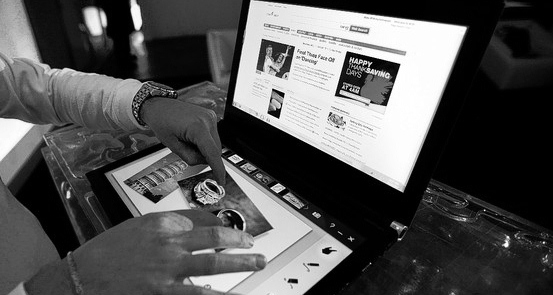
To be honest, I don't think I have seen a successful application of dual-screen ever, apart from the Nintendo DS handheld. And being a small gaming device, it's hard to apply the same ideas that have contributed to the DS's success to tablet devices and mobile computing. The Acer Iconia Touchbook isn't a terrible attempt, however there are many of the same issues that have plauged dual-screen devices in the past present. And once again, its limitations and annoyances, most particularly the touch-screen keyboard don't make up for its increased screen real estate. Also, that obnoxious gap between the two displays that has been haunting the dual screen concept for a long time, has still not been taken care of or put to good use.

A rather obvious and large advantage of the two screens is basically more display estate for essentially the same size given their ability to fold up. One of the limitations - not quite a limitation but on a relative scale when compared with dual screen devices - of tablets is simply the fact that a 10 inch form factor will only permit at most a 10 inch display. Whereas on dual screen devices, it can be double that.

The gap or hinge between the two displays is often viewed as a hindrance to dual screen contraptions, and if nothing is done to help put them to good use then it really is one of the most infuriating limitations technology has ever seen. However, since nothing can be done to get rid of it, the logical way is to find some way in which it can actually assist us. Much the same way that Sony should have hired George Hotz to help build security measures into the Playstation products. Nonetheless, I believe that the gap can be useful, because it provides a physical or mental boundary between certain tasks. Come to think of it, its potential in multitasking productivity is quite vast. Any of you Windows 7 users will know how handy that quick snap split screen feature really is, I myself didn't know how much I needed this nifty functionality until I got my hands on Windows 7.

Dual screen contraptions can work in much the same way. Perhaps you want to download some PDF's while sending an email to your boss, or play a game with the capability of not having your fat thumb on the persons face that you're trying to shoot. Perhaps you want to IMDB a certain movie on one display, while watching it on the other display. Maybe something much more simple, like working on your files on one display while organising it on the other. All of these inevitably increase productivity significantly.

Apple's success has created the assumption that tablets are all about 99 cent apps, having fun, making movies and playing music and not about productivity as such. You could argue that the iPad does have many apps available that sufficiently do productive tasks, however Apple doesn't market it this way therefore obviously doesn't intend the iPad to be this. However the fact is that consumers actually do want to get work done on tablets. The desire to do productive work on tablets is evident because many consumers are struggling to make the pick between a low end notebook or a tablet, obviously because they want the tablet form factor but the productive capabilities of the notebook.

Dual-screen lends a lot in terms of its practicality in doing productive tasks. The last in my pack of useful functions: 'organising files while working on them' is actually quite an important one, and one that I believe will be of great use to consumers. Most of the other examples are somewhat obvious, however this one's potency will be often underestimated. By organising files, I don't mean specifically that, however it represents an umbrella word for sorting things out, putting things together and accessing things easily.
Perchance you're just gathering some information for a particular assignment, just snippets of a webpage, and an image or two. Instead of arduously undergoing a tedious copy and paste process, flicking snippets and images onto the other display for collection or accumulation is an increasingly more appealing way to get work done. Another example would be using one display as a Windows Explorer / Mac Finder kind of thing, and the other for previewing files or working on them, this would allow constant and easy access to content.

Think about the iPad, it doesn't offer the same ease of use in multi-tasking as this dual screen approach would. Working side by side is essentially impossible, and using two windows or applications at once requires constantly flipping between the two, which is hardly productive. An apt dual screen approach should be able to eradicate such restrictions.

Many people when thinking of dual screen devices form this image in their head of someone holding one like a book, however dual-screens versatility in itself is potentially a huge selling point. Hold it like a book, use it like a notebook, game on one like a DS: it's all possible with two screens. Obviously some uses will be impractical if the size of the device does not permit, for example DS-like gaming on two 10-inch displays in somewhat preposterous. However as was seen in the Sony S2 dual-screen tablet promo video, a demonstration was shown depicting the bottom screen being used for game controls, whilst the top obviously for the game visuals. This is great for gamers since there is nothing worse then having fingers in the way of gameplay.

Dual-screen isn't the only way in which true productivity can be achieved on a tablet or mobile device, however it's definitely a step in the right direction. Despite its strong benefits there are many things that can really hamper the dual-screen experience, and most of these crimes have been committed already.

Simply having two screens for the sake of having two screens is extremely distasteful. The gap between the screen has no use when dual-screen is implemented in this manner, and only makes the user progressively more frustrated that there is gaping black line running through their Youtube video or webpage. In extreme cases the frustration can escalate to a point where the user snaps the device in two hoping to end up with two singular screen devices. Also, if no OS optimisation is made to take advantage of the two screens, then again it is simply wasted.

Perhaps one day dual-screen will finally be able to reach its full potential. With current available software and operating systems, none of them are built specifically optimised to take advantage of dual screens. Android I suppose can be customised, but I have mentioned before that customisation can only go so far. In the end, the double screen concept needs truly capable software to back it up, otherwise it's just like a beautiful glass with no Coke inside. Manufacturers moreover need to not be afraid to go against Apple's flow, I said this in one of my older articles regarding the 'sea of sameness', but the key really is 'don't sell what a consumer is buying, sell what a consumer wants'. Does the consumer really want what they're buying? They think so but their preferences can only go as far as what they see available. The iPad is the only thing that's truly appealing, perhaps a really great dual-screen tablet with an optimised OS is what consumers want even more. 

Sunday, March 20, 2011

Vaio Nostalgia: A shadow of its past. *tear*


Here I am, enjoying some alone time sitting on a park bench with the wind peacefully blowing and the sun gradually setting, having a think over some things like you do when you're enjoying alone time. I think about school and my science project on biological warfare, I think about life in general, more importantly, with my Vaio Z blinking it's amber power light next to me, I have a think about Vaio's. 
What do I come up with? I see a dying brand.

I remember a time when the Vaio name meant premium class computers, innovative, versatile and powerful. 
I used to respect Vaio as a brand synonymous with high-end computers, which were able to be tough as nails, and as powerful as god, yet achieve this in such grace and style. The only Vaio that embodies this description today is the new S series, and the Z depending on whether the computer has been discontinued in your country or not. 

Don't get me wrong I'm still a fan of Vaio's, being a Sony fan, however I am disappointed at best with the way the Vaio brand has ended up the way it is today. Many factors have contributed to the way I now view the Vaio brand, and the way consumers see the Vaio brand and the way Sony has used the Vaio brand. Long gone are the TT, TZ, TX and SZ series Vaio's which were created in a period, which I believe was the epitome of the Vaio brand, the TT, TZ and TX were simply marvelous computers, and dare I say, compared to similar notebooks today, are still comparable if not better.

Some people get nostalgic over there childhood, others get nostalgic over past events, I get nostalgic over the old Vaio spirit. The old Vaio spirit was one of creation, innovation and non-conformism. Now, I don't see a spirit at all in the Vaio brand, I simply see a brand falling into the same old corporate trap, the deathly spiral of money and greed.

Basically, more than anything, the Vaio lost its spirit.

I've always viewed the most successful consumer electronics companies as the ones that are run through the desire to create and inspire, rather than simply to make money. Henry Ford famously said, 'a business that makes nothing but money is a poor business.' This quote is written in the 'About Me' section of my blog, because it is simply so instrumental to a companies success, and so true, hence why it's my favourite quote. The old Vaio that I used to love, embodied this phrase like no other, the UX Vaio, was creative, innovative, but so niche it was almost useless. But the fact that it was useless and didn't sell that well, doesn't matter as such, since it alluded the Vaio spirit of non conformism, back in a time when Sony weren't afraid to go out on a limb and create something just completely different, and insanely creative. It said a lot about the Vaio brand.

Old favourites like the TT, TX, TZ and SZ are the yardsticks of the Vaio I once loved - premium, expensive and uncompromising. All, have been replaced by inferior and more generic models.
Now, I grimace as I write this, the E series, perhaps it’s just a personal hatred, but the E series represents the lowest of the low for the current Vaio line-up. Bland, fat, and poor battery life, the E series completely defies the legacy of the vastly acclaimed ‘T’ (TT, TZ and TX) models. Don’t get me wrong, they are perfectly adequate computers, however apart from being blindingly colourful, they don’t offer anything of value to live up to the ‘Vaio premium’, or the ‘Sony tax’ as others call it. It is appropriate to argue that the E series is better value than the X series or the P series which are both, in a pure performance for price ratio - inferior computers. But both the P series and X series are unique one-of-a-kind machines, and are incomparable with computers from competing vendors, the E series on the other hand, is hell deep in the sea of sameness.

Perhaps it was just natural evolution to have the Vaio degrade in such a way, maybe Sony themselves haven’t even noticed what has happened. But I think this sudden and unbidden alteration winds us back to the usual suspect: targeting a larger market. This general mentality is frowned upon in many industries, in the music industry it’s called ‘selling out’. In consumer electronics it doesn’t have a specific name, but it’s frowned upon nevertheless. Microsoft did it with the Kinect, and is Sony doing it with the Vaio? I think so. The Vaio brand as we knew it previously provided high-end and expensive computers that catered for the people who wanted the lot with absolutely no compromises. This in itself created a brand image of premium, high-class quality computers - when we thought of Vaio, we thought of a man in a slick tux chilling in a boardroom, or an elegant woman gracefully clasping a Vaio in her hands. Now our thoughts range from a young teen with a colourful Vaio, to a businessman with a jet black Vaio to your classy and fashionable lady with a sleek gold Vaio. In other words, a case of brand dilution.

I'm not saying that Vaio's should only be bought by snobby rich people, but having a certain image to which the Vaio is associated immediately gives it value. The Vaio of old meant premium, so if someone found a Vaio of equal spec and price to a competing vendor, Vaio would be the logical choice simply because of the brand. My basic point is, a strong brand, helps boost sales too. In trying to cater for a larger market, Sony have damaged it.

We look at Vaio now, and yeah maybe they are making more money than before, and in a purely business sense, more 'successful'. I cannot help but reiterate Henry Ford's philosophy once again, 'A business that makes nothing but money is a poor business'. If Sony are here simply to make money, then why do they try? Why do they continue to create amazing products like the Playstation, why do they bother with 3D when it's not making them that much money? In consumer electronics, you can't survive with the philosophy of just making money. I hope Sony are here because they want to create, to innovate and to touch the hearts of consumers and make lives better.

How does it feel to be no different from your competitors? Right now the Vaio brand doesn't hold much against its competition, but it used to. There is nothing more shameful and degrading than to be drowning ass deep in the sea of sameness. The Vaio still has enough brand equity to make a comeback. The simple fact is, Sony has shown in the past with older Vaio's, that Sony definitely can be better than the competition.

So why waste their time being like everyone else?