Saturday, May 28, 2011

Where the PC stands in a Post-PC invasion

I thought I would discuss an interesting and also extremely debatable topic today. Currently, where does the traditional PC market stand and what is the outlook? Is it rainbows and flowery hills or murky and hellish depths? Or is it flat and unchanging, remaining a reliable segment of the consumer electronics market. Apple's iPad 2 event was quite some time ago, however there was one theme of the unveiling event that has implanted itself in my mind. Steve Jobs - the visionary, mentioned that we are living in the 'Post - PC' world now. The iPad is Apple's third post PC 'blockbuster', following the ubiquitous iPod and iPhone.

A lot of people will consider this nothing more than a clever marketing ploy, a healthy dose of Steve Jobs charisma and Apple's corporate sugar. After all, it would make logical sense to persuade consumers into the land of post-pc products if you, yourself are almost tyrannically in control of it. However the significance of Steve's statement go far beyond his desire to take your cash, but perhaps we do live in the post-pc world now. I know people who use their conventional PC multitudinously less because of the presence of their post-pc products.

Before one can even debate the future outlook of traditional PC's, it must be first defined what 'post-pc' really means. The prefix 'post' means 'after', so logically post-PC defines products that proceed PC's. This doesn't tell us much. What defines after? It can be argued that 'after' doesn't even have a significance in this instance as we can't be 'after' PCs if they still exist. As a general term, post-pc can be best defined as products that can capably replace our traditional personal computer. Smartphones for example, can do many things that PC does albeit in a smaller and more eye-straining way. This, in essence can be considered a post-pc product.

Having said that, to analyse why a shift in demand might be imminent we have to examine how the average consumer uses their computer. I once read a funny but staggeringly true statement: a computer without internet is like a bowl without fruit. This says a lot about how consumers use computers, it's abundantly clear that we spend the majority of our time on the internet. More than often we will word process, however often the things that we write are merely products of the things that we research. On the internet. We like to think that we use a lot of media software on our computers, but in all honesty a Facebook user would be hard-pressed to say that they spend more time doing other tasks on a computer than they are on Facebook. This is one of the reasons why PC's are getting bitten by our post-pc products, it's because tablets and smartphones browse the internet so well. It's all about user experience and pinching to zoom is significantly more efficient and fun than Ctrl +, using fingers to physically scroll a page rather than a scroll ball is appealing. And of course touching links rather than clicking is pleasingly natural.

I'm not a believer of dying technologies and dying trends. In consumer electronics, things never die, they merely evolve. And that is what I believe is going to happen to our PC. We will always have PC, but in 20 years time it may look a lot different than the one I'm typing on as I speak. There was once a time when technology was all about becoming more advance and gaining leaps and bounds in technicality. The feature-set and sophistication of an offering determined how good it was. However, now I believe we've reached an era where it's all about intuition. The aim now appears to be creating products that are natural and intuitive. But also experiences that successfully mimic the real, tangible products that they replace.

This might be hard to understand, but here's a scenario: Real magazines are so yesterday. It's all about the magazine subscription on your iPad. The flicking of the screen for page turning aims to mimic the experience of a real magazine, which dare I say will never be replaced. Ebook readers aim to do the same with the same flicking motion to turn pages and their paper like displays. This is also why I believe the stylus is up for a come back, the HTC Flyer has revealed its potential. People do not write with their fingers, people write with pens, and the Flyer successfully imitates the usefulness of taking notes and highlighting and circling important points. It's the only tablet on the market which can really act like one of man's timeless creations: pen and paper.

The unreleased Mac OS X Lion heads the PC transformation. The intuition factor of the iPad plays a huge part in the design of Lion. The advertised features are no longer about the inside workings and the intermediates, but rather it's about getting things done more naturally and easily. For example the new Airdrop feature removes the stigma of difficulty out of wireless file sharing. Sharing files shouldn't be a hard task, after all in the real world it would only require you to grab your paper, walk over to the person you want to give it to and physically hand it to them. It shouldn't be any harder than that on a computer. The concept of Airdrop succeeds in creating technologies as easy as nature, simply drag the file onto someone's name.

Having said this, PC will never become a tablet. The sheer feeling of productivity and power of using an actual computer will never be able to be emulated in a touchy-feely device like a tablet or a smartphone. I'm not a believer in keyboard slider tablets either, or the tablets of old with the spin around displays and touch-pen input. On paper, they are superior devices but they are merely a compromise. They neither offer the pure portability of a tablet, nor do they offer the full power of a dedicated personal computer. Nobody will ever be expected to get much work done on a tablet, they are by enlarge convenience devices which allow you to quickly touch up things. They've never been intended to be the device where you can start and complete projects. Tablet's lack of keyboard is one of the main reasons for this. So what about the Asus EeePad Transformer, or Samsung Slider? Yes, you could very well add a keyboard to a tablet, but it doesn't really measure up. If you truly wanted to be productive then I'm sure most people, and I personally would just buy a portable and capable notebook. Like a Macbook Air, for instance.

It's not about the convergence of devices, and it's not about how much a certain device can do but rather how well it does them. This is the philosophy that spells out the future of any of our devices. It's not logical to build a 5 inch smartphone/tablet, as just because it can be two devices at once, it doesn't mean that it's necessarily going to be good at them. Personally, I don't want my phone to be 5 inches, because its large screen real estate would eat into the portability factor. A tablet will supply for my large screen appetite, and personally I don't want my tablet to have a keyboard because guess what? That's what my laptop's for.

Phone, tablet, laptop: three products that serve their purpose fully and well.

Consumers don't want compromise, obviously. Nobody wants a compromise. However many manufacturers are willing to provide just that because they believe that the more devices they can combine into one determines its quality. Rather it is how well it performs its purpose that determines how good it really is. Tablets are defining the shift in consumer technology, their sales are strong because they do some of the things that PC can do in a far more natural and intuitive way. However it can't do the thing that makes PC so essential: efficiently complete work. PC will evolve and will definitely introduce more tablet like features and develop more natural and life-like experiences. But one thing's for sure -

The PC will never become a 'Post-PC' product. The PC is here to stay.

Saturday, May 14, 2011

Capturing the 'indecipherable' ladies market

Beyond stereotypical image of two women frolicking in their natural habitat
What is it that females look for in their consumer electronics? This is a puzzle that has baffled manufacturers for many years, and still no one has perfected the 'ladies' device. A brief look at the behaviours of your typical female and it's not difficult to see several traits that most of the species share: a love for fashion, shopping and social networking. And of course texting. Naturally, they are very social creatures.

Given this brief analysis of female interests, dedicated ladies electronics have generally been extremely stereotypical.  Most if not all dedicated ladies phones are jam packed with shopping applications, certain texting features, QWERTY keypads, crocodile skin aesthetics and often laden with that ghastly colour of hot pink. Perhaps throw in a free handbag in there too. None of these approaches have ever successfully completed the puzzle of consumer technology for females. I don't want to be stereotypical and say that all women are make-up obsessed, window shopping addicts, as thank god I have met many girls who are not like this. However, the general consensus is that there are many females that fit this description and a lot of consumer electronics vendors are trying to target just this. I'm going to explain why targeting females in such unimaginative ways will never work, and why targeting females at all is just an inefficient waste of time.

You might have noticed that the word indecipherable in the article title, is placed between apostrophes. This is because people assume that the ladies market is so confusing and unbreakable. We wonder if women want pink phones, or petite handbag sized netbooks. However in the end there is nothing to decipher at all. It's not as difficult as it is made out to be, there's no need to go into the deep complexities of female psychology. But rather, we just need to know one simple fact: women are just looking for a great experience. 

The fact that most women aren't as knowledgeable or interested in the tech field has forced manufacturers to blindly assume that women are to be targeted separately via alternative means. Instead of having normal products for normal people, there's suddenly a need to have modified phones for women. It's like they're not normal humans! However, piecing apart the overall market and providing tailored products for individual segments not only dilutes the value and unity of products in the lineup, but is essentially more costly. Piecing apart and spreading the target market also means spreading promotional expenditure and support expenditure. It's an inefficient way to do business. I'm not necessarily a supporter of small one product line-ups, since one product is often not enough to be able to encapsulate the entirety of the target market. However the ratio of products to consumers should always remain as small as possible. Apple has done well in this respect, though they represent an extreme in this philosophy. The iPhone is one product for all, it suits females, it suits males, it suits students and it suits business professionals.

I know there are many people and manufacturers that would aggressively counter this philosophy, Samsung is probably the most prominent of such offenders. In my opinion Samsung's smartphone line-up is excessive. Excessive to the power of 4. Daily, there is a new review of a Samsung handset: Infuse 4G, Galaxy S II, Droid Charge and plenty more. To be brutally honest, only one or two of these have a legitimate reason for existence. The Galaxy S II is a great phone, and most of the others are just cheap copies of the same device. Evidently, Samsung is trying to break the smartphone market through pure scale. Not much effort has gone into branding or exclusivity, however the 'shove in your face' factor forms the core of Samsung's smartphone effort. They want that obnoxious Samsung logo to be so ubiquitous that when picking a smartphone, the odds are that you'll end up with a Samsung. I can't say that this plan isn't effective, because I would be lying and the ubiquity of Samsung's smartphone effort is from what I've heard proving to be effective. And Samsung's strong hardware calibre has definitely earned the respect of technology enthusiasts. However speaking as a consumer and analyser of such technologies, this strategy offers little in terms of gaining brand value and consumer respect. Only time will tell Samsung's prospects.

Back on topic (consumer electronics for females), another factor that must be considered is a product's general ease of use and tech appeal. And by tech appeal, I'm referring to a lesser focus on tech appeal. A recent article that I wrote talked much about most vendors focus on hardware superiority in the tablet space, instead of aiming to excel in user experience. If technology nerds are the target market, this strategy is gold, however for everyone else and particularly ladies this strategy is far from effective. In this regard, I could say I'm much like a female, I couldn't care less about that 'ghz' and 'dual-core' junk. If it works well and smoothly then it works for me. This is why expert studies have shown that females have a strong preference for iOS over the geeky Android. iOS's omnipresence and 'I don't need a manual' interface has ensured that a lot of consumers are aware of iOS's great user experience. Android's geeky name, general geek appeal, and tailored user experience across difference devices has added confusion and complexity into Android purchases. For example, just because the Galaxy S II is a brilliant phone, I can't be guaranteed that Xperia Arc which runs on Android too will likewise be a great phone. On the flip side, I can be certain that the white iPhone 4 will be just as good as the black iPhone 4, and iPad 2 will definitely be an improvement over iPad 1. 

All up, I have shown two effective to captivate the minds of females. Being stereotyped as pink-loving window shoppers is not one of them. In actual fact, I believe that females dislike being patronised in such a way, the need to have devices specially tailored for them is somewhat degrading and evokes the feeling of deficiency. The most efficient way to capture females is to pull them into the company's overall target market, not aim for them individually by taking them out of the target market. Once again, females are just like males, looking for a great user experience, however, minus the hardware complexities.

What do you think about selling consumer electronics to women? Is it easier or harder than it looks?

Saturday, May 7, 2011

Recollecting Sony's handling of the hacker quandary: Stringer must go.


Given it's the biggest tech news going around these two weeks I thought I would comment on the PSN hacking debacle and how Sony have handled it, or not handled it. I'm not going to go into detail about the specifics and intermediates of the event as you've probably read it millions of times and are sick of the same news all over again. Overall, I would rate Sony's handling of the situation decent, but to be honest not too flash. It was largely because of the initial delayed responses and the general lack of specifics that made consumers nervous, and even angry. However, updates have been consistent and frequent which is great, and the occasional Q & A's have really assisted in keeping nervous consumers informed.

I'm not a Playstation or Qriocity customer myself, which you might say is odd given that I blog about this stuff weekly. There were many aspects of Sony's handling that I found disappointing. The fact that Kaz Hirai addressed and apologised to the public in an entirely Japanese press meeting was unacceptable. It's not modern news that Sony is a Japanese company and many of the execs speak Japanese much more fluently and understandably than they do English, however this is a worldwide problem and the least they could do is address a worldwide audience. We have seen the execs speak English at CES, which is a proud and beneficial event for an electronics corporation. However in this case of shame and mortification it is abundantly clear they've chosen to hide behind the language barrier.

Which brings me to my next point, and most important point, where was Howard Stringer? In this situation of desperation where a leader need be present to show agitated consumers who's in control. Perhaps casually lazing by a pool or a high-end game of golf with other wealthy figures. It's not a good image when a leader is present in such events like CES to promote products, yet goes missing for a fortnight when he's most needed to repair the products. Being a leader is not a title or a job. Becoming a leader is crafted by actions, and Stringer's lack of action and commitment has seen my respect bar for him drop to a new low. It was only today, two weeks after the situation began that he issued a public letter to consumers. Even this was simply an echo of what has already been said far too many times by the Sony group. Themes like 'we are sorry', 'we've been working around the clock', 'the hacking was a criminal act' were rampant in Stringer's letter, and yet the letter failed to offer any strong answers to the questions that have been haunting customers for the last 14 days. The media has been all over him for not going public since the incident began, this overdue letter is simply to seek the praise and acceptance of the media.


I believe that this lack of commitment shows us that Stringer is certainly not the right person to head Sony. It's time that Stringer left the helm. It's time for a new face for Sony, one that represents light and potential for the corporation. Stringer's charisma fooled me, he is definitely not the man for the job.


Stringer's need to leave isn't solely because of the hacker outbreak, but this incident represents a possible breaking point. Now I realise that he's a funny and painfully charming man with not enough knowledge in consumer electronics and consumer behaviour to really drive Sony forward. When Stringer took the top job in 2005, he brought along with him several goals with which he wanted to achieve by the end of his tenure. Most notably, the one he wanted to achieve was breaking down 'silo walls'. He wanted the company to integrate its technologies, to work together on projects instead of separately, and to create a unified product line. So far that hasn't happened. I understand that company turnarounds of such magnitude require time but 6 years is simply too long. He turned Sony into a shallow corporation, throwing big parties, huge events and flashy marketing campaigns for products that would never live up to the hype. Walkman X for example was launched in a decorated train carriage, however Walkman X wasn't even able to create a ripple in the MP3 market. The PS3 is now fighting for top spot, when its predecessor the PS2 had an almost impassable lead. And besides all this, the corporation's media subsidiaries Sony Pictures and Sony Music still aren't creating any worthy synergy with the hardware that the company sells.

Sony's inability to provide competitive products in a competitive market has been troubling. The inability to create a unified platform despite their bounty of resources is disappointing. And more importantly, their inability to recapture the spirit of the old days is the biggest problem of them all. The PSN predicament is the bubble burst for Stringer. Stringer had the right idea, however didn't go about them effectively. Under Stringer, the company has created products and attempted to integrate them later, however products need to be created with the sole purpose of integration in mind.

Is Kaz Hirai the right man for the job then? I thought so, however I think Kaz Hirai's reputation has been jeopardised by Stringer's ineptitude. In my opinion, a young fresh mind is what the company needs to feed its innovation appetite once again. A young fresh mind, or a beginners mind. Beginners minds are great because they aren't hampered by difficult past experiences, their minds aren't infected by 'oh, we tried that, this won't work'. Like infants, they are curious and creative, and their thoughts are ocassionally out of line with deemed reality, yet can often lead to ridiculously innovative ideas. The best products aren't created through thorough market research, however purely from a sense of the consumers desires. Additionally, I believe that it would be preferable to have someone who can't be associated with such mishaps like this hacker debacle.

Perhaps it's a good thing that the hacking has happened, its allowed Sony to rethink what's gone wrong and possibly make for a restructuring of the company's board. Stringer is a good man no doubt, however his lack of commitment and passion for the Sony group has been clearly evident this fortnight, and this is the last thing Sony needs.

What are your thoughts on Stringer?

Thursday, May 5, 2011

Imperfect technologies: The two faces of dual-screen.


I think that the concept of multiple screen devices falls along with the stylus in the box of brilliant concepts that have never quite been executed to the point of perfection. Both of these technologies are applicable to tablet devices and mobile computing, the stylus used to be the primary input method for PDA's and old mobile contraptions of the like. As for dual-screen, off the top of my head I can only think of one iconic device or trend that has utilised this idea, an that is the Nintendo DS.

The success of Apple often forces us to believe that Apple's way and concepts are the only truly effective ways to do things. For example manufacturers have believed that since the iPad has been such a phenomenal success, therefore large touch screen devices are what they should be making. However, it's simply because there is nothing better in the market currently. It's great to know this since it means that certain ideas such as the stylus and dual-screen are not dead, however simply need to be implemented in a way that is not outdated or just a burden as such. In this article I will be talking about the advantages and disadvantages of dual screen and how I believe it can be successfully implemented. Hence the two faces.

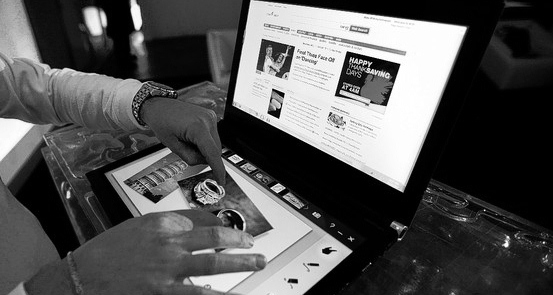
To be honest, I don't think I have seen a successful application of dual-screen ever, apart from the Nintendo DS handheld. And being a small gaming device, it's hard to apply the same ideas that have contributed to the DS's success to tablet devices and mobile computing. The Acer Iconia Touchbook isn't a terrible attempt, however there are many of the same issues that have plauged dual-screen devices in the past present. And once again, its limitations and annoyances, most particularly the touch-screen keyboard don't make up for its increased screen real estate. Also, that obnoxious gap between the two displays that has been haunting the dual screen concept for a long time, has still not been taken care of or put to good use.

A rather obvious and large advantage of the two screens is basically more display estate for essentially the same size given their ability to fold up. One of the limitations - not quite a limitation but on a relative scale when compared with dual screen devices - of tablets is simply the fact that a 10 inch form factor will only permit at most a 10 inch display. Whereas on dual screen devices, it can be double that.

The gap or hinge between the two displays is often viewed as a hindrance to dual screen contraptions, and if nothing is done to help put them to good use then it really is one of the most infuriating limitations technology has ever seen. However, since nothing can be done to get rid of it, the logical way is to find some way in which it can actually assist us. Much the same way that Sony should have hired George Hotz to help build security measures into the Playstation products. Nonetheless, I believe that the gap can be useful, because it provides a physical or mental boundary between certain tasks. Come to think of it, its potential in multitasking productivity is quite vast. Any of you Windows 7 users will know how handy that quick snap split screen feature really is, I myself didn't know how much I needed this nifty functionality until I got my hands on Windows 7.

Dual screen contraptions can work in much the same way. Perhaps you want to download some PDF's while sending an email to your boss, or play a game with the capability of not having your fat thumb on the persons face that you're trying to shoot. Perhaps you want to IMDB a certain movie on one display, while watching it on the other display. Maybe something much more simple, like working on your files on one display while organising it on the other. All of these inevitably increase productivity significantly.

Apple's success has created the assumption that tablets are all about 99 cent apps, having fun, making movies and playing music and not about productivity as such. You could argue that the iPad does have many apps available that sufficiently do productive tasks, however Apple doesn't market it this way therefore obviously doesn't intend the iPad to be this. However the fact is that consumers actually do want to get work done on tablets. The desire to do productive work on tablets is evident because many consumers are struggling to make the pick between a low end notebook or a tablet, obviously because they want the tablet form factor but the productive capabilities of the notebook.

Dual-screen lends a lot in terms of its practicality in doing productive tasks. The last in my pack of useful functions: 'organising files while working on them' is actually quite an important one, and one that I believe will be of great use to consumers. Most of the other examples are somewhat obvious, however this one's potency will be often underestimated. By organising files, I don't mean specifically that, however it represents an umbrella word for sorting things out, putting things together and accessing things easily.
Perchance you're just gathering some information for a particular assignment, just snippets of a webpage, and an image or two. Instead of arduously undergoing a tedious copy and paste process, flicking snippets and images onto the other display for collection or accumulation is an increasingly more appealing way to get work done. Another example would be using one display as a Windows Explorer / Mac Finder kind of thing, and the other for previewing files or working on them, this would allow constant and easy access to content.

Think about the iPad, it doesn't offer the same ease of use in multi-tasking as this dual screen approach would. Working side by side is essentially impossible, and using two windows or applications at once requires constantly flipping between the two, which is hardly productive. An apt dual screen approach should be able to eradicate such restrictions.

Many people when thinking of dual screen devices form this image in their head of someone holding one like a book, however dual-screens versatility in itself is potentially a huge selling point. Hold it like a book, use it like a notebook, game on one like a DS: it's all possible with two screens. Obviously some uses will be impractical if the size of the device does not permit, for example DS-like gaming on two 10-inch displays in somewhat preposterous. However as was seen in the Sony S2 dual-screen tablet promo video, a demonstration was shown depicting the bottom screen being used for game controls, whilst the top obviously for the game visuals. This is great for gamers since there is nothing worse then having fingers in the way of gameplay.

Dual-screen isn't the only way in which true productivity can be achieved on a tablet or mobile device, however it's definitely a step in the right direction. Despite its strong benefits there are many things that can really hamper the dual-screen experience, and most of these crimes have been committed already.

Simply having two screens for the sake of having two screens is extremely distasteful. The gap between the screen has no use when dual-screen is implemented in this manner, and only makes the user progressively more frustrated that there is gaping black line running through their Youtube video or webpage. In extreme cases the frustration can escalate to a point where the user snaps the device in two hoping to end up with two singular screen devices. Also, if no OS optimisation is made to take advantage of the two screens, then again it is simply wasted.

Perhaps one day dual-screen will finally be able to reach its full potential. With current available software and operating systems, none of them are built specifically optimised to take advantage of dual screens. Android I suppose can be customised, but I have mentioned before that customisation can only go so far. In the end, the double screen concept needs truly capable software to back it up, otherwise it's just like a beautiful glass with no Coke inside. Manufacturers moreover need to not be afraid to go against Apple's flow, I said this in one of my older articles regarding the 'sea of sameness', but the key really is 'don't sell what a consumer is buying, sell what a consumer wants'. Does the consumer really want what they're buying? They think so but their preferences can only go as far as what they see available. The iPad is the only thing that's truly appealing, perhaps a really great dual-screen tablet with an optimised OS is what consumers want even more. 

Thursday, April 28, 2011

Competing in a fat tablet market, and why Android is the culprit.


We can't all help but notice the continuing overflow of tablets coming into the market. Tablet after tablet, here and there, most of no differentiation to one another. The announcement of Sony's tablet comes as no surprise as inevitably Sony would want to join the big party, albeit a little late. The product didn't surprise me either: Honeycomb, Qriocity, 'Playstation Certified' were all expected, the dual screen clamshell was surprising, especially Sony's odd design. Instead of the traditional linear chassis, instead they have opted for a distinctively curved design, which looks astoundingly similar to those glasses cases that have the ability of closing from both directions. I hope you know what I'm talking about as I am at a loss in better ways to explain it.

Nonetheless, Sony's entrance into the tablet space is well, just another tablet. Just another Android tablet.

I wanted to discuss the overflow of products in this segment with this article, it has been discussed many times before but it simply gets all the more prominent every passing day. Almost everyday, when I hang out on tech blogs, there's bound to be a new post with a table, displaying a new tablet's specifications, display size, processor, Honeycomb no doubt. And possibly a release date. Ok, cool. Forgotten. Another new tablet: Wow, Tegra 2, 1ghz dual-core! Cool story bro. Another one? The point is that all these devices are flooding in, and most of them don't manage to take hold and are just dropping in like dead fish into the sea of sameness. Instead of being, a glorious and vibrant emerging market, the tablet segment is becoming a breeding zone for 'me too' devices. We're not seeing a great collection of products that scream innovation and freshness, but rather a pile of cheap devices made simply with the mentality of 'I can do that too'.
I can sum it up pretty well in this rather clever analogy, the tablet market isn't expanding in a good way, too many devices of no value or differentiation don't add value to magnitude, rather the tablet market is becoming much like an obese person, filled with fat and excess, with little muscle.

If I was to pick someone to blame for this shocking outcome, you'll be surprised at who I'm pointing my finger at: Android.

This is certainly not a bad thing, and given some of my previous articles you might be deceived into thinking that I'm not a fan of Android. In actual fact, speaking as a consumer, we can never really get enough options or choices and Android has provided us virtually limitless choices. Speaking from a vendor's point of view however, Android's benefits have been countered almost equally by a set of growing disadvantages. There's no doubting that the sole benefit that Android has provided to its OEM's is a very good operating system with a vast app store, to compete sufficiently with the iOS app store. Additionally, OEM's will not have to spend time and funds to build their own operating system which would inherently be inferior due to the initial lack of third party applications. Sounds great at first glance, but what is most disadvantageous, is that all potential OEM's have access to this operating system, thus creating an enormous environment of virtually identical devices made by different manufacturers.

This creates the quite grand problem of finding a way to make your product exclusive amongst almost indistinguishable competitors. It's impossible to stand out in terms of app selection. It's possible to stand out in terms of user experience, but Android can only be skinned so much until it becomes loaded and impractical. Simply, in terms of the devices software, there is no way to give it enough exclusivity to warrant a no-brainer purchase over other Android competitors nor is there enough exclusivity to warrant a significant price gap over competitors as well. Thus, competing purely with software, the only hole-proof way to win in the Android space is via competitive pricing. And because bare-bones products with rock bottom prices is not feasible to many licensees, it is evident that many vendors have decided that in order to attract consumers, they must win in the hardware space. It's very obvious: high end processors, better graphic capabilities, more RAM, and faster 3G or 4G internet access. Instead of placing an emphasis on a great user experience, it appears that the focus is now on the fact that it's fast, it's light and possibly more physical connectivity to peripherals. Maybe even an attachable keyboard.
These are all good things but at the end of the day the consumer makes a decision based on four fundamental factors: how enjoyable something is to use, how easy it is to use, how customisable the device is and how attractive the product design is. Of these four major factors, only one corresponds directly to the quality of the hardware.

It's common knowledge that in a digital and connected age, the software takes precedence over the hardware. TV's are no longer purchased primarily on the quality of the picture, phones are no longer focused on call quality, nor are tablets made or broken by the specifications of the components inside. The software is what consumers experience and feel and 'connect' with, if the software isn't up to scratch, there's no way hardware can save that. This is why the Xoom was so astoundingly underwhelming at launch, and more importantly its sales volume was vastly disappointing. The Xoom was just another Honeycomb tablet, albeit the first one, and it didn't quite strike a home run with its hardware either. Despite its Tegra 2 and powerful innards, the display quality disappointed.

It's difficult, and more or less a Catch 22 situation for Android OEM's. Either win in the hardware arena or create a cheap no-frills Android tablet. None of these options is optimal in winning back market share from Apple. Through my eyes, I see two ways out of this quagmire: either introduce an exclusive service, or go out on a limb and just create an innovative and entirely new product. Possibly even start up a sub-market within the tablet segment. Neither of these are as simple as it sounds. However if there's one company off the top of my head that has the framework to achieve both of these, it's Sony.

The Playstation brand is much like a stepping stone for everywhere that Sony decides to go, and I understand and I encourage that since it would be wasteful to not utilise such a strong brand. Unfortunately though they've decided to ruin the potential exclusivity of 'Playstation Certified' by allowing it to be used by all Android vendors. However, Qriocity is still an exclusive Sony only service presently and represents the first way out of the Android dilemma: introducing an exclusive service. Like I said it's not as simple as just implementing the service into Sony devices. Qriocity is not yet a strong enough brand in its own right, and iTunes still has the immense trust and loyalty of its consumers. Also speaking of trust and reliability, Qriocity's reputation has already been damaged by the hacker predicament from the last week involving credit card access and service shut downs. Qriocity is still in relative infancy and requires time to grow, and just as importantly more funds need to be directed into marketing.

Additionally, in regards to 'creating an innovative and entirely new product' Sony has the building blocks for this too, and it was just announced this week. I'm referring to the S2 tablet, the dual-screen sun glasses case looking contraption. In my next article I will be talking more deeply about the advantages and disadvantages of the dual-screen concept. What I can say now is that dual screen has great potential if executed correctly. I don't think I've seen any manufacturer quite nail the two screen idea yet, apart from Nintendo. And even though the Nintendo DS has been a winner in the sales department, there's certainly room for improvement.

All the same, you've probably inferred it's becoming increasingly difficult for manufacturers to compete in an ever expanding tablet market. Each time a new generic Android device pops up, no matter how poor it is, everyone takes a hit. The Android arena has more or less been split into two major segments: low end no frill tablets for the simple minded and high end power tablets for the tech savvy. Here, the high end manufacturers are putting all their eggs into the hardware basket in an attempt to fend off competing Android tablets but are mindlessly missing the bigger picture. iPad. In essence, despite their obviously smaller ecosystems, platforms like webOS, and Blackberry tablet OS are in a better position, merely because they don't have to compete against generic rivals in a price battle. They can consequently put their focus into slaying the monster (iPad), not their 'allies'. Being exclusive has these advantages.

My analysis concludes that the availability of Android is become as much of a problem as it as an advantage. Given the immense scale of the Android ecosystem, manufacturers of Android tablets therefore have to deal with two battles: the battle against competing Android vendors and the more important battle against the iPad. If the race continues this way, individual Android OEM's will never be winners unless of course they can create a winning formula in either two methods I described earlier: introduce exclusive services or create entirely new products.

Thursday, April 21, 2011

Confessions from a Walkman devotee. How long can a fan hold on?


Dear Sony, when are you due for a Walkman X upgrade?

Often I ask myself this question, yet I can never be sure whether a new Walkman is in the works. Nobody really knows if Sony have completely given up on the Walkman, the X series I mean. Will there still be a market for standalone PMPs in around 5 years time? Questionable. My Walkman X1060 isn't getting old or dilapidated by any means, in actual fact I can proudly say it's in pristine condition. My leather case has protected my little baby well. But why do I always search Walkman in Google news to see what rumors have sparked regarding an upgrade. I guess, it's just the comfort I'm seeking of knowing what my next media player will be once my Walkman really does go down the drain.

...Perhaps I should tell you the story from the start.

3 years ago I was the proud owner of a Sony Ericsson Walkman W880i phone, if you're familiar with the 'About Me' section of this blog you would know exactly the phone I'm talking about. That very phone served me from late 6th grade through to mid 8th grade as my primary music player. With its 1GB M2 micro memory card, the little in-ear Sony Ericsson buds and that booming Megabass EQ function, that phone kept me rocking all that time, my boredom buddy I would call it. Yes I know, 1GB was enough for me at the time, how many songs could a 7th grader have? As time progressed though, I started to feel like some sort of outcast. All my mates had their iPod nanos and those ubiquitous white buds while here I was rocking my 1 gig worth of tracks on a Sony Ericsson handset. Like the normal kid I was, I succumbed to the pressure and bought an iPod, an iPod Touch. How quickly I went from just the ordinary phone guy to the one with the iPod was astonishing. Back in that time the iPod Touch was a rare specimen in our school, I believe I was the first one in the year level to get one. I would have mates scrambling around me often to try out that cool app: iBowl, Tap Tap Revenge, Crash Kart, old classics like that. I would even have kids I had never talked to or affiliated myself with come up to me for a spin on the Touch. But over time the cool appeal faded. Everybody had an iPod Touch, apps lost their usefulness and jailbreaking took the satisfaction and joy out of purchasing apps.

And I was missing my booming Megabass.

Then strolled in Walkman A729, my first dedicated Sony media player. Oh, the sound! Boy I missed the bliss of quality sound after using that iPod. That booming bass, those fantastic rubber tip earbuds. But how an upgrade could be such a downgrade! I took for granted the convenience of a browser on a mobile device, I took for granted so many functions on my iPod that I overlooked when I had it in my possession. The dictionary I missed the most. Oh, the arduousness of flipping through an actual dictionary. With my Walkman A729, I felt unique that's for sure, but along with that I felt regressed somewhat. I had thrown away all the perks of the Touch and gone back to the bare basics of music, video and photos. And a clock. How could I enjoy the sound quality of owning a Walkman, yet still enjoy the extra perks that my Touch had offered? I knew that I couldn't quite have it all, there had to be some kind of compromise somewhere. Walkman X was my first viable option, it had the internet browsing, touch screen and Youtube, and as far as my research concluded still had the same legendary sound quality I had expected from my experiences with Walkman A729. And like a cherry on the cake it had Digital noise cancelling to top it off. Timely as a sparrow at dawn I spotted a great deal on eBay, and prancing in came Walkman X1060. 12 movies, a TV season and 1500 songs later, here I am today.
The proud owner of a Walkman X series.

There's about 3 years of my life summed up in a lengthy couple of paragraphs. I hope you get the gist. I've never been afraid of voicing my devotion to the Walkman, however that has changed of late. I'm still a fan but lately I've felt that I'm only devoted to the brand and not so much the product itself. I have absolutely no problem in saying I'm a proud owner of a Walkman but every time I pull the contraption out of my pocket, the feeling doesn't quite equate.

I have received an innumerable number of inquisitions over why I didn't just get an iPod Touch instead. The apps and the whole iTunes ecosystem is so bloody tempting. There is no way I could possibly counter iOS's enormous ecosystem of content. What could I say about the Walkman? Well it has great sound quality and it...it...has an OLED screen and it...well yeah. Here I am defending a brand that I've been solely devoted to for the last three years when really there is nothing of fundamental value there to defend. I was a fanboy by all means and perhaps I still am. Fanboys are blind, and now I realise how blind I really was. I look back and I see that sacrificed so much just to get behind a brand and a product that I was so mindlessly in love with.

Had I stuck with the iPod instead perhaps things would be so much different. I haven't touched that horrific browser on the Walkman in months, I would rather wait for a computer to boot if I wanted to Google something. At least I have the comfort of knowing that it will be able to render correctly the sites I will be visiting. Not to mention that diabolical keypad on the Walkman. The real world practicality of apps is questionable but perhaps I would be doing so many things in a more mobile manner and more efficiently with the iPod. The Walkman X's limited capabilities don't help with anything besides enjoying my media. How many times have I shamefully asked to use someone else's iPod or iPhone to briefly check something up, or even worse, to play an app? Numerous times, and all that time they're probably thinking: 'sucked in bud, should've got an iPod'.

I was fully aware of the Walkman's limitations before I purchased it. I can't recall what was going through my head when I made my mind and settled on the Walkman, but I guess I figured, it's a great price on eBay, when the new Walkman comes out I'll just sell the X back and hopefully break even. Then of course purchase the new one which would hopefully be awesome. It seemed like a pretty hole-proof plan, I did overlook one hole though. That was if Sony never made a new Walkman. Well right now, air is seeping through that one hole, and its getting larger and larger.

Sony knows what the fans want: a proper browser, apps, a comparable experience to what the iPod Touch is offering. But instead they mock us, chucking out irrelevant junk like the E series and the S series. The only decent offering being the A series, which satanically isn't available in the states and has been removed from the market here in Australia. The Xperia phones are nice aren't they, but I've already got a phone, I'm not a mountain of money. Not to mention the Xperia phones don't even carry Walkman brandng for their music players - no thank you says Walkman fan. Additionally a dedicated Walkman phone doesn't appeal to any of us, because it's just not the same, it doesn't offer the legendary sound quality we've all been spoilt with and it's really just fan bait. I get the feeling that Walkman phones only take advantage of the loyalty of Walkman users.

'Oh, our smartphone business is a little down, don't worry we'll chuck a 'W' on one of those phones and those fanboy suckers will be salivating more than a twelve year old reading Twilight.' 

There's nothing differentiating in terms of their functionality, they just have a nice orange 'W' slapped on. Sony I hate to tell you, but your Walkman devotees have a sweet bevy of alternatives at their hands: Zune HD, certain Cowon models... We're not readily just going to pick up a Zune and just ditch the Walkman. But Sony's tempting an exodus.

It's confusing, what do they want to do with the Walkman. Are they just going to ditch a brand that literally carried them for 30 odd years, one of their most famous and beloved brands thrown into the dust just like that? Are they really that morally deficient? I don't know, perhaps for the sake of business sense. Nobody can know what's going inside the heads of the Walkman department at Sony HQ, but I think they're confused. Stuck between saving an old brand, or utilising other methods to get themselves started in portable entertainment. But all this time while they're stuck deciding, my Walkman X gets older and older. New iOS and Android devices keep on pouring in, pushing my Walkman further and further behind the times. In a few years time my Walkman will be like the tortoise in the the tortoise and the hare, but this time, the hare never stops. Yet, when my Walkman's time is up and no new quality Walkman comes out...I'm in uncharted waters.

Do I think Sony's going to roll out a new Walkman? No, but I still want one all the same. I'm hesitating in getting a new PMP or maybe a smartphone simply because there is still an inkling of hope I will be able to enjoy Walkman again in a beefy new flavour. If I make the leap and switch somewhere else, I would sorely miss the sound, and the Digital Noise Cancelling. But do these features and that 'W' logo really measure up against the sacrifices I've had to make to obtain them. I used to think so, but in a growing and expanding age I'm beginning to doubt it now. Zune HD will give me great sound with some apps and a decent browser. iPod Touch will give me everything with forgiveable sound. And an Android smartphone will give me everything too, with decent sound also I suspect. Perhaps it's time to make the leap, I'm beginning to think waiting for a new Walkman won't bear me any fruits.

I don't regret my purchase of the Walkman X mind you. It's a great media player and the noise cancelling has really assisted in shutting up the noisy private school snobs on the tram. However when it's time for upgrade and there really is no upgrade, I have no choice but to jump ship. It doesn't leave me, a Walkman diehard in a good place, to me, it's a moral dilemma. I take this stuff too personally. In the face of stiff competition and continual releases of new devices, the limitations and sheer backwardness of Walkman X really come to light. Thus I've come to the realisation and many other anxious Walkman fans that we can't let the connection for the 'W' hold us back any further. How can we expect to cling on and have faith in a brand that really doesn't have any faith in itself.

I'm sticking with Walkman X for now, it's not the time yet. But remember Sony, time to get the act together, or you're losing me too...

Wednesday, April 20, 2011

Cisco dumps the Flip. What about you Sir Bloggie?


How ironic that my last article stated how I was having a break from my school work yet I've spent the last week trying to finish it off. Nevertheless it's great to be back. What I came back here for was to discuss the demise of the Flip. It's all old news now, more than a week late but I haven't had any time. I can't say the Flip's recent demise was a surprise, the product just felt out of place in the connected and converged world of consumer tech that we live in today. There are several reasons that form the basis of my analysis as to why Cisco shut down the Flip line of camcorders.

How often do you find that a market share leading device get shut down just like that? Two years running after Cisco purchased Pure Digital for 590 million dollars and all of it is essentially down the drain. Probably the largest contributing factor was the pressure from competition. Essentially smartphones and other portable media devices were eating into Flip's dwindling niche segment, it couldn't go on forever. Why would one choose to pick up a stand alone device when they can get comparable devices half the size that can essentially do twice as much.

This is really where it all fell apart, Cisco really didn't know where the Flip wanted to be, what it wanted to be and what kind of people it was supplying. They never wanted the Flip to be the do-it-all devices that are all the rage today. Flip was always going to be a camcorder for the unprofessional, it attracted a certain lifestyle. That grab and go lifestyle was what the Flip really wanted to achieve. Oh, an untimely event? No problem I have my Flip camcorder handy in my back pocket or in my handbag. Then strolled in smartphone and iPod, talk about untimely events! Smartphone or iPod didn't give consumers the same quality video as Flip did, but if people really cared about quality then why not get a proper full size camcorder. The smartphone and iPod essentially stole the market from Flip by providing an inevitably less focused, but more capable product.

This is what I meant by saying the Flip didn't know where it wanted to be. It wanted to be your camcorder  for your grab and go requirements, but it also wanted to be of a great quality, which added to its size and gave it its niche factor.
In trying to be so many things, Flip didn't really end up being anything. 

Cisco's core business revolves around supplying network solutions to big business and enterprise. This is where it started for them, and its where their focus really is, being the significantly larger part of their business structure. Sucked in by the glamour and success stories of the consumer market, Cisco purchased Pure Digital and more importantly the Flip brand. However the new spread of focus saw Cisco confused with its priorities. HP and others threatened Cisco in the enterprise market, everyone threatened Cisco in consumer market. Where should the focus go? Focus half and half on both wars and logic says you'll eventually lose both. The Cisco restructuring set the priorities straight, the consumer market simply wasn't where Cisco belonged. Flip hung by a thread, and Cisco chopped it.

This whole news on the Flip camcorder shut down begs the question: what about the Sony Bloggie? Or any other mini camcorder for that matter. Are they destined for the same fate? I would believe so. History tells us, common sense tells us, and even biological evolution has shown us that things without a reason for existence, will cease to exist. This is the case for the Bloggie, the product is trapped like a sandwich between two hearty buns. Exactly like the Flip it doesn't want to be high-end, but it's not low end enough to allow for convergence with other devices. Additionally, it's hampered by a hunky slice of beetroot on top with competition from it's own siblings like the Cybershot line, Xperia smartphone line and possibly even the Handycam line. The Bloggie is the unwanted child.

Back to the Flip, despite all its missteps, Flip was a successful contraption. It managed to succeed against the odds until Cisco made the decision to chop it. Whenever I saw someone with a Flip, I would think to myself isn't your phone or digital camera good enough? Either way, Flip had an effect on consumers that can't be described and in spite of overwhelming pressure from encroaching market segments Flip still fought on.

Monday, April 11, 2011

The importance of the in-store experience.


Saturday, being the first day of the term holidays I gave myself a break from the stresses of all my homework and assignments and took an off day. Not quite an off day, I was still relatively active traveling off to various places, but off from anything school related at least. First a property auction with dad, then to a computer store to hopefully get my Vaio serviced to be told that it must wait till Monday, then to another computer store to find that they weren't even open, and then finally, to the Sony store. I didn't take my Vaio to the Sony store to get it serviced as their quoted price was light-years beyond what we considered to be an appropriate price point, but we dropped in just so dad could check out some camcorders. That's all.

Initially it was intended to be a go in, get out sort of affair, and that was the kind of experience that I had become accustomed to when visiting the Sony Centre. In the past there had never been anything striking that had achieved successfully to stray me from my sense of focus. Our intention was to have a look at various camcorder models and then straight back to the car. Though there was something pleasantly different about my experience at the Sony Centre that day, I was distracted.

Distraction is generally a notion that is frowned upon, and is associated with a lack of productivity or a blatant unnecessary usage of time, but when it comes to creating a good store, distraction is truly an achievement. Why is it that in a supermarket all the essentials are located at the end, advertently forcing you to walk past a collection of 'distractions' subtly screaming at you to be purchased. Why is it that at any store products are never boxed and price labelled vacuously, but are open and set up to be seen, touched and experienced. I'm sure stores are designed with this 'distraction' factor in mind.

As I mentioned previous visits to the Sony Centre never evoked this pleasant distraction factor. However most of my visits to JB Hi-Fi or the Apple Store are initiated upon distraction. I never have any intention of dropping into these places or purchasing anything when I do, but I always drop in when I walk past, because the excitement of playing with something new or seeing something new is enough to pull me in. At my visit on Saturday to the Sony Centre the first thing I noticed was the usual wall of camcorders to the left, the table of Vaio's in the centre and the wall of Bravia televisions at the very end. Though the interesting thing to my left was a display, and above it it said something along the lines of 'smile to take a photo'. It was meant to advertise the smile detection feature on some Cyber-shot models, basic concept was that you smiled at the Cyber-shot and it would automatically take a photo of you displayed on the big screen. My sister and I had a lot of fun with this, and it was only then that the monumental importance of the in-store experience really struck me.

There was a young couple, no older than 25 years old that didn't appear to be your usual geeky tech consumer. They were having an absolute ball playing with the contagiously fun device and I recall one jokingly saying 'I feel like a kid again'. I had never realised what really made a great product or experience until then. Of course you have the usual generic factors like 'it has to look good' and 'it has to be durable and enjoyable to use', but it is really those products and experiences that change people that can be truly considered to be successful. The couple were there completely in a world of their own pulling faces at the camera, dancing around, creating hand gestures to try and fool the camera into thinking it was a smile, with a complete disregard to the people including me, looking at them amused. My sister by nature isn't a consumer electronics guru, as long as the product works, then it works for her. Even she though was entertained by this most infectious contraption. I had never seen my sister so voluntarily occupied by what was nothing more than just a digital camera.

I always knew the store experience was important, customer service has to be good, products have to be displayed and able to be experienced and touched. But I didn't think it was this important. Consumers open up to new experiences whether they're a fan or not in the first place. I'm sure if I saw a real working Teletubby outfit in a Supre (teeny clothing chain) store I would have a new found respect for Supre, even though these stores are bottom of the barrel in my collection of displeasing venues. From this, it's appropriate to conclude that the store experience is almost equal in importance to the product itself. Creating the product is one thing, but if people aren't able to experience it to its full potential before purchase then consumers can't appropriately evaluate what they're paying for.

Amidst all my ramble you might be struggling to see the point behind this article, but the idea is that the experience when a consumer walks into a store is crucial to how a consumer feels about a product, a brand and can make or break a potential purchase. Had that camera been cheaper or we had been less lacking in funds, that camera very well might have been an impulse buy. Sony can't simply go with the assumption that stores are merely a place to purchase items, they are much more, they are a place to learn, experience and maybe even have a little fun. Sony realise this, and they've responded especially with the opening of the first 'Sony Store' in Los Angeles, but Sony's store presence in Australia is still really lacklustre. My sister walked in grudgingly, the mere notion of an electronics store upset her, but in the end it was all smiles, pun intended. The young couple were distracted like little children at this painfully addictive contraption; I'm sure they hadn't walked in with the knowledge of the existence of such a fun device, perhaps they hadn't even walked in to have a look at cameras at all.

Bottom line is, a great store isn't just a place to take money from your buyers, but a place to capture your potential consumers. This, is the importance of the in-store experience.

Tuesday, April 5, 2011

How would I change the Xperia Play. Opinions from a hater.

As it is, the Xperia Play is junk, 'playful' junk if you must.
There is no way one could possibly sugarcoat the Xperia Play's imminent demise. The product and concept in itself was looking to face an uphill battle already, however the lackluster end product pretty much sealed the deal. I don't want to appear to quick to judge though, the Xperia Play still could win an audience of gaming enthusiast who have a complete disregard to the Play's limitations, but a brief analysis will conclude that the Play won't make it. Instead of ranting about how much the Xperia Play would fail though, I figured I would channel these thoughts to more construction tasks, like pretending I was Sony Ericsson and the things I would do to make the Xperia Play a more appealing product.

I just thought that I would add that this brief analysis will be based on reviews of the handset that I have read as obviously I have not been able to get my hands on one (and will probably never).

Displays are normally one of Sony/Sony Ericsson's strong areas with experience from the Bravia line and a legacy dating back to the first Trinitrons. However reviews are telling how phenomenally disappointing the display really is for a phone of this caliber. What's more disappointing is how phenomenally awesome the Xperia Arc's screen is in comparison, so now we know it's not a case of not knowing, they simply didn't try.
  • First improvement. Better Display. 
The display as far as I'm concerned is actually one of the smaller of the Play's library of issues. People say rather naively that sex sells, but the simple fact of the matter is that the Xperia Play isn't sexy. Oh shiny, shiny, glossy, glossy - I think someone forgot to tell Sony Ericsson that glossy coverings are actually less attractive than the fingerprints all over them. Additionally, making the edges of the design shiny is fine and all, but when you're using materials like plastic to attempt to simulate a high-profile shining metal aesthetic not only does it come out looking cheap, but the futile attempt is embarrassing. The game-pad isn't the most attractive thing in the world and also adds quite a lot of fat to the device, but then again there isn't much that can be done since the game-pad is the only thing that keeps the device a step (forward or backward) from its competitors. Overall my thoughts on the devices aesthetics are simply my opinions, nevertheless I still hate it. Mind you some people, perhaps even yourself will like the design. But I loathe it with the wrath of anthrax and atomic bombs.

  • Second improvement. Give it a goddamn face-lift.
Referring back to improvement number 2, I noted that the game-pad added quite a substantial amount of fatness to the product. Being me, I would delightfully trash the game-pad completely, however that would render the existence of the Xperia Play utterly pointless, which in my brutal honesty is actually preferable. However the point of this post was to discuss ways to improve the Xperia Play, not get rid of it, which I have already written about, to no avail. The game-pad is simply too one purpose to remain useful, I'm sure most users would actually get more productivity from having a QWERTY board there instead.  Having said that, it would be extremely useful to replace the game-pad with a touch screen, so essentially the Xperia Play would be a dual touch-screen phone. The slide out display could be used as a QWERTY, game-pad, secondary screen or used for other applications. Possibilities are endless, and the Xperia Play would not just be the gamers phone.

  • Third improvement. Replace that ghastly game-pad with a touch-screen, and give the device real potential.
That pretty much sums it up, my brief analysis on how I would almost completely alter the Xperia Play. I may have skimped out on a couple of small things like the quality of the camera and Android skinning, but these things only really matter to geeks and techies. This is not an insult to average consumers, as I am an average consumer myself, but all that really matters to us is usability and design. The intermediates like camera quality and inside specifications aren't huge selling points. There's a limit to how good a smartphone camera can be until it doesn't really matter anymore. Also, in regards to Android skinning most everyday consumers really have not the slightest clue nor care of how good or bad the Sony Ericsson skin is in comparison to the default Google Android theme. On the other hand, I'm sure some of the things that I mentioned don't matter to you or some people either, it's a spherical world. If you agree or disagree with what I have to say I'd love to hear from you, so feel free to comment. At that, catch ya'nother time